Most sellers think of the eBay intellectual property policy as a rule about fakes.
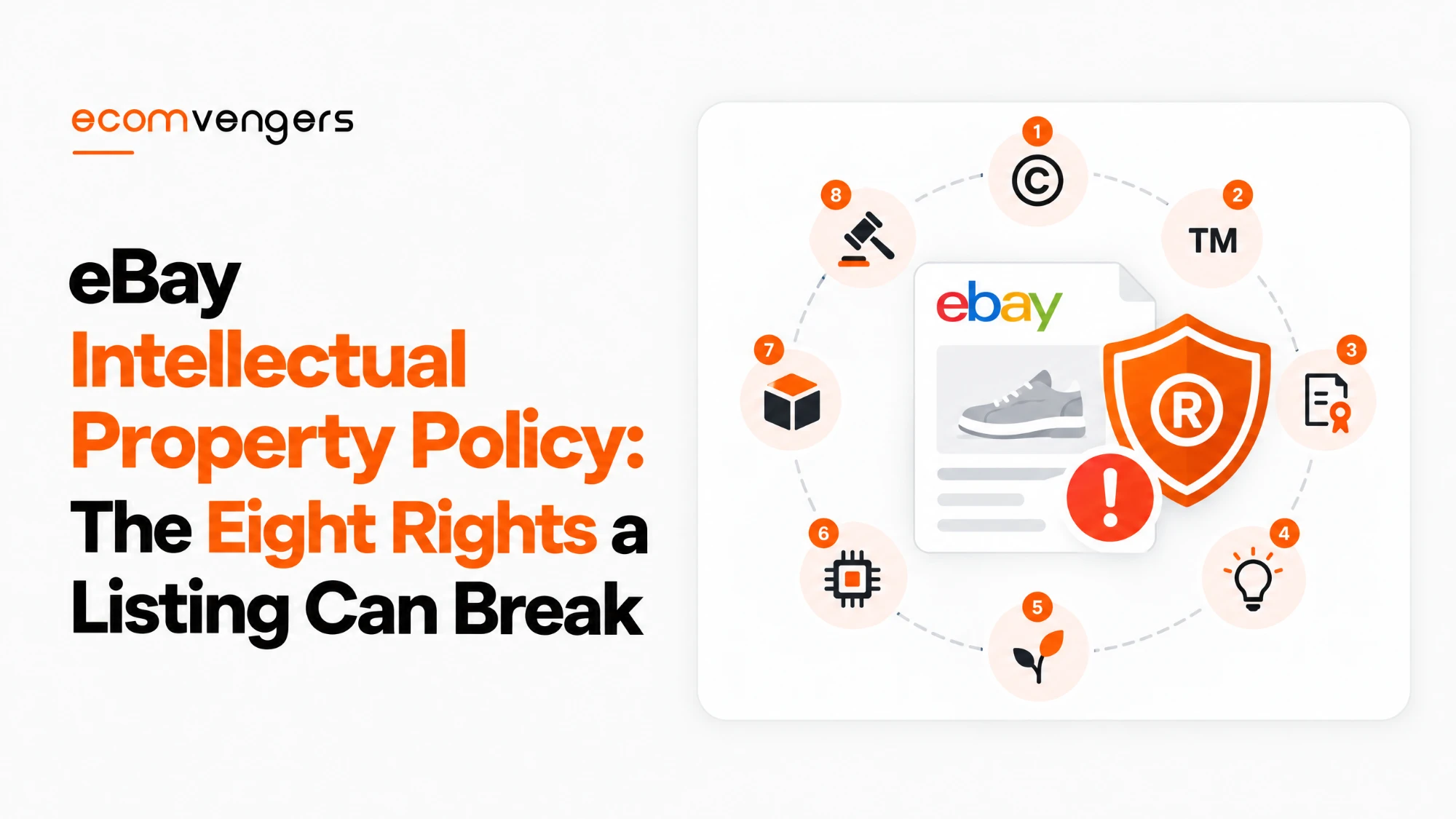
It is wider than that. The policy names eight kinds of right, and a genuine item can still break several of them through a photo, a sentence or a store name.
That is why IP removals so often surprise honest sellers. The item was real, but the listing was not entirely theirs.
Repeated IP problems are also one of the quieter routes to a suspension, which is where our eBay suspension team tends to meet them.
This guide maps each right the policy protects, the eBay process that enforces it, and the checks worth running before you list anything with a brand on it.
Key Takeaways
- eBay’s policy protects eight kinds of right: copyright, trademark, design rights, patents, utility models, parallel import rules, publicity rights and warranty claims.
- The seller carries the burden. eBay says sellers are responsible for making sure every item is authentic and every listing is clean.
- You cannot list an infringing item at all, but you can sometimes fix an infringing listing.
- Only list an item you are certain is genuine. eBay’s counterfeit policy says not to list it if you cannot confirm it is real.
- eBay bans “dupe” next to a brand name, and “inspired by” a brand with its logos or designs.
- Fake or missing safety marks count as counterfeits, including CE, UKCA and UL marks.
- A brand name in your username or Store name can infringe, as can a third-party logo in your profile picture.
- Copied photos and catalogue text are copyright problems, even on a genuine item.
- Selling abroad can turn genuine stock into an infringement, through unauthorised parallel imports.
- Authenticity Guarantee is automatic on eligible watches, shoes, apparel, handbags, trading cards, jewellery and coins, with no opt out.
- An item that fails authentication never reaches the buyer, and the buyer gets their money back.
- Many brands publish VeRO profiles setting out their own rules for resellers, free to read before you list.
What the eBay Intellectual Property Policy Covers
The eBay intellectual property policy bans products and listings that infringe rights owned by someone else.
It names copyrights, trademarks, designs, patents and utility models outright. It then gives examples of banned items: fakes, replicas, unauthorised copies and unauthorised parallel imports.
Read further down and two more appear: the right of publicity, and misrepresenting a manufacturer’s warranty. That makes eight distinct ways a listing can infringe.
Most sellers only ever meet two or three of these. The others turn up rarely, but they turn up without warning.
Why the seller carries the burden under eBay’s IP policy
eBay puts the responsibility on the seller. In its own words, sellers must ensure “any item they list on eBay is authentic” and that items and listings do not infringe anyone’s rights.
It does not offer a checking service for most goods. Its advice on anything uncertain is to seek legal advice, and on patents it says plainly that infringement is “often complex and not obvious”.
So the policy works less like a filter and more like a liability. eBay removes what people report, and the seller answers for what they listed.
Item or Listing: The Distinction That Decides the Fix
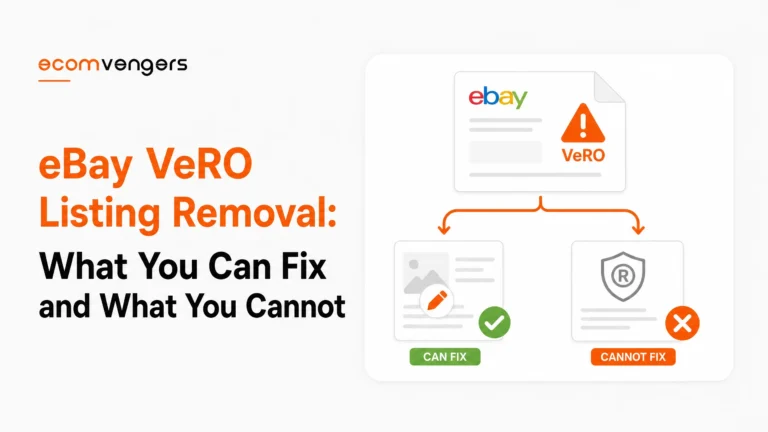
eBay separates an infringing item from an infringing listing, and the difference decides whether you can fix the problem at all.
If the item itself infringes, eBay bans every listing that sells it. A counterfeit handbag stays a counterfeit whatever the description says.
If only the way you listed it infringes, such as a copied photo, eBay says you may be able to revise the listing and remove the problem content.
Our guide to eBay VeRO listing removal explains how to tell which one a removal notice is pointing at, and what each route back involves.
Counterfeits, Replicas and Dupes Under eBay’s Counterfeit Policy
eBay’s counterfeit policy bans any item designed to mislead buyers into thinking it is genuine or authorised when it is not.
Its examples go well beyond designer handbags. They include perfume with a brand’s label that the brand never made. Chargers and cables sold under a brand without permission make the list, and so do jerseys with team logos the team never approved.
Unauthorised copies sit under the same policy. It names bootleg recordings, burned software, reprinted trading cards and USB drives full of copied files.
The word “dupe” next to a brand name
eBay does not ban the word “dupe” on its own. It bans using it, or “inspired by” a brand, in a way that suggests the item comes from or connects to that brand.
In practice that rules out most of the way the word is used. “Dupe” next to a brand name, with that brand’s logos or designs, is exactly the combination eBay calls out.
The safety-mark rule most sellers would never file under IP
The counterfeit policy also covers products with fake or invalid conformity marks, such as CE, UKCA, UKNI and UL. So do items missing the maker or importer details the law requires.
That catches sellers of cheap imported electronics who never set out to copy a brand. eBay treats a charger with a doubtful CE mark as a fake, not a paperwork slip.
What eBay expects you to keep as proof
eBay’s guidance is blunt: if you cannot confirm an item is authentic, do not list it.
The policy suggests keeping invoices from the brand or its official dealers. Serial numbers, grading reports, accepted certificates and assay cards also count.
That paperwork matters most when a buyer reports the item. eBay says it may ask for proof, and if the item appears counterfeit, it must be disposed of and not resold.
Keep the invoice with the stock. If a buyer reports a branded item as fake, eBay may ask for proof of authenticity. An invoice from the brand or an authorised distributor is the strongest answer, and it is far easier to keep than to find later.
Trademarks: How Brand Names Get eBay Sellers Into Trouble
Trademark problems on eBay usually come from how a brand name is used in the listing, not from the item.
The IP policy gives two examples that sound obvious and happen constantly. One is a generic iPhone case listed under the brand name “Apple”. Another is an adidas shoe with “Nike” added to catch extra searches.
Our guide to eBay listing titles covers the title side of this, because that is where most brand misuse starts.
Five trademark uses that break the eBay policy
- Irrelevant brand names, used where the product is not made by or specifically compatible with that brand.
- Slightly altered names that create a false impression of a link to the trademark owner.
- Third-party logos added to your images or description.
- A brand in your username or Store name, implying a connection to the trademark owner without permission.
- Someone else’s logo in your profile picture, again without permission.
The last two are the ones sellers rarely think about. They sit outside any single listing, so a whole account can be infringing while every item on it is genuine.
How to mention a brand you are allowed to mention
You can name the brand of a genuine branded product and show your own photos of it. eBay’s guidance allows exactly that.
Two limits apply. Never suggest you are an authorised dealer or reseller unless you are, and put “fits” or “for” before a brand name when the product is made for that brand rather than by it.
Geographical indications count as trademarks too. The law protects place names that show where a product comes from, so you cannot borrow them for goods made elsewhere.
Copyright on eBay: Photos, Text and Music
Copyright on eBay is mostly about content you did not create: photos, descriptions and, increasingly, music.
The IP policy lists images or text copied from other websites, stock photos used without permission, and scans from catalogues or adverts. It also lists editing a copied image and then using it, which does not make the image yours.
Two uses sit outside listings entirely. A third-party photo in your profile image or feedback can infringe, and so can copyrighted music played during an eBay Live event.
The catalogue is the one shortcut eBay approves. If your item matches the eBay product catalogue, you can use the images and details already there.
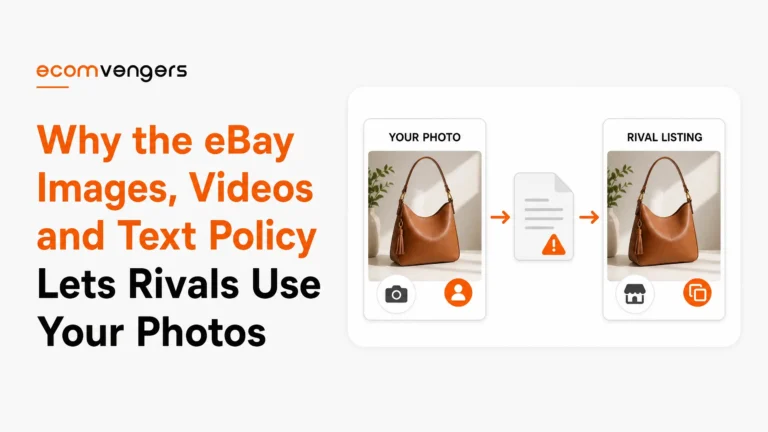
Our guide to the eBay images, videos and text policy covers the other side of that arrangement, including why rivals can end up using photos you took.
Design Rights, Patents and Utility Models on eBay
Design rights, patents and utility models protect how a product looks or works, so they catch items that copy rather than counterfeit.
eBay’s design example is a sofa that imitates the shape and textures of a protected design. No brand name is involved, and none needs to be.
Its patent example is closer to home for most sellers: a generic wireless earbud using a touch-control feature patented by a major tech brand.
Utility models work like patents but are not examined by patent offices and last for a shorter time. eBay treats them the same way and says checking either “is often complex and not obvious”.
Unbranded generics are where this bites. Sellers check the label for a trademark, find none, and assume the product is safe, when the risk sat in its design or mechanism all along.
Parallel Imports: When Genuine eBay Stock Becomes an Infringement
A parallel import is a genuine product sold in a country or region without the rights owner’s permission, and eBay’s policy can treat it as an infringement.
eBay’s example is a branded handbag meant for sale only in the United States and then offered to buyers in France. The bag is real, but the sale may still infringe.
Things work differently in Europe’s single market, the EEA. Once the rights owner has put a product on the EEA market, or allowed it there, it can be resold within the EEA without further consent.
eBay makes the seller responsible for the law in both the selling country and the destination. Its suggested safeguard is practical: exclude countries you should not ship to through your shipping business policies.
Faces, Names and Signatures on eBay Listings
Under eBay’s faces, names and signatures policy, you cannot list an item with another person’s image, name or signature on it. The exception is when that person made or approved it.
eBay’s examples are pointed. A key chain with an unauthorised picture of a rock star is not allowed, even if the seller took the picture at the concert.
Band t-shirts follow the same logic. Official merchandise is fine, while unofficial shirts need the band’s permission.
You can sell real autographs, and eBay suggests adding a certificate of authenticity. A scanned copy of a signed photo is not allowed.
Warranty Claims That Count as Trademark Infringement on eBay
Promising a manufacturer’s warranty that does not actually cover your sale can count as trademark infringement under eBay’s IP policy.
eBay gives two examples. One is quoting the manufacturer’s warranty without checking whether it covers resale. The other is offering the original warranty on an item whose warranty does not transfer.
It is an easy sentence to paste into every description. It is also one rights owners can report.
How eBay Authenticity Guarantee Works for Sellers
Authenticity Guarantee sends eligible sales to an expert checker before they reach the buyer. Eligible items join on their own, and you cannot opt out.
It currently covers watches, shoes, apparel, handbags and other luxury accessories, trading cards, jewellery and coins. Each category has its own price threshold and conditions.
| Category | Covered automatically from | Optional buyer add-on |
|---|---|---|
| Watches | $2,000 | $80, for $500 to $1,999.99 |
| Sneakers | $100, lower for some models | None stated |
| Other shoes | $500 | None stated |
| Apparel from eligible brands | $200 | None stated |
| Handbags and accessories | $500 | $40, for $200 to $499.99 |
| Trading cards | $200 | None stated |
| Jewellery from listed brands | $500 | None stated |
Shipping rules sit on top of the price points. eBay excludes local and in-store pickup everywhere, and most categories also exclude PO boxes.
What happens to an item that fails authentication
An item that fails authentication never reaches the buyer. eBay refunds the buyer, and the seller must help take the item out of circulation.
The check against the listing comes first. An item can fail for not matching its own title, description or photos, before anyone looks at whether it is genuine.
Signature confirmation applies on the leg to the authenticator for anything sold at $750 or more. Returns go back through the authenticator too, who checks the item still has its tags and accessories before it returns to you.
eBay also warns that some orders may be delayed by 7 days or more because of demand. Plan your handling time with that in mind.
How the eBay VeRO Program Lets Rights Owners Enforce Their IP
The Verified Rights Owner program, known as VeRO, is how intellectual property owners report listings that infringe their rights.
eBay’s IP policy recommends rights owners use VeRO rather than the general reporting tools, because it is built for them. For sellers, it is the route most IP removals arrive through.
The full seller response, from reading the notice to the counter notice route, lives in our guide to eBay VeRO listing removal. This pillar covers the parts that come before a removal.
Read a brand’s VeRO profile before you list its products
Many rights owners publish free VeRO participant profiles setting out their own rules for resellers.
A profile can list the brand’s trademarks and copyrights, its permissions for selling items carrying its IP, the consequences of infringing, and how to contact it with questions.
The list runs alphabetically and includes names such as Bose, Burberry and Adobe. eBay notes it is not a complete list, and not every VeRO participant has a profile.
Reading one takes a couple of minutes. It is the closest thing eBay offers to asking a brand’s permission in advance.
What a VeRO profile offers brand owners
For brand owners, a VeRO profile is a free way to tell resellers the rules before a dispute starts.
eBay invites owners to share their IP, set out permissions and consequences, and add contact details and FAQs. The process starts by emailing askvero@ebay.com, and eBay notes that rights owners are solely responsible for what their profile says.
For brand owners reading this. A VeRO profile will not stop infringing listings on its own. It does give honest resellers a clear standard, which leaves fewer genuine sellers caught in the reports you file later.
What Repeated IP Problems Do to an eBay Account
Repeated IP problems escalate from removed listings towards restrictions and suspension, and each removal makes the next one cost more.
Every eBay IP policy page ends the same way. eBay may remove the listing or content, issue a warning, restrict activity or suspend the account, and it describes these as examples only.
The restrictions and suspensions page adds the part that compounds. When eBay removes listings for a policy breach, it takes earlier breaches into account, and you can lose listing fees.
The counterfeit policy is more direct still. Not following it can lead to restrictions or suspension, and eBay may ask for proof of authenticity.
Our guide to eBay account suspension covers what to do if that stage arrives. IP suspensions tend to follow a pattern of small removals rather than one dramatic one.
Treat a single IP removal as a catalogue audit. If one listing broke a rule, others built the same way probably do too. Search your live listings for the same brand name, photo source or claim before the next report finds them.
FAQs About the eBay Intellectual Property Policy
Can I sell genuine branded items on eBay?
Yes. You can name the brand and use your own photos, provided you do not imply you are an authorised dealer when you are not.
Can I use the manufacturer’s photos in my eBay listing?
Not without permission. eBay treats photos from a maker’s website or catalogue as a copyright breach. The one exception is when your item matches the eBay product catalogue.
Is it allowed to write “dupe” in an eBay listing?
Only in a way that does not suggest a link to a brand. “Dupe” or “inspired by” alongside a brand name, logos or protected designs is not allowed.
Can I sell replicas on eBay?
Mostly no. eBay bans unauthorised replicas. One narrow exception is one-sided replica paper money, resized below 75% or above 150% and labelled “replica”.
What proof of authenticity should I keep?
Keep invoices from the brand or its official dealers, plus serial numbers, grading reports or accepted certificates. eBay may ask for proof if a buyer reports an item.
Can my eBay Store name infringe a trademark?
Yes. Using a third-party trademark in your username or Store name without permission, in a way that implies a connection, can infringe under eBay’s policy.
Are parallel imports allowed on eBay?
It depends on the jurisdiction. Genuine goods sold into a country without the rights owner’s permission can infringe, so check the law where you sell and where you ship.
Can I sell items with a celebrity’s photo on them?
Only if the person made or authorised the item. eBay bans unauthorised images, even photos the seller took personally.
Can I offer the manufacturer’s warranty when reselling?
Only if it genuinely covers your sale. Misrepresenting a warranty that does not transfer can count as trademark infringement.
Can I opt out of eBay Authenticity Guarantee?
No. Eligible items join automatically and free of charge, with no option to opt in or out.
What happens if my item fails Authenticity Guarantee?
eBay does not send it to the buyer. It refunds the buyer, and you must help take the item out of circulation.
How do I find a brand’s rules for selling its products on eBay?
Check the VeRO participant profiles in eBay’s Seller Center. Not every brand has one, and eBay says the list is not complete.
How does a brand owner join the eBay VeRO program?
Rights owners report through the VeRO program, and eBay’s Seller Center says brands can start a free profile by emailing askvero@ebay.com.
Can eBay suspend my account for IP violations?
Yes. Suspension is among the actions every eBay IP policy lists, and previous violations are taken into account when eBay acts again.
Check the Right Before You List the Item
The eBay intellectual property policy is less about fakes than about ownership. Every photo, sentence, name and claim in a listing belongs to someone, and the policy asks whether that someone is you.
Most IP trouble comes from careless listings of real stock. A copied photo, a borrowed brand name or a warranty line from the box is enough.
The checks below take minutes per brand, which is a reasonable price for keeping the account clear:
- Confirm the item is genuine, and keep the invoice or serial number with the stock.
- Take your own photos, or use the eBay catalogue where the item matches it.
- Write your own description rather than copying the manufacturer’s.
- Name a brand only when it made the item, and use “fits” or “for” when it did not.
- Keep brand names and logos out of your username, Store name and profile picture.
- Check for a VeRO participant profile before listing a brand for the first time.
- Exclude destinations where your stock could count as a parallel import.
- Treat any single IP removal as a reason to audit every similar listing.
Done consistently, these checks turn most of the policy into a non-event. The rest is knowing which right a removal names, and our VeRO guide picks up from there.
Sources
- The rights eBay protects and how to name brands: eBay intellectual property policy
- Rules on fakes, copies, dupes and proof: Counterfeit policy
- Photos, names and signatures of real people: Faces, names, and signatures policy
- Price points, checks and returns for luxury items: Selling with Authenticity Guarantee
- How brands report listings: Verified Rights Owner program
- Rules some brands set for resellers: VeRO participant profiles
- What happens to an account after repeat breaches: Account restrictions and suspensions
Faisal Iqbal is the eBay suspension expert at EcomVengers. He handles account recovery: MC011 verification reviews, MC999 suspensions, payout holds, VeRO takedowns, linked account restrictions, and the appeals and plans of action that go with them. He writes our guides on what each eBay notice means and which route back is still open.
View all posts by Faisal Iqbal