Your listing was live at nine. By half past it had gone, and the email explaining why turned up after the fact.
That order of events is deliberate. eBay says the law requires it to act on a rights owner report quickly. So the listing comes down first, and the conversation happens later.
Which leaves you reading words like trademark and utility model. Have you done something serious, or merely something careless?
Usually the second. And that difference decides whether you get the listing back at all.
We read these notices most weeks on behalf of sellers we act for, so we know how many are survivable. Yet the search results here are mostly lists of brands to avoid. A bit like answering a fire alarm with a leaflet about matches.
Two kinds of removal. Four ways out. One mistake that turns a fixable problem into a suspension.
Key Takeaways
- An eBay VeRO listing removal starts with a verified rights owner reporting you. eBay pulls the listing before it contacts you.
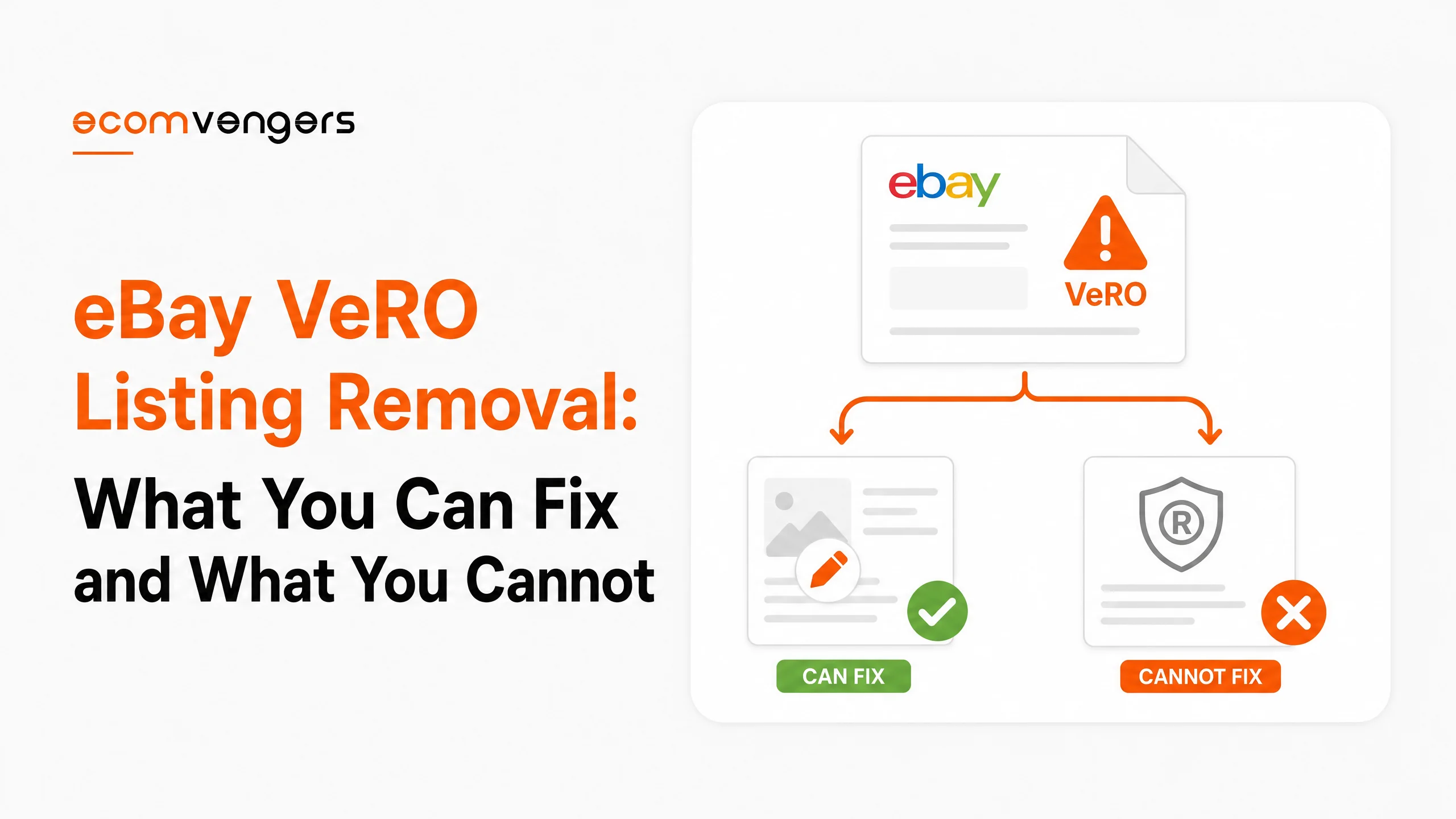
- eBay separates an infringing item from an infringing listing. That single distinction decides whether any fix exists.
- Where the item itself infringes, no version of the listing may run. Where only your wording or imagery infringes, you can revise it.
- The policy covers copyrights, trademarks, design rights, patents and utility models. It also covers counterfeits, parallel imports, right of publicity and false warranty claims.
- eBay cannot verify whether your item is genuine. It states plainly that the duty sits with you.
- Your removal notice names the rights owner who reported you. You may contact them and ask for a retraction.
- Hold written authorisation and you can appeal with it, or send the paperwork to vero@ebay.com.
- eBay judges an appeal on the listing as reported. Revise first and the revision becomes a separate case instead.
- Ending a reported listing yourself does not cancel the violation. The problem existed when the report arrived.
- Brand names run on genuine goods, on parts with compatibility wording, and on one brand only in a multi-fit title. Universal products get none.
- eBay refuses reports resting purely on distribution deals or minimum advertised pricing. No brand may use VeRO to police your prices.
- Repeat violations escalate from a warning to selling restrictions, then to permanent suspension. eBay tells you to fix the cause, not the listing.
What an eBay VeRO Listing Removal Actually Is
VeRO stands for Verified Rights Owner. It is the channel eBay gives brands, publishers, designers and their agents to report listings they believe infringe.
Notice who is missing from that sentence. eBay is not the accuser, and it is not really the judge either.
A rights owner files the report. eBay reviews it, removes the listing, then messages you with the reason and the reporter’s name.
Because the law obliges a marketplace to move fast on credible reports, that removal lands before you can argue. Sellers read this as eBay taking sides. It is closer to a shop clearing a shelf while the paperwork catches up.
The policy itself is broad. Copyrights, trademarks, design rights, patents and utility models all sit inside it. So do counterfeits, replicas, parallel imports, right of publicity claims and misrepresented warranties. We map all of them in our guide to the eBay intellectual property policy.
Key point: eBay is not the accuser in a VeRO case. A private rights owner reports you, and eBay removes first because the law demands speed, which is why arguing about fairness with support achieves so little.
The Distinction That Decides Everything
eBay’s policy holds one pair of sentences that most sellers skim straight past. That pair determines your entire afternoon.
Where an item infringes, no listing selling that item may run. Full stop. No revision, no clever rewording.
But where the way you listed it infringes, you may be able to revise. A copyrighted image used without consent is eBay’s own example.
Two removals. Identical notices. Completely different futures.
Working out which one you have
Read the reason field, not the subject line. Does the notice describe a counterfeit, a replica, an unauthorised copy, or an import sold outside its permitted market? Then the object in your stockroom is the problem.
Does it point instead at an image, a block of description text, a logo, a brand name or a warranty claim? Then the object is fine. The page describing it was not.
That second group is most of what we see, and all of it is repairable. Yet sellers hear the word infringement and quietly bin perfectly saleable stock. An expensive way to misread an email.
What the Removal Notice Tells You
eBay sets out three things it will explain when a reported listing comes down.
Why the listing was removed. Which aspect of it may have infringed. And how to revise it so that it complies, where revision is possible at all.
That third item is the tell. Where the notice offers no revision route, you are looking at an item problem rather than a listing problem.
The message also carries the rights owner’s name and contact details. Sellers often miss this because they read the summary in Seller Hub and never open the full message in My eBay Messages.
Open it. Everything you need to act sits in there, including the identity of the party you may need to negotiate with.
One thing the notice will not tell you is whether your item is genuine. eBay states outright that it cannot verify authenticity or legal status. That judgement was yours at the moment you sourced the stock, and it stays yours now.
Four Routes Back After a VeRO Report
eBay documents four responses. Which one fits depends entirely on the paperwork you hold, and not at all on how unjust the report felt.
Route one: appeal with evidence of permission
File the appeal and attach proof from the rights owner supporting your right to use their intellectual property. A distribution agreement, a written licence, an authorised reseller letter.
Vague permission does not travel well. A reviewer wants a document with a name on it, not your recollection of a phone call in March.
Route two: contact the VeRO support team
Send documentation to vero@ebay.com showing that the rights owner authorises sellers to use their intellectual property on eBay. eBay names a copy of the contract as its example.
This route suits sellers with a standing relationship, where one document covers many listings rather than one.
Route three: ask the rights owner for a retraction
Because eBay hands you their contact details, you can approach them yourself and request that they withdraw the report.
Check their VeRO participant profile before you write. Rights owners publish these pages to explain their policies, and yours may already answer the question you were about to ask.
When you do write, eBay suggests including your user ID, your eBay email address, the removed listing numbers, and images of the product where you can supply them.
Keep it short and unemotional. You are asking a legal department for a favour, and legal departments do not respond to indignation.
Route four: revise and republish
No evidence, and no realistic retraction? Then strip the offending content instead. eBay points sellers at the Resolution Hub for this.
Remove the copied photograph. Rewrite the description in your own words. Delete the logo, drop the second brand name, correct the warranty claim.
One warning, and sellers ignore it constantly. Never republish an item the rights owner objects to without their approval. A second removal follows almost immediately, and repeat removals are what end accounts. A removal is one form of eBay account warning, and it adds to that history.
Pro tip: check the rights owner’s VeRO participant profile before you write to them. Many publish exactly what they will and will not authorise, which saves you drafting a letter they have already answered.
Why Revising Before You Appeal Backfires
Here is the sequencing trap, and it catches careful sellers rather than careless ones.
You get the notice. You tidy the listing immediately, because tidying feels like cooperation. Then you appeal, expecting the reviewer to see your improved version.
They do not. eBay states that your appeal rests on the original version of the listing, the one that was reported. Changes made since are reviewed as a separate case entirely.
So the appeal fails on the old listing, you receive a denial, and your carefully corrected version sits in a different queue waiting for its own outcome.
Decide first, then act. Appeal if you hold evidence about the listing as reported. Revise if you do not. Doing both at once produces two decisions and one very confused seller.
The same logic explains a question we hear weekly. Ending a listing after a report does not remove the violation, because the issue existed at the moment of reporting. Ended listings remain visible on the site too, so ending one hides nothing.
Brand Names: Four Cases eBay Sets Out
Trademark reports are the commonest listing-side removal we handle, and nearly all of them come from one of four situations.
First, a genuine branded product. Use the brand name freely, because the item really is that brand. Just never add a rival brand alongside it to widen your reach.
Second, a part built for one brand. A phone case, say. eBay allows the brand name provided you put a compatibility term such as compatible with, fits, or for in front of it.
Third, a part that fits several brands, which is car parts territory. Only one brand name may appear in the title, again behind a compatibility term. Additional brands belong in the description, and eBay suggests the fitment chart for the rest.
Fourth, a universal product. A USB-C cable works with everything, so no brand name may appear in connection with compatibility at all.
Running alongside all four is a rule sellers break by accident. Never suggest you are an authorised dealer or reseller when you are not.
The title side of this has its own traps, which we cover in the guide to where titles cross into keyword spam. Two policies, one sentence of text, both able to pull it down.
Third-Party Content, Logos and Warranty Claims
Three more listing-side triggers, and each one has a simple version of the rule.
Images and text you did not create
Photos, videos and descriptions should be original. eBay says not to copy them from websites, third-party catalogues or other sources without approval.
Stock photographs count, and so do edited stock photographs. Cropping a manufacturer image and adding a border does not make it yours, however satisfying the cropping felt.
Where a product sits in eBay’s catalogue, you may use the catalogue images and details instead. That is the sanctioned shortcut, and it is free. Our guide to the images, videos and text policy covers what happens to your own photographs afterwards.
Logos belonging to somebody else
Using a third party’s logo without permission is a trademark violation. eBay goes further and warns that a logo merely resembling another brand can infringe too.
Check your own branding here, not only your product shots. Watermarks and shop banners have triggered reports for sellers who never thought of them as listing content.
Warranty claims you cannot support
Misrepresenting a warranty can violate trademark law, which surprises most sellers who assume it is merely a customer service matter.
eBay treats warranty details as material information. Read the terms or ask the manufacturer before you write anything.
Offering your own cover? Say clearly that it comes from you or a third party rather than the maker. Quoting a manufacturer warranty? Confirm it survives resale, and where it does not, state that no warranty applies.
Selling outside the market an item was made for
Genuine stock can still infringe. Where a product is authorised for one region and you ship it to another, that is a parallel import, and trademark or copyright law may bite.
eBay’s advice is blunt. List only where the item is authorised for sale, and switch off international shipping on region-restricted products.
The Reports eBay Will Not Act On
This paragraph is worth the price of admission for anybody being leaned on by a brand.
eBay states that it does not accept reports based solely on selective distribution agreements, minimum advertised pricing policies, or other private contractual terms.
Read that again if you sell branded goods below the price a manufacturer prefers. Undercutting a MAP policy is not intellectual property infringement, and VeRO is not a pricing enforcement tool.
Brands do try. Some send threatening letters implying that selling outside their approved dealer network is itself unlawful on eBay.
Where a genuine trademark or copyright issue rides alongside the pricing complaint, eBay will act on that part. Where the pricing complaint is the whole of it, eBay says it will not.
The United States Counter Notice Route
Almost nobody writes about this one, and it is the strongest formal remedy a seller has.
Counter notices apply only to copyright reports in the United States, under the Digital Millennium Copyright Act. Trademark complaints and other marketplaces are outside it.
What the process does is genuinely powerful. Once eBay receives a valid counter notice, it sends a copy to the VeRO participant and tells them the listing returns after 10 business days.
Their only way to stop that is to inform eBay they have filed an action seeking a court order against you. Which moves the argument from a support queue into a courtroom, and most reporters decline the invitation.
The required contents are set out in 17 U.S.C. section 512(g)(3), and sellers file through copyright@ebay.com.
Treat it seriously. A counter notice is a sworn legal statement, so use it when you are confident of your position rather than when you are merely annoyed.
What Happens After More Than One Violation
eBay describes the consequences as escalating, running from selling restrictions through to permanent suspension. If yours arrives as an MC113 notice that calls the decision final, read how to challenge an eBay MC113 suspension first.
Notice what it does not give you. There is no published table saying that a third report costs you seven days and a fifth costs you thirty.
Seller forums are full of numbers like that, offered confidently by people who watched it happen to themselves once. Treat them as weather reports rather than timetables.
eBay’s own recommendation is the useful part, and it is a sentence worth pinning up. Identify and address the root cause of the violation to help prevent future reports.
Root cause, not listing. Where one supplier’s product photos appear across 400 of your listings, fixing the reported one leaves 399 reports waiting to happen.
Should a restriction already have landed, our guide to every eBay restriction type and how each is lifted covers what you are dealing with. The restriction identifier will narrow it down faster than reading the whole thing.
Worth knowing: eBay publishes no fixed number of violations before suspension. The forum figures of 3, 7 and 30 days are seller anecdote, not policy, so plan around the cause rather than the count.
Why Similar Listings Stay Live
Every seller asks this within about ten minutes of the removal, usually with a screenshot attached.
Twelve identical listings from other sellers, all still trading, and yours gone. eBay offers three explanations.
Differences you cannot see from the outside may exist between the listings. The rights owner may simply not have reported the others yet. Or those sellers may hold authorisation that you do not.
None of the three helps you, which is the frustrating part. VeRO is complaint-driven, so enforcement lands where somebody chose to point, not evenly across a category.
You may report listings you believe infringe, through the question mark icon on the item page. Whether that is a good use of your morning is another matter.
What a Removal Costs Beyond the Listing
The listing is the visible loss. Several quieter ones follow it.
Fees may come back to you. eBay says a removal for a policy violation may qualify for a fee refund, depending on which policy was breached and whether you have had similar issues before.
Sales history vanishes with the listing, and that is the expensive part for anything long-running. A listing with two years of transactions behind it does not come back at the same placement, no matter how clean the replacement looks.
Then there is the compounding risk. Where the same content sits across a catalogue, a single report tells you exactly where the next twenty are coming from.
Audit by content, not by listing. Search your own catalogue for the offending phrase, image name or brand term, and fix the whole set in one sitting.
What Fixing Your Listings Cannot Undo
Honesty about the limits saves a great deal of wasted effort.
Clean listings will not make a counterfeit sellable. Where the item infringes, the answer is to stop stocking it, and no amount of careful wording changes that.
A perfect revision does not erase the violation already recorded against your account. It prevents the next one.
Nor does compliance stop a determined rights owner reporting you again. Some brands report aggressively across entire categories, and being right does not spare you the admin.
And a rescued listing does not restore the sales it was making. That recovery is its own job, covered in our guide to getting sales back after a break in trading.
What compliance does buy you is the absence of the next email. Unglamorous, but that is most of what running a stable eBay account consists of.
Frequently Asked Questions
What does VeRO stand for on eBay?
Verified Rights Owner. It is eBay’s programme for intellectual property owners and their authorised representatives to report listings infringing their copyright, trademark or other rights.
Why did eBay remove my listing without warning me first?
eBay says it must remove a reported listing as quickly as possible to comply with the law and protect rights owners. Notification follows the removal rather than preceding it.
Can I appeal an eBay VeRO listing removal?
Yes, and the appeal works best when you hold evidence from the rights owner showing you had permission to use their intellectual property. Without that evidence, revising the listing is usually the better route.
I revised my listing and my appeal still failed. Why?
Because eBay reviewed your appeal against the version that was reported, not your corrected one. Changes made afterwards are treated as a separate case, and you receive a separate outcome for them.
Does ending the listing myself remove the violation?
No. eBay states that ending or updating a listing does not remove a violation already reported, since the problem existed when the report was made. Ended listings also stay visible on the site.
How do I contact the rights owner who reported me?
Their name and contact details arrive in your My eBay Messages notification. Check their VeRO participant profile first, then include your user ID, your eBay email address, the removed listing numbers and product images when you write.
Can a brand use VeRO because I sell below their minimum advertised price?
eBay says it does not accept reports based solely on selective distribution agreements, minimum advertised pricing policies or other private contractual terms. Pricing alone is not an intellectual property matter.
Can I use a brand name in my title for a compatible part?
Yes, with a compatibility term such as compatible with, fits, or for in front of it. Where an item fits several brands, only one brand name belongs in the title and the rest go in the description.
Will eBay refund my fees on a removed listing?
You may be eligible. eBay says a fee refund depends on which policy was violated and whether you have had similar issues previously, so treat it as possible rather than automatic.
What is a counter notice, and can I file one?
It is a formal DMCA response available for copyright reports in the United States. Once eBay accepts a valid counter notice, it reinstates the listing after 10 business days unless the reporter tells eBay they have gone to court. File through copyright@ebay.com.
Can eBay confirm whether my item is genuine?
No. eBay states plainly that it cannot verify the authenticity or legal status of specific items, and that ensuring your goods are genuine and authorised for sale falls to you.
How many VeRO violations before eBay suspends an account?
eBay publishes no fixed number. It describes escalating consequences running from selling restrictions to permanent suspension, and recommends addressing the root cause instead of counting your remaining chances.
Read the Reason Field First
A removal notice feels like a verdict. It is closer to a question, and the question is which of the two problems you have.
Four steps, in this order, on the day one arrives.
First, open the full message in My eBay Messages rather than the summary. You need the reason, the aspect eBay flagged, and the reporter’s details, and only the full message carries all three.
Second, classify it. Is the item the problem, or the page describing it? Where eBay offers a revision route, you have the fixable kind.
Third, pick one route and commit to it. Appeal with documentation if you hold documentation. Approach the rights owner if a retraction looks realistic. Revise through the Resolution Hub if neither applies. Do not revise and appeal simultaneously, because that produces two cases and one denial.
Fourth, search your catalogue for the same content before you close the laptop. One report is information about the other listings you have not been reported for yet.
Worth keeping in mind through all of it: a VeRO report is an allegation from a private party, not a finding against you. eBay acts fast because the law requires speed, and speed is not the same thing as certainty.
Most sellers we work with were not selling fakes. They were using a supplier’s photograph, or naming two brands in a title to catch more searches, or repeating a warranty line from a manufacturer’s website. Careless rather than criminal, and every bit of it fixable in an afternoon.
Sources
- eBay’s intellectual property policy, for the rights it covers, the infringing item versus infringing listing distinction, and the range of actions from warning through to account suspension.
- The Seller Center intellectual property pages, for the removal notification contents, the four appeal routes, the vero@ebay.com and copyright@ebay.com addresses, the counter notice terms, the fee refund position and the escalation language.
- Brand name, third-party content, logo, warranty and international selling rules also come from those Seller Center listing essentials sections.
- Counter notice requirements sit in 17 U.S.C. section 512(g)(3) of the Digital Millennium Copyright Act, which eBay cites directly.
- Our own patterns come from client casework, and the wider library lives on the EcomVengers blog.
One job to pair with this. Where a report reached your titles, run a few through the eBay listing title analyser and you will see the brand-name problems before a rights owner does.
Where reports have already cost you selling privileges, that is a different repair job, and the one we do. Bring the notices with you, because the reason fields tell us more than the dashboard does.
Faisal Iqbal is the eBay suspension expert at EcomVengers. He handles account recovery: MC011 verification reviews, MC999 suspensions, payout holds, VeRO takedowns, linked account restrictions, and the appeals and plans of action that go with them. He writes our guides on what each eBay notice means and which route back is still open.
View all posts by Faisal Iqbal