A buyer went to their bank instead of coming to you.
That is a payment dispute, and it is a different animal from an eBay case. eBay is not judging it. The buyer’s card provider is.
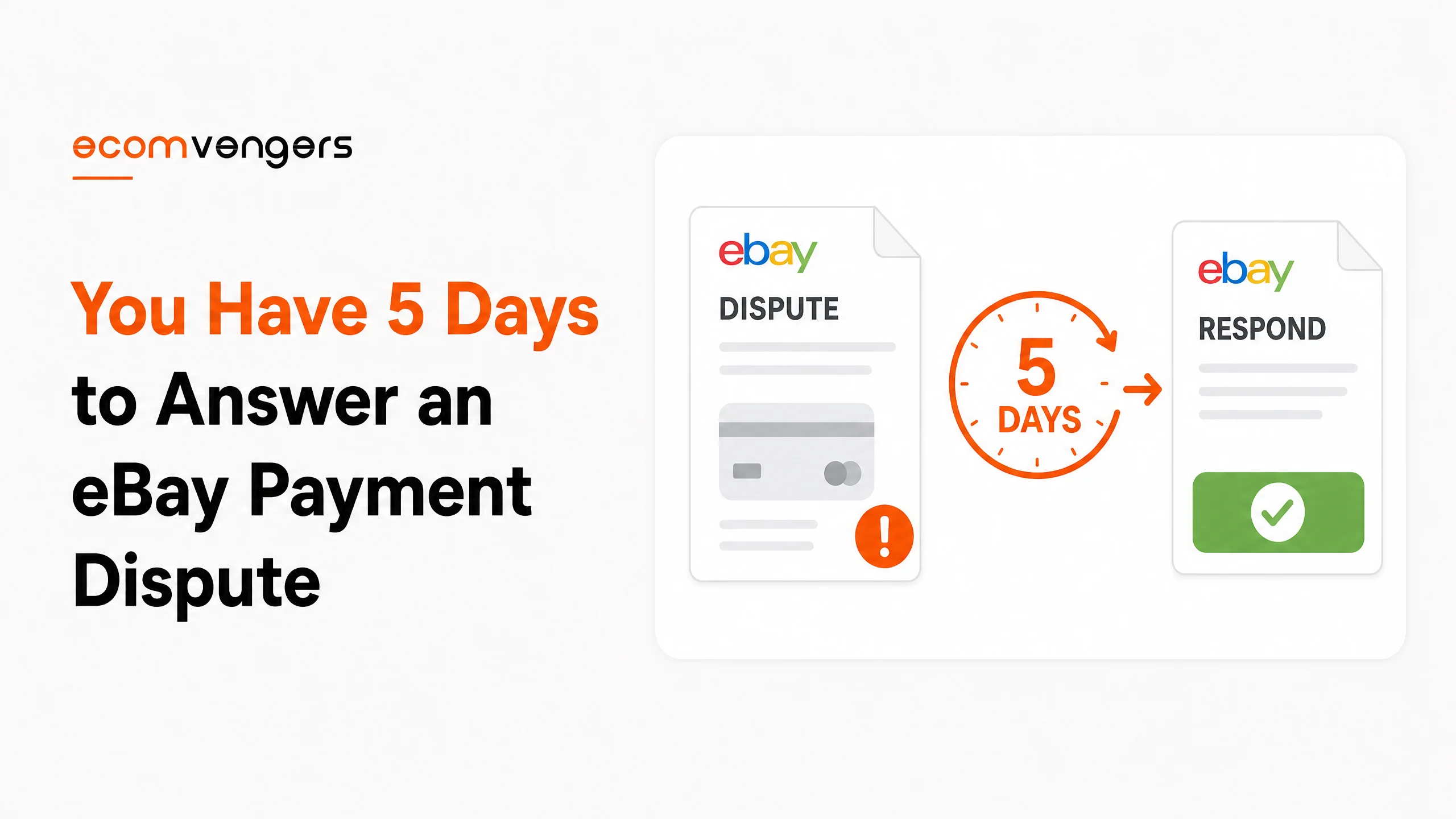
You get five calendar days to reply. Miss them and eBay says the payment institution is likely to find in your buyer’s favour, without ever hearing your side.
Five days sounds generous until a dispute lands on the Friday of a bank holiday weekend.
Disputes reach us most often after the window shut, which is the one part nobody can undo.
Two choices, one short clock, and the evidence limit nobody mentions.
Key Takeaways
- A payment dispute is a chargeback. The buyer raises it with their bank, card provider, PayPal or Venmo.
- The buyer’s payment institution decides the outcome, not eBay.
- You have 5 calendar days to accept or challenge it.
- Miss that window and eBay says the institution is likely to find for the buyer.
- Accepting refunds the buyer. It also waives the dispute fee and returns some or all of your selling fees.
- eBay may challenge on your behalf even after you accept, and then no fee applies.
- Challenging sends your evidence to the bank, which can take 90 days or more.
- The disputed amount can sit on hold for up to 90 days while that runs.
- eBay caps your evidence at 5 files, under 1.75MB in total, as JPEG, JPG or PNG.
- Win and you pay neither the refund nor the fee.
- Lose and what you pay depends on payment dispute seller protections.
- eBay never charges more than one dispute fee per order.
What an eBay Payment Dispute Actually Is
A chargeback wearing an eBay label.
eBay defines it as a buyer asking for their money back by reporting an issue to their bank, card provider, PayPal, Venmo or another payment institution.
That is the whole distinction. A Money Back Guarantee case is raised on eBay and decided by eBay. A payment dispute is raised somewhere else and decided somewhere else.
eBay tells you it happened, collects what you send, and passes it on. It does not rule on it.
Key point: eBay does not decide a payment dispute. The buyer’s bank does, on evidence eBay forwards, which is why a well argued appeal to eBay achieves nothing here.
Sellers write to eBay as though it were an appeal. It is closer to submitting evidence to a court that eBay does not sit in.
The Five Day Clock and the Ninety Day One
One belongs to you. The other belongs to a bank you will never speak to.
Five calendar days to accept or challenge. eBay contacts you when the dispute opens, and you respond through My eBay Orders or through Requests and disputes in Seller Hub.
Calendar days, not working days. A dispute opening on a Friday before a long weekend leaves you two useful days.
Then the long clock starts. eBay may hold the disputed amount for up to 90 days, and says resolution can run to 90 days or more depending on the card provider.
So the money leaves your available balance either way for a while. Plan the cash flow rather than the argument.
Accepting a Payment Dispute Is Not Giving Up
It costs less than sellers assume, and it ends the thing today.
Accept and the buyer gets refunded. eBay takes the money from your available and processing funds, or from your payment method on file where those do not cover it.
Then two things go your way. eBay waives the dispute fee, and it returns fee credits for some or all of your selling fees on that transaction.
You can also ask for the item back while accepting. eBay will try to recover it, though it says plainly that it cannot guarantee the buyer returns anything.
Worth knowing: accepting waives the dispute fee and returns fee credits on the sale. On a low value order that can leave you better off than winning slowly.
There is a quieter clause worth knowing. eBay may challenge the dispute on your behalf even after you accept it, and where that happens no dispute fee reaches you at all.
How to Challenge a Payment Dispute Properly
Evidence, in the format the bank will actually look at.
Choose Respond to dispute from My eBay Orders or from Requests and disputes in Seller Hub, then Challenge dispute and provide proof.
You can request the item back on the same screen, check the details eBay already holds, add supporting text, and upload files.
The upload limits nobody warns you about
Five files. Under 1.75MB in total. JPEG, JPG or PNG only.
That total is the part that catches people. Two photos straight off a modern phone will breach it on their own, so crop and compress before you start.
eBay suggests cropping to the relevant area, and merging images where that helps. A single clear screenshot beats four blurry ones you had to shrink.
Signature confirmation on higher value orders
eBay treats this as a requirement rather than an upgrade.
Its signature confirmation policy exists so sellers are protected when a buyer reports an item not received or opens a payment dispute, and it applies to higher value orders.
Skip it on an expensive parcel and you have removed your own best evidence before the dispute even starts. Check the threshold for your marketplace, because it varies.
Match the evidence to the dispute reason
eBay groups the reasons, and each group wants something different.
Where the buyer does not recognise the transaction, or says the item never arrived, delivery evidence carries it. Tracking to the address at checkout, and proof of collection where that applies.
Where the item supposedly did not match, arrived damaged or had parts missing, you are proving what left you. The listing, photographs taken before despatch, and the message thread.
Authenticity disputes want documentation of provenance. Refund disputes want proof the refund went out.
Sending the wrong bundle is the most common failure we see. Tracking does not answer a not as described claim, however good the tracking is.
What Happens When the Bank Decides
Three outcomes, and only one of them is free.
Win and you keep the money. eBay charges you neither the refund nor a dispute fee, and the held funds are released back to you.
Lose without protection and the refund comes out of your available and processing funds, with a dispute fee on top.
Lose with protection and the picture changes completely. eBay covers the amount, refunds the dispute fee, and removes negative and neutral feedback tied to that transaction.
That protection is the difference between an annoying afternoon and a real loss, and it depends on eligibility rather than on how well you argued. The conditions sit in the eBay seller protections you lose the moment eBay steps in.
Where the Money Sits While You Wait
On hold, visible, and not yours to spend.
The disputed amount shows as On hold in the Payments tab of My eBay and Seller Hub. What happens to it depends entirely on the outcome.
Accept, and eBay may use those held funds to refund the buyer. Challenge, and they can stay held for up to 90 days while the payment institution works through it.
Worth separating this from the other holds sellers meet. A payment dispute hold is not a transaction hold, and it is not a payout hold on your account, which is covered in how to survive an eBay payout hold.
Three different mechanisms, three different fixes, and one word doing all the work.
Which Payment Disputes Are Worth Challenging
Not all of them, and the maths is unsentimental.
Challenge where the evidence is documentary
Item not received, on a tracked order that shows delivery to the checkout address.
That is a fact rather than an opinion, and facts travel well through a bank. The same goes for a buyer who says they never got a refund you can prove you sent.
Think twice where it turns on condition
A not as described claim is a judgement call, and the person judging has never seen the item.
You can still challenge, and photographs taken before despatch genuinely help. Accept that you are asking a stranger to prefer your photographs to your buyer’s account.
Where the item was borderline, accepting early costs the refund and nothing else.
Weigh the fee against the order
On a low value order the dispute fee can approach the item price.
Accepting waives that fee and returns your selling fees, so the gap between winning and accepting narrows fast at the cheap end. Our eBay fee and profit calculator will tell you what the order was actually earning before you spend an hour on it.
How to Get Fewer Payment Disputes
Most start as something smaller that nobody answered.
Answer messages before the bank hears about it
A buyer who cannot reach you phones the number on the back of their card.
That call is cheaper for them than waiting on you, and far more expensive for you. A reply inside a working day heads off a surprising share of disputes.
Make the descriptor recognisable
One of eBay’s own dispute reasons is the buyer not recognising the transaction.
Some of those are fraud. Plenty are a person scanning a statement six weeks later and seeing a name that means nothing to them.
Track everything you can afford to track
Tracking is the only evidence that answers an item not received dispute.
Without it you are asking a bank to take your word against a customer who has already been refunded once in principle. That is not a contest you win often.
The same scan protects your late shipment rate, which is the argument in how to fix an eBay late shipment rate.
What a Payment Dispute Does to Your Metrics
Less directly than a case, and it still reaches your account. For the metric a case does feed, see the eBay transaction defect rate.
A dispute is not a Money Back Guarantee case, so it does not arrive as a case closed without seller resolution on its own.
Where it bites is the feedback and the fees. A buyer angry enough to call their bank often leaves a comment on the way past, and that comment is removable only where protection applies.
eBay states that a protected payment dispute has the negative and neutral feedback for that transaction removed alongside the money.
Unprotected, that comment stands until you find another ground for it. The full list of those sits in how to remove negative eBay feedback.
What Responding Well Cannot Fix
The decision itself, which was never yours.
A perfect evidence bundle sent inside the window can still lose, because the buyer’s bank applies its own rules to its own customer. eBay is a messenger here.
Responding well changes the odds and the fee, not the jurisdiction.
It also cannot recover the item. eBay will try where you ask, and it says openly that it cannot guarantee the buyer sends anything back.
One more honest limit. A rising dispute rate is a signal about your listings or your despatch rather than about unlucky buyers, and no amount of skilled responding answers that.
Frequently Asked Questions
What is an eBay payment dispute?
A chargeback. The buyer asks for their money back through their bank, card provider, PayPal or Venmo rather than opening a case on eBay.
How long do I have to respond to a payment dispute?
Five calendar days. eBay says that if you do not respond, the payment institution is likely to find in your buyer’s favour.
Who decides an eBay payment dispute?
The buyer’s payment institution. eBay passes your evidence on and tells you the outcome, but it does not make the ruling.
Where do I respond to a payment dispute?
Through My eBay Orders, or through Requests and disputes in Seller Hub. Both lead to the same Respond to dispute screen.
What happens if I accept the dispute?
The buyer is refunded from your available and processing funds, or your payment method on file. eBay waives the dispute fee and returns fee credits for some or all of your selling fees.
Can I still get the item back if I accept?
You can ask. eBay will try to recover it whether you accept or challenge, and it states that it cannot guarantee the buyer returns it.
What evidence should I upload?
Whatever answers the specific reason. Delivery tracking for an item not received, and the listing plus pre-despatch photographs for a not as described claim.
What are the file limits for payment dispute evidence?
Five files maximum, under 1.75MB in total, in JPEG, JPG or PNG. Crop and compress first, because two phone photos alone can exceed that.
How long does a payment dispute take?
Up to 90 days, and eBay says it can run longer depending on the payment method or card provider. The disputed amount may be held throughout.
Do I pay a fee if I lose?
It depends on payment dispute seller protections. Protected, eBay covers the amount and refunds the dispute fee. Unprotected, the refund and the fee both come out of your funds.
Can I be charged two dispute fees on one order?
No. eBay states you are never charged more than one dispute fee per order, even where the buyer used several payment methods.
Does a payment dispute count as a case closed without seller resolution?
Not by itself. A payment dispute runs outside the Money Back Guarantee process, though the feedback and fees still reach you.
Answer It Today, Argue About It Later
The five day window is the only part of this you control, and it is the part sellers lose.
Four steps, in this order, the day a dispute lands.
First, read the reason before you read the amount. Item not received, does not match the listing, not recognised, no refund received. The reason decides which evidence is worth gathering.
Second, decide honestly whether the evidence is documentary or a matter of opinion. Tracking travels well through a bank, and your view of a scratch does not.
Third, if you challenge, prepare the files before you open the form. Five of them, under 1.75MB together, cropped to the thing you want somebody to notice.
Fourth, if you accept, do it early and ask for the item back. The fee goes, your selling fees come back, and the afternoon is yours again.
Worth holding on to while you decide: this is not an eBay ruling and there is no appeal to write. A bank is deciding between its own customer and a merchant it has never met, on paper, weeks from now.
That framing changes what you send. Stop explaining that you are a good seller of eleven years standing, and send the delivery scan.
Answer inside the window. Everything else is somebody else’s timetable.
Sources
- eBay, Handling payment disputes, for the definition, the 5 calendar day window, the accept and challenge routes, the evidence types by dispute reason, the 5 file and 1.75MB upload limits, the 90 day holds, the fee outcomes and the single fee per order.
- The seller protections pages, on eBay covering the amount, waiving the dispute fee and removing negative and neutral feedback where a transaction is protected.
- Terms in the eBay Money Back Guarantee, for the case route this is often confused with.
- Details in the seller standards policy, for the metrics a case does feed and a dispute does not.
- Our own examples come from client disputes we have worked, and the wider guides sit in the EcomVengers blog.
One number to have in front of you first. Whether an order is worth challenging depends on what it was earning, and the eBay fee and profit calculator gives you that in a minute.
Where disputes are arriving often enough to be a pattern, the disputes are the symptom. Finding the cause is the work we do, and it usually sits in the listings rather than the buyers.

Ali Khan is the founder of EcomVengers, the eBay growth and account recovery agency. He has spent the better part of a decade pulling suspended sellers back from MC011 and MC999 notices, repairing wrecked defect rates, and turning buried listings into ranked ones. When eBay's villains show up, he is the one sellers call. You handle the millions, he handles the villains.
View all posts by Ali Khan