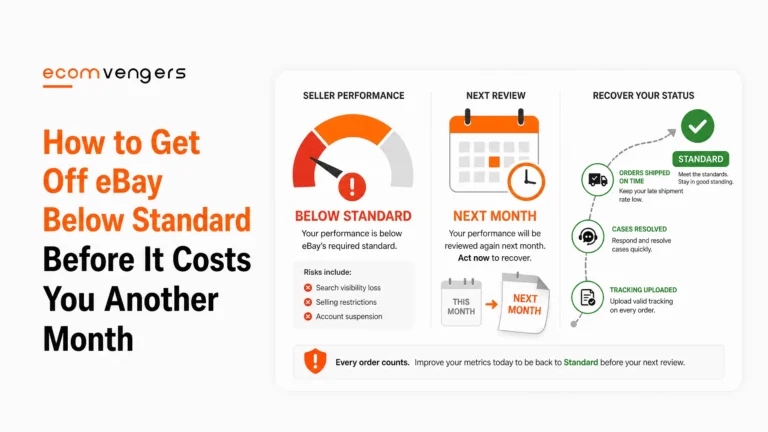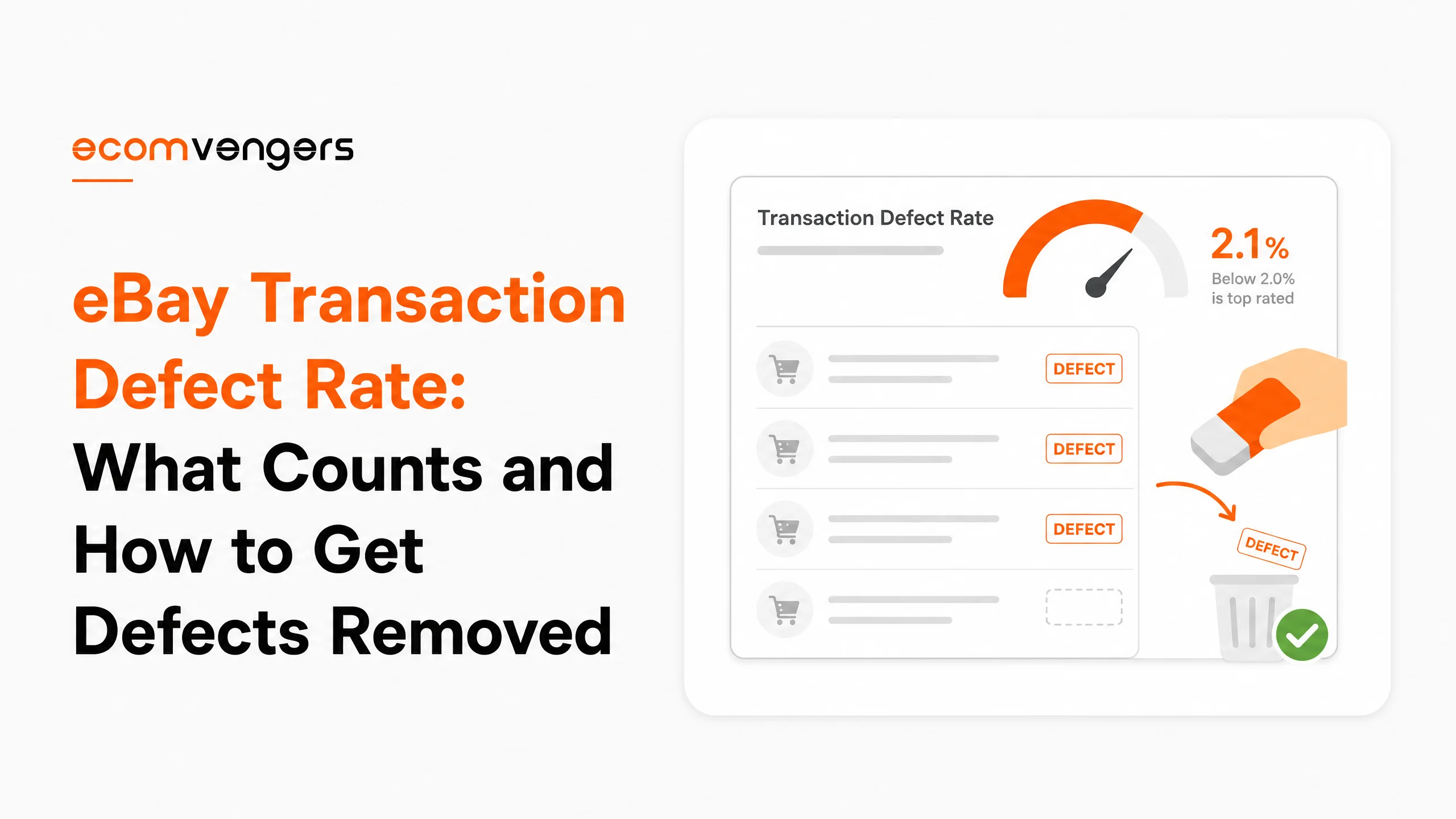
One eBay seller cancels 25 orders out of 1,000. That is a 2.5% transaction defect rate, comfortably past eBay’s 2% limit.
eBay rates them Above Standard anyway.
A second seller cancels the same 25 orders out of the same 1,000. Same 2.5%. eBay drops them to Below Standard.
Both examples come from eBay’s own seller standards policy. The difference between them has nothing to do with the percentage, and almost nobody selling on the platform knows what it is.
We clear defects and restrictions off eBay accounts for a living, and the transaction defect rate causes more avoidable panic than any other number on the dashboard. Four steps. Most of the work happens before you write to eBay at all.
Key Takeaways
- Only two things create a transaction defect. You cancel an order unexpectedly, or a buyer reports a problem you do not resolve and eBay finds against you.
- Negative feedback is not a defect. Neither is a return, a refund you handled yourself, or a case you resolved before eBay stepped in.
- The transaction defect rate limit is 2% of transactions. Top Rated demands no more than 0.5%.
- Unique buyers decide your fate. eBay rates you Below Standard only when your defects involve more than 4 different buyers.
- eBay evaluates on the 20th of every month. Top Rated upgrades land on the 1st of the following month.
- Your evaluation window depends on volume. More than 400 transactions in 3 months means eBay looks at 3 months, otherwise it reaches back 12.
- One transaction carries one defect, maximum. A single terrible order cannot compound against you.
- eBay removes some defects without being asked. Abusive buyer findings, site errors, unpaid items, and carrier disruptions all trigger automatic removal.
- Cases closed without seller resolution have their own limit: 2 cases, or 0.3% of transactions, whichever is higher.
- Below Standard costs money, not just ranking. eBay blocks Promoted Listings immediately and raises your final value fees from the 1st of the next month.
- Appeal a case closed without seller resolution within 30 days of eBay’s decision.
- Removals apply at the next evaluation, not instantly. Clear a defect on the 22nd and your level moves on the 20th of the following month.
What Is the eBay Transaction Defect Rate?
Your eBay transaction defect rate is the percentage of your transactions that picked up a defect during the evaluation period.
eBay describes a defect as “a part of a transaction that eBay considers to have created a bad shopping experience for buyers.”
Simple enough as a definition. The trouble starts when sellers guess at which parts of a transaction qualify.
Most guess wrong, and they guess wrong in the same direction: they assume the metric punishes unhappy buyers. It does not. eBay counts specific seller actions, and buyer mood never enters the calculation.
Three numbers drive your seller level, and the transaction defect rate sits alongside cases closed without seller resolution and your late shipment rate. Our guide to eBay account restrictions covers what happens when performance problems escalate into something worse.
What Actually Counts as a Transaction Defect on eBay?
eBay counts exactly two events. Nothing else.
- You cancel an order unexpectedly. eBay gives the examples plainly: the item went out of stock, or you sold it to somebody else.
- A buyer reports an issue and you fail to resolve it. eBay steps in, reviews the case, and finds you responsible. Internally this counts as a case closed without seller resolution, and it lands on both metrics.
Read that list again if you have spent the past week worrying about a one-star review.
What eBay does not count as a defect
Plenty of things feel like defects and never touch the metric.
- Negative or neutral feedback. Ugly on your profile, invisible to your transaction defect rate, and sometimes removable on the grounds eBay publishes.
- Returns. Accepting a return is the system working, not a failure, though a return policy does not cover everything.
- Refunds you issued yourself. Solving the problem is the opposite of a defect.
- Cases you closed before eBay intervened. Only cases eBay decides against you count.
- Late deliveries. Those feed the separate late shipment rate.
- Buyer cancellations. When the buyer asks to cancel, no defect attaches to you.
Key point: the metric measures what you did, not how the buyer felt. A furious buyer who received their item on time and kept it costs you nothing.
Sellers routinely spend weeks chasing feedback removal while an out-of-stock cancellation quietly does the actual damage.
One more protection worth memorising. eBay states plainly: “We don’t count more than one defect per transaction.”
So the nightmare order that went out of stock, arrived late after you found one, and ended in a case still costs you exactly one defect.
Two sellers, one rate, opposite outcomes
The four worked examples eBay publishes, plotted against the 2% transaction defect rate limit and the 0.5% Top Rated bar.
Figures taken directly from the worked examples eBay publishes on its seller standards policy.
What Is the eBay Transaction Defect Rate Limit?
eBay allows up to 2% of transactions with defects within an evaluation period.
Top Rated sellers face a much tighter bar: no more than 0.5%, associated with no more than 3 different buyers.
Cases closed without seller resolution carry their own separate ceiling of 2 cases, or 0.3% of transactions, whichever works out higher.
| Metric | Above Standard | Top Rated |
|---|---|---|
| Transaction defect rate | 2% or less | 0.5% or less, 3 buyers or fewer |
| Cases closed without seller resolution | 2 cases, or 0.3% | 2 cases, or 0.3% |
| Late shipment rate | No minimum requirement | 5 late, or 3% of transactions |
| Tracking uploaded on time | No minimum requirement | 95% of transactions |
The unique buyer rule that saves accounts
Here is the answer to the puzzle at the top of this article.
eBay writes it in one sentence: “You’ll only be evaluated as Below Standard if your transaction defects are associated with more than 4 different buyers.”
Both sellers in the opening had a 2.5% transaction defect rate on 1,000 transactions. eBay’s published example gives the first one just 2 unique buyers, because one customer had placed multiple orders from a single faulty listing.
Two buyers falls under the threshold, so that seller stayed Above Standard. The second seller’s 25 defects came from 25 different buyers, and down they went.
Count your unique buyers before you panic about a percentage. The percentage alone cannot tell you whether your level is genuinely at risk.
How your sales volume changes the evaluation window
eBay adjusts how far back it looks, and the fork sits at 400 transactions.
Sell more than 400 items in the past 3 months and eBay counts only those 3 months. Sell fewer, and eBay reaches back across the full 12 months.
That single rule explains why small sellers suffer disproportionately. A defect from last October still counts against a seller doing 80 orders a quarter, while a high-volume seller sheds the same defect after 90 days.
Volume dilutes. It also shortens the memory.
Most things sellers panic about are not defects
The full test, in two questions. A no to both means the metric never moves.
Follows the definition on eBay’s defect removal page: a defect arises from an unexpected cancellation or a case eBay closes against the seller.
Why Does a High Transaction Defect Rate Cost More Than Search Position?
Falling to Below Standard triggers two waves of consequences, and eBay times them differently.
What hits you straight after the evaluation
- Best Match demotes your listings. eBay may place your items lower in search results, and getting out of Below Standard is the only way back.
- Selling limits may drop. Your ceiling can come down without warning.
- Promoted Listings shut off. eBay blocks you from creating new campaigns or editing existing ones.
- Payouts can go on hold until tracking shows the item heading to the buyer.
- Return deductions stop. You lose the ability to deduct from a refund when an item comes back used or damaged.
That third one deserves a moment. Losing paid traffic and organic position in the same week hollows out a Q4 quickly, and rebuilding campaign history afterwards takes longer than most sellers expect. Winning the organic half back is its own piece of work, separate from clearing the metric.
What arrives on the 1st of the following month
eBay may charge you higher final value fees.
Stay Below Standard for an extended period and the picture darkens further. eBay may downgrade your Store to Basic, and it may place selling restrictions on your account and related accounts, or block you from registering a new one.
Note the phrase “related accounts.” A performance problem on one account can reach the others, which is exactly the mechanism behind many of the notices our eBay suspension removal service deals with.
Worth knowing: the fee increase lands on the 1st, but the Promoted Listings block lands immediately. Sellers who discover a Below Standard rating on the 21st have already lost their ad campaigns.
Check the dashboard on the 20th, not when the fee invoice surprises you.
Recovery runs on the same clock. When your level improves at a future evaluation, eBay applies the same time frames in reverse to lift the limitations.
Step #1: Pull Your Transaction Defect Report Before You Contact Anyone
Open the data before you open a support ticket.
eBay publishes a Transaction Defect Report that syncs daily with your seller dashboard. It carries the defect details and, usefully, the date eBay removed any defect it has already cleared.
Download it. Then build a four column list: order number, defect type, buyer, date.
Three questions fall out of that list immediately.
- How many unique buyers? Under 5 and your level survives regardless of the percentage.
- Which defects are cancellations, and which are cases? They come off through different routes.
- Which fall outside your evaluation window? Anything older than the window costs you nothing and needs no appeal.
Sellers routinely appeal defects that had already aged out. Hours spent on those are hours the clock runs down on the ones that matter.
Our published defect and late shipment removal case started exactly here, with an audit that separated the appealable flags from the permanent ones. That audit is the whole job, and everything after it is administration.
Step #2: Separate Automatic Defect Removals From Requested Ones
eBay clears some defects on its own. Requesting those wastes a week.
Defects eBay removes without being asked
eBay lists these as automatic. Check each one against your report before you write a single appeal.
- The buyer never paid and eBay recorded an unpaid item against them.
- eBay ruled a Money Back Guarantee request in your favour.
- An eBay site issue or program error caused the defect.
- eBay acted against the buyer under its Abusive buyer policy.
- eBay told you to hold the shipment or cancelled the transaction itself.
- Valid tracking shows a systemic delay. eBay names wide-scale carrier delays, items stuck in customs, and power outages from extreme weather, and it posts these events on its announcement board.
That last bullet earns a calendar reminder. Check the announcement board after any weather event or carrier strike that touched your despatch window, because eBay handles the removal centrally and you simply need to confirm it happened.
Do the arithmetic once: if 6 of your 9 defects qualify for automatic removal, your rate drops from 0.9% to 0.3% without you writing anything. Work out that number before you decide how urgent this is, or let the seller level calculator do it and show you what headroom is left.
The protection most sellers never claim
eBay finds an item-not-received case in your favour when you shipped within your stated handling time and supplied tracking before the buyer escalated the case. That is eBay seller protection doing its job.
Transactions of $750 or more need signature confirmation to qualify.
Win that case and something better follows. eBay removes all buyer feedback from the transaction, positive, neutral and negative alike, along with the detailed seller ratings.
Those detailed ratings feed your seller standards. Clearing the comment while leaving the ratings behind tidies your storefront and moves no metric at all, which is the trap on our published case study library that took the longest to explain to clients.
Step #3: Request Removal With the Evidence eBay Names
Work each defect separately, against the specific ground that applies to it.
Bundling five complaints into one message invites a single refusal covering all five.
Seller Help handles the requests. eBay opens it to anyone who has listed or sold an item within the past 120 days, and you can use it to request defect, late shipment and feedback removals.
| What you are appealing | The ground eBay recognises | What to have ready |
|---|---|---|
| Case closed without seller resolution | The decision was wrong on the evidence | Message trail, tracking, the resolution you offered. Appeal within 30 days of the decision |
| Late shipment flag | Tracking shows on-time despatch or delivery | Carrier scan inside your handling time, or delivery by the estimated date |
| Defect from a buyer eBay has actioned | Abusive buyer policy | Usually automatic, so confirm rather than argue |
| Cancellation eBay instructed | eBay directed the hold or cancellation | The eBay message telling you to stop |
Notice what the middle column never says. Nowhere does eBay recognise “this feels unfair” or “I have sold here for eleven years” as a ground.
Defect removals turn on evidence and on citing the rule that applies, never on how strongly you argue the case. If you want the long version of that discipline, we wrote a guide to writing an eBay plan of action that applies the same logic to restrictions.
Appealing a late shipment flag
eBay states the two grounds directly: valid tracking showing the item arrived by the expected delivery date, or a carrier scan within your stated handling time.
Either one wins. You do not need both.
On the eBay AU account we published, that evidence already sat inside eBay’s own system, and eBay’s response named the ground exactly: tracking showed the order went out and arrived on time.
Step #4: Check Your Seller Dashboard After the Next Evaluation
Removals do not move your seller level the moment eBay grants them.
eBay puts it plainly: if removing a defect means you meet the minimum standards again, your seller level changes at the next evaluation.
So the calendar matters more than the effort. Win a removal on the 22nd and you wait until the 20th of the following month to see the level change.
Win the same removal on the 18th and you catch the very next evaluation, two days later.
Pro tip: work backwards from the 20th. Anything you can clear in the week before an evaluation earns you a full month you would otherwise spend Below Standard, paying higher fees and running without Promoted Listings.
Two things deserve a check once the evaluation runs.
- The Transaction Defect Report. It records the date eBay removed each defect, so you can confirm the removal landed rather than assuming it did.
- Your projected level. The dashboard shows both your current level and what it would be if eBay evaluated you today, which turns the next month into something you can steer.
Your sales volume decides how long a defect haunts you
eBay adjusts the look-back period so the sample stays fair across seller sizes.
How eBay sets the evaluation period, from its seller standards policy.
How Do You Get Back to Top Rated After a Below Standard Month?
Climbing back takes two evaluations, not one, and sellers routinely underestimate the gap between the two bars. The full route is in our guide to becoming an eBay Top Rated Seller.
Above Standard asks for 2% or less. Top Rated asks for 0.5% or less from no more than 3 different buyers, plus a late shipment rate at or under 5 late orders or 3%, plus tracking uploaded on time for 95% of transactions.
eBay adds a few account requirements on top: 90 days of activity, at least 100 transactions, and $1,000 in sales with US buyers over the past 12 months on eBay.com.
Meet all of it at an evaluation and eBay upgrades you automatically on the 1st of the following month.
Why the 10% fee discount is the real prize
Top Rated Plus pays for itself in a way the seal never does.
Offer same-day or 1-business-day handling alongside 30-day or longer free returns, and eBay grants a 10% discount on final value fees, calculated on the total sale including shipping and tax.
Two exclusions apply. The discount skips the per-order portion of the final value fee, and it skips extra fees on categories where your service metrics rate Very High for item-not-as-described returns.
Run those percentages against your own numbers before you commit to free returns. Our eBay fee and profit calculator will tell you what the discount is actually worth on your catalogue, which is sometimes less than the returns cost.
Rebuilding visibility after the demotion
Getting the level back does not restore your position overnight.
Listings that spent a month lower in Best Match lose click history, and paid campaigns that eBay switched off lose their performance record. Rebuilding both runs on a slower clock than the metric that caused the problem.
Start with the listings themselves rather than the ad spend. Our eBay listing optimization guide covers the organic side, and Promoted Listings management is the paid half once the block lifts.
What Should You Do If eBay Refuses the Removal?
Read the refusal for the ground it names, then decide whether you hold anything new.
Repeating the same request with firmer wording closes files. Adding a document eBay has not seen reopens them.
Accept the ones you cannot win, too. Not every defect qualifies for removal, and a genuine out-of-stock cancellation on an order you really did cancel will stay exactly where it is.
Those age out instead. Volume and time do the work that an appeal cannot.
Where a performance problem has already turned into a restriction notice, you have moved into different territory. Start with our MC011 restriction guide or the MC999 suspension guide, depending on which notice arrived. A verification hold is different again, and we cleared one in 48 hours on eBay AU.
How Do You Keep the Transaction Defect Rate Down Once It Is Fixed?
Only two events feed the transaction defect rate, so prevention has an unusually small surface area.
Stop cancelling for stock
- Hold a buffer on anything with a single supplier. One unit of slack removes most cancellations.
- End listings rather than cancel orders. Ending a listing costs you nothing on the metric, and there are ways to cancel an eBay order without a defect when you must.
- Reconcile stock before the weekend, when nobody is watching the inbox and orders keep arriving.
Resolve cases before eBay steps in
A case only becomes a defect when eBay decides it and finds against you. Resolve it yourself at any point before that and the metric never notices. A payment dispute runs on a separate track, which is why responding to an eBay payment dispute is its own job.
Answer requests inside a working day, and treat a refund as cheaper than a defect on a marginal case. One defect on a small account can cost more in fees and lost visibility than the item was worth.
We apply the same maths across the accounts we manage, and the free eBay seller tools we publish exist to make that comparison quick.
Frequently Asked Questions
What is a good eBay transaction defect rate?
Anything at or under 2% keeps you Above Standard, and 0.5% or less unlocks Top Rated. Plenty of healthy accounts run at 0.00%, because the two events that create defects are both avoidable in normal trading.
Does negative feedback count towards the transaction defect rate?
No. eBay counts only unexpected cancellations and cases it closes against you, so a negative comment on its own leaves the metric untouched. Feedback still matters for conversion and for Top Rated eligibility through detailed seller ratings, which is why sellers confuse the two.
How often does eBay update the transaction defect rate?
eBay evaluates seller levels on the 20th of each month, and the Transaction Defect Report syncs daily with your dashboard in between. Watching the daily report lets you act before the monthly evaluation locks your level in.
How long does a defect stay on my account?
A defect counts for as long as it sits inside your evaluation window. Sellers with more than 400 transactions in the past 3 months work to a 3 month window, while everyone else carries defects across a full 12 months.
Can I get a transaction defect removed?
Sometimes, and eBay removes several categories automatically without any request from you. For the rest, Seller Help handles removal requests from any seller who has listed or sold within the past 120 days, and success turns on citing the ground eBay recognises rather than on how forcefully you argue.
Why is my transaction defect rate above 2% but my account is still Above Standard?
Check how many different buyers those defects involve. eBay rates an account Below Standard only when the defects touch more than 4 unique buyers, so a cluster of orders from one or two customers cannot sink your level on its own.
What happens to my fees if I go Below Standard?
eBay may charge higher final value fees from the 1st of the month following the evaluation. Other consequences arrive faster, including a block on Promoted Listings and lower placement in Best Match, both of which apply straight after the evaluation.
Does a late shipment create a transaction defect?
No, late shipments feed a separate late shipment rate. A high late shipment rate will not push you Below Standard by itself, though it will block Top Rated status, which requires no more than 5 late orders or 3% of transactions.
Can one bad order create several defects?
No. eBay states that it counts no more than one defect per transaction, so a single order that went wrong in three different ways still costs you one.
How do I appeal a case closed without seller resolution?
You get 30 days from eBay’s decision on the case. Bring the message trail, the tracking, and evidence of the resolution you offered, and remember that this metric carries its own limit of 2 cases or 0.3% of transactions. We take that metric apart in why two cases closed without seller resolution can end an account.
Will a defect removal fix my seller level immediately?
No, the level moves at the next evaluation rather than the moment eBay grants the removal. Clearing defects in the days before the 20th therefore saves you an entire month of higher fees and suspended campaigns.
Do defect rules differ on eBay UK or eBay Australia?
The framework holds, but eBay states that different performance thresholds may apply on other eBay sites and when you sell to international buyers. Check the seller standards policy for the site you trade on, and read eBay’s global seller performance policy if you ship across borders. We have set out how eBay global seller performance works.
Where to Start This Month
Three moves, in order, and the calendar decides how much they are worth.
First, download the Transaction Defect Report and count unique buyers. Under 5 buyers and your level holds whatever the percentage says, which turns an emergency into a housekeeping task.
Second, mark every defect eBay should have removed automatically. Unpaid items, cases you won, buyers eBay actioned, carrier disruptions on the announcement board. Confirm those before you write anything.
Third, appeal what is left, one defect at a time, before the 20th. Each one carries its own ground and its own evidence.
Sellers lose more to misunderstanding the transaction defect rate than to genuinely bad service. Knowing that feedback never touches it, and that 4 unique buyers stand between you and a downgrade, changes what you spend your week on.
Sources
- eBay, Seller standards policy, for the 2% limit, the unique buyer rule, evaluation dates and windows, Top Rated requirements, and the consequences of a Below Standard rating.
- eBay Seller Center, Defect removal, for the definition of a defect, the automatic removal categories, and the Transaction Defect Report.
Our own figures come from published client work with the eBay messages attached. More guides sit in the EcomVengers blog.
Not sure whether you are looking at a metric problem or a policy one? Send us your dashboard numbers and we will tell you which.
Abdul Mannan is the eBay account health expert at EcomVengers. He works on the numbers that decide a seller's standing: transaction defect rate, late shipment rate, cases closed without seller resolution, service metrics, returns and feedback. He writes our guides on keeping an account out of Below Standard and on finding out why sales have dropped.
View all posts by Abdul Mannan