When do I get my money?
That is the question sellers actually ask, and it is rarely the one articles answer.
Reinstatement guides talk about appeals. Performance guides talk about metrics. Meanwhile the stock is sold, the buyers are happy, and the balance is sitting somewhere you cannot reach.
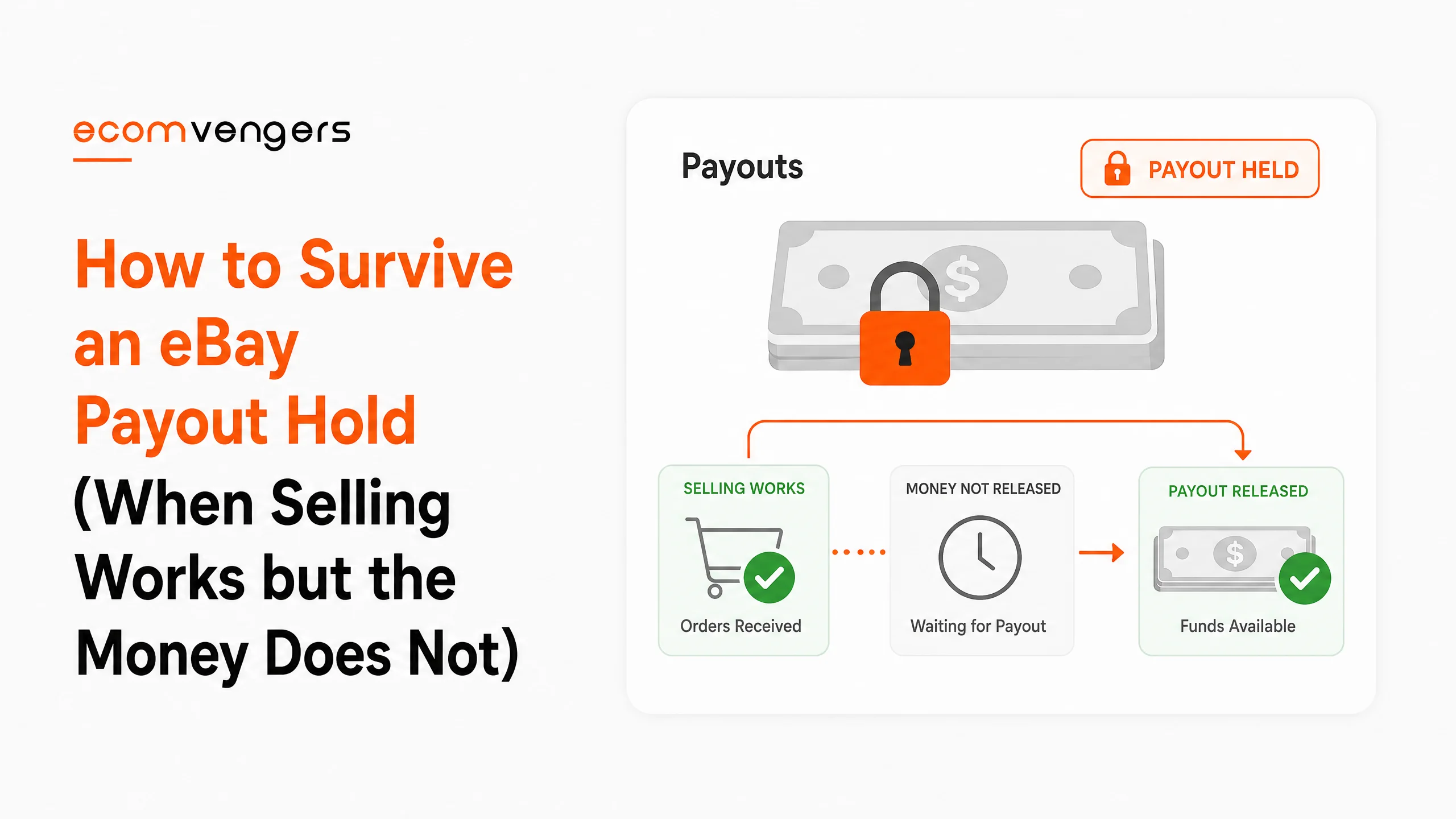
An eBay payout hold is a cash flow event first and an account event second, and the sellers who lose businesses to one usually lost them to the cash flow.
Three moves, and a calendar.
Key Takeaways
- A payout hold is not one thing. eBay applies several different holds for different reasons, and they release on different conditions.
- A restriction hold lasts as long as the restriction. eBay states payouts may be held until the restriction or suspension is lifted.
- A delivery hold outlives the restriction. Funds can stay held until tracking shows the item is on its way to the buyer.
- Reinstatement does not mean instant access. One account we recovered was told funds would be available 7 days after delivery confirmation.
- The terms improve as deliveries confirm. That same account moved to funds releasing 2 days after the buyer pays.
- Previously undistributed funds are included. Money tied to orders that had not yet arrived was released on the same schedule as new sales.
- Below Standard triggers its own hold. eBay lists held funds among the limitations applied directly after that evaluation.
- The hold does not stop your obligations. Suppliers, couriers and refunds all keep their normal timing.
- Cancelling orders makes it worse. A cancellation for being out of stock is one of only two things that creates a defect.
- Tracking is the release mechanism. Uploading it promptly is the single fastest thing you can do about a delivery hold.
- One documented freeze ran 18 days. An eBay UK account had payouts held from 19 July until the restriction closed on 6 August.
- Model the gap before you commit to stock. The mistake that closes businesses is buying inventory against money that has not arrived.
What Is an eBay Payout Hold?
It is eBay keeping money you have earned until a condition is met.
The sale completed. Your buyer paid. The funds exist and they are yours. What has changed is when eBay will release them to your bank account. Since eBay moved sellers onto Managed Payments, it controls that release itself rather than a payment processor.
Understanding which condition applies to you is the whole job, because each one releases differently.
Three holds that look identical in your balance
What starts each hold eBay can apply, and the condition that lifts it.
Conditions from the eBay account restrictions policy and the eBay seller standards policy.
The three holds that behave differently
Sellers describe all of these as “eBay is holding my money”. eBay files them under payments on hold and marks the money as on hold in the Payments tab. That gap in vocabulary is why the advice sellers get is so often useless.
A restriction hold releases when the restriction lifts. Delivery holds release when tracking confirms the item moved. A performance hold releases when your seller level improves at an evaluation.
Same symptom, three completely different timelines.
What eBay actually says
Three statements matter, and they sit in different policies.
On restrictions, eBay states that if you are a seller, your payouts may be placed on hold until the restriction or suspension on your account is lifted. That comes from the eBay account restrictions and suspensions policy.
On performance, it lists among the limitations applied directly after a Below Standard evaluation that funds from your orders may be held until tracking information shows that the item is on its way to the buyer. That one is in the eBay seller standards policy.
On transactions, eBay’s payments on hold page names the triggers directly.
- An open case or dispute on a transaction.
- A buyer reporting a problem with the order.
- A restricted or suspended account.
- Money owed to eBay.
- Being a new or infrequent seller.
That page also puts numbers on it. A hold usually clears within 30 days, and new sellers may in limited circumstances wait up to 21 days.
Read those three together and the shape of the problem appears. One hold is tied to your account status. The other is tied to every individual parcel.
Key point: the parcel level hold is the one that outlives your restriction. Sellers celebrate reinstatement, check the balance the next morning, and find most of it still sitting there waiting on delivery scans.
How Long Does an eBay Payout Hold Last?
As long as its condition takes, which is why the answer varies so wildly between sellers.
eBay puts a 30 day figure on transaction holds, but publishes nothing equivalent for a hold tied to a restriction. So the useful thing to look at is what has happened on accounts with the messages attached.
Eighteen days, on a restriction hold
eBay flagged an eBay UK account for unusual selling activity on 19 July and held its payouts while it reviewed.
The restriction closed on 6 August, which released the hold with it. Eighteen days of trading with no incoming cash and every outgoing obligation intact.
The notices are on the MC011 suspension removal case study, and that notice type has its own mechanics in our MC011 recovery guide.
Seven days, then two, on a delivery hold
A different account shows what happens after the restriction lifts.
When eBay restored an Australian seller’s privileges, it set out the terms in the same message: funds available 7 days after delivery confirmation, applying to new transactions and to previously undistributed funds tied to undelivered orders.
As ongoing delivery confirmations built up, that moved to funds releasing 2 days after the buyer pays.
Same account, same month, two very different cash positions. The full message is on the day two new seller restriction case study.
Worth knowing: the phrase “previously undistributed funds” is the one to look for. It means money from orders placed before the restriction gets pulled onto the new, slower schedule rather than paying out on the old one. Sellers budget for the new sales and forget the backlog.
What Does a Payout Hold Actually Cost You?
More than the delay, because the money you cannot reach is the money you were going to trade with.
Every obligation keeps its normal timing. Suppliers still invoice, couriers still bill, refunds still come out, and the eBay fees on the sales you just made are still due.
What stops is the inflow that funds all of it.
Most of a held month is not lost, it is waiting on scans
An illustrative month of completed sales, split by what each order is waiting on.
Illustrative arithmetic, not measured data. The release conditions come from the eBay seller standards policy.
The loop that closes accounts
This is the part worth understanding before it happens to you.
Held funds mean you cannot buy stock. No stock means you cannot fulfil the orders already placed. Unfulfilled orders become cancellations and cases, and those land on the metrics that decide your seller level.
A Below Standard evaluation then triggers its own funds hold, which tightens the same loop again.
The payout hold did not close the business. Those forced cancellations did.
A cash problem becomes a performance problem in one month
The chain that turns a temporary hold into a lasting restriction.
Cancellations and Below Standard consequences from the eBay seller standards policy. The chain is ours.
Why cancelling is the expensive way out
It looks like the responsible option and it is the costliest one available.
eBay counts only two things as a transaction defect, and a seller cancellation for being out of stock is one of them. Cancelling ten orders to avoid ten late despatches trades a timing problem for a permanent metric problem.
Ship late if you must. Our guide to transaction defect rate removal covers what eBay will take back off afterwards, and late despatch is far more recoverable than a cancellation.
If you want the arithmetic on your own numbers, our eBay ROI calculator will show what a held month does to a working capital cycle.
Day One: Identify Which eBay Payout Hold You Have
Before anything else, work out what is holding the money, because the answer changes every decision after it.
Open eBay Messages and read the notice for the condition rather than the tone. If it names a restriction, your payouts are tied to that restriction closing. If your account is fine and only the money is slow, you are looking at a parcel level hold.
Those two need opposite responses on day one.
Then count what is actually held
Open the Payments tab in Seller Hub and separate three numbers: your available funds, what is pending release, and what is tied to orders you have not despatched.
The third number is the one you control today. Everything you despatch and track moves from the untouchable pile toward the releasable one. Where eBay can give one, the Payments tab also shows an estimated release date against funds on hold.
Write those three figures down. You will need them for every conversation that follows, including the one with your bank.
Week One: Protect Your eBay Metrics, Not the Margin
The first week decides whether this stays a cash problem or becomes an account problem.
Every order you can fulfil, fulfil. Every parcel you despatch, upload tracking the same day. Both of those feed the mechanism that releases funds and the metrics that keep your seller level intact.
Margin is a next month problem. Defects are a next year problem.
Three moves, in this order
- Despatch and track everything you already have. Tracking is the release trigger on a delivery hold and the protection on a late despatch flag, so it does two jobs at once.
- Tell affected buyers before they ask. A message explaining a short delay prevents the cases that become defects, and it costs nothing you currently have.
- Fund the gap from outside eBay. A short overdraft, a supplier payment holiday or a slower restock is cheaper than a cancellation, every time.
None of that is comfortable. All of it is cheaper than the alternative.
Week Two: Work the eBay Payout Release Conditions
By now the easy despatches are done and the payout hold is releasing on its own schedule.
This is the point to check whether anything is stuck rather than simply slow. A parcel with no tracking, a return sitting unresolved, an open case nobody answered: each one is a small pool of money that will not move until you touch it.
Clear them individually. There is no bulk fix.
| Period | Your job | What you are protecting |
|---|---|---|
| Day one | Identify which hold applies | Every decision that follows |
| Week one | Despatch, track, communicate | Seller level and defect rate |
| Week two | Clear stuck orders individually | The funds that will not release on their own |
| Past a month | Escalate, and reforecast the business | Solvency rather than performance |
Notice that only the last row is about money. The first three are about not making the hold worse.
Past a Month: When an eBay Payout Hold Threatens Solvency
At some point this stops being an eBay problem and becomes a business one.
If a restriction has run past the window stated on your notice, or a delivery hold is not shortening as confirmations accumulate, something is stuck that will not unstick on its own.
Two things matter now, and neither of them is another polite message.
Reforecast honestly
Work out how long you can trade without the held balance, and put a date on it.
Sellers avoid this calculation because the number is frightening, then run out of runway without having seen it coming. A date you can see is a date you can plan around.
Our eBay fee calculator is useful here, because fees keep accruing on sales whose money you have not received.
Then deal with the cause, not the symptom
A payout hold is downstream of something else in almost every case.
Clearing the restriction releases the restriction hold. Improving the metrics releases the performance hold. Chasing the money directly moves neither, which is why so many sellers spend a fortnight on the wrong conversation.
Our guide to every eBay restriction type and how each one is lifted covers the diagnosis, and what the documented timelines actually look like covers the wait.
Can You Prevent an eBay Payout Hold?
You cannot prevent every one, and you can remove most of the reasons eBay applies them.
Both of the common holds key off the same two behaviours, which is convenient, because it means one habit protects you from both.
Despatch inside your stated handling time
A delivery hold exists because eBay cannot yet see that an item moved.
Handing parcels over promptly and getting the carrier scan on the same day removes that uncertainty before it becomes a payout hold. It also protects the late despatch metric, which is the one that eventually drags a seller level down.
Set your handling time for your worst week rather than your best one. A three day promise you always keep beats a one day promise you sometimes miss.
Keep the account boringly healthy
The performance version of a payout hold arrives with a Below Standard evaluation, and that evaluation is monthly and visible in advance.
Checking the dashboard weekly rather than after something breaks gives you three or four weeks of warning, which is enough time to appeal defects and clear open cases before the evaluation reads them.
Do not run on eBay money alone
This is the one real protection, and it has nothing to do with eBay.
A business that can trade for a month without an incoming payout treats a hold as an inconvenience. A business that restocks from Monday takings treats the same hold as an emergency, and makes emergency decisions.
The buffer is the difference, and building one is the only version of prevention that works on every hold at once.
What Releases Each Type of eBay Payout Hold?
Different triggers, and only some of them respond to anything you do.
| Type of hold | Releases when | Can you speed it up? |
|---|---|---|
| Restriction hold | The restriction or suspension lifts | Only by clearing the restriction |
| Delivery hold | Tracking shows the item is on its way | Yes, by despatching and uploading tracking |
| Performance hold | Your seller level improves at an evaluation | Slowly, and only on the monthly cycle |
| Post-reinstatement schedule | Delivery confirmations accumulate | Yes, by shipping cleanly and consistently |
| Unresolved case or return | The case closes | Yes, and usually the same day |
Three of those five respond to work you can do this afternoon. Start there rather than with the one that does not.
Frequently Asked Questions
Why is eBay holding my money when my account is fine?
Almost always because the hold is on individual orders rather than on your account. eBay can hold funds until tracking shows an item is on its way to the buyer, which means a healthy account with undespatched or untracked parcels still sees a frozen balance. An open item not received case does the same thing on the single order it covers.
Can eBay hold funds indefinitely?
A payout hold lasts as long as its condition remains unmet, so a restriction that never closes keeps its hold in place. That is precisely why working the restriction matters more than chasing the balance, since the money follows the account status rather than the other way round.
Do I still pay eBay fees while my payouts are held?
Yes, and this is the detail that catches sellers hardest. Fees accrue on the sales you have made regardless of whether the proceeds have reached you, so a held month can leave you owing eBay money on revenue you have not yet seen.
Should I cancel orders I cannot afford to fulfil?
Only as a genuine last resort, because eBay counts a seller cancellation for being out of stock as one of just two things that create a transaction defect. Despatching late is unpleasant and often appealable afterwards, whereas a cancellation lands on the metric that decides your seller level.
Does uploading tracking release funds immediately?
It starts the clock rather than opening the tap, since eBay looks for tracking showing the item is genuinely on its way rather than simply a number in a field. Uploading a label you have not yet handed to the carrier does not produce the scan the release depends on.
What are previously undistributed funds?
Money from orders placed before your restriction that had not paid out when the hold landed. On the account we documented, eBay applied the new 7 day schedule to those as well as to new sales, which means the backlog arrives on the slow terms rather than the old ones.
Will my payout schedule ever go back to normal?
It shortened on the account we handled, moving from 7 days after delivery confirmation to 2 days after the buyer pays as confirmations accumulated. That improvement came from a clean delivery record rather than from asking for it.
Can I ask eBay to release funds early for a hardship?
You can ask, and it rarely moves a payout hold that is tied to a stated condition. Explaining that the money is needed does not satisfy the condition the hold exists to check, which is a distinction we cover in why most eBay appeals fail.
Does a payout hold affect my selling limits?
Not directly, though the quiet trading month a payout hold usually produces can lower your ceiling at the next monthly review. We cover that knock-on effect in how to raise eBay selling limits.
Is a payout hold the same as a suspension?
No, and the two can exist independently of each other. A suspension stops you trading, whereas a hold only stops the money moving, which is why an account can be selling perfectly normally with a frozen balance sitting behind it.
How do I stop this happening again?
Keep despatch inside your stated handling time and tracking uploaded promptly, because both of the common holds key off exactly those behaviours. Beyond that, the reliable protection is not needing the money the moment it lands, which is a working capital decision rather than an eBay one.
When should I get help?
When the hold is tied to a restriction you have already tried and failed to clear, since at that point the money is downstream of a problem that is not moving. That is the situation our eBay suspension removal service exists for.
Trade Through the Gap
A payout hold is survivable. What is not survivable is the month of cancellations sellers make trying to avoid one.
First, identify which hold you have by reading the condition rather than the tone, then write down what has cleared, what is pending, and what is tied to undespatched orders.
Second, despatch and track everything you can this week, and tell affected buyers before they open a case.
Third, fund the gap from outside eBay and put a date on how long you can trade without the held balance.
Then work the cause. The money has never once been released by asking about the money.
Sources
- eBay, Payments on hold, on why eBay holds funds, what releases them and the timescales it gives.
- Guidance in Account restrictions and suspensions, on holds that arrive alongside a restriction.
- The seller standards policy, on the performance side that can trigger one.
- Details on selling limits, which often move at the same time as a hold.
- Our own figures come from published client cases with the eBay messages attached, collected in our eBay case study library.
Both payout timelines on this page come from documented cases with the eBay messages attached, collected in the case study archive. More on account health across the rest of the EcomVengers blog.
If selling has resumed but the orders have not, the problem is placement rather than cash, and we cover that in rebuilding the signals that decide placement.

Ali Khan is the founder of EcomVengers, the eBay growth and account recovery agency. He has spent the better part of a decade pulling suspended sellers back from MC011 and MC999 notices, repairing wrecked defect rates, and turning buried listings into ranked ones. When eBay's villains show up, he is the one sellers call. You handle the millions, he handles the villains.
View all posts by Ali Khan