Most sellers choose their eBay account type in about four seconds.
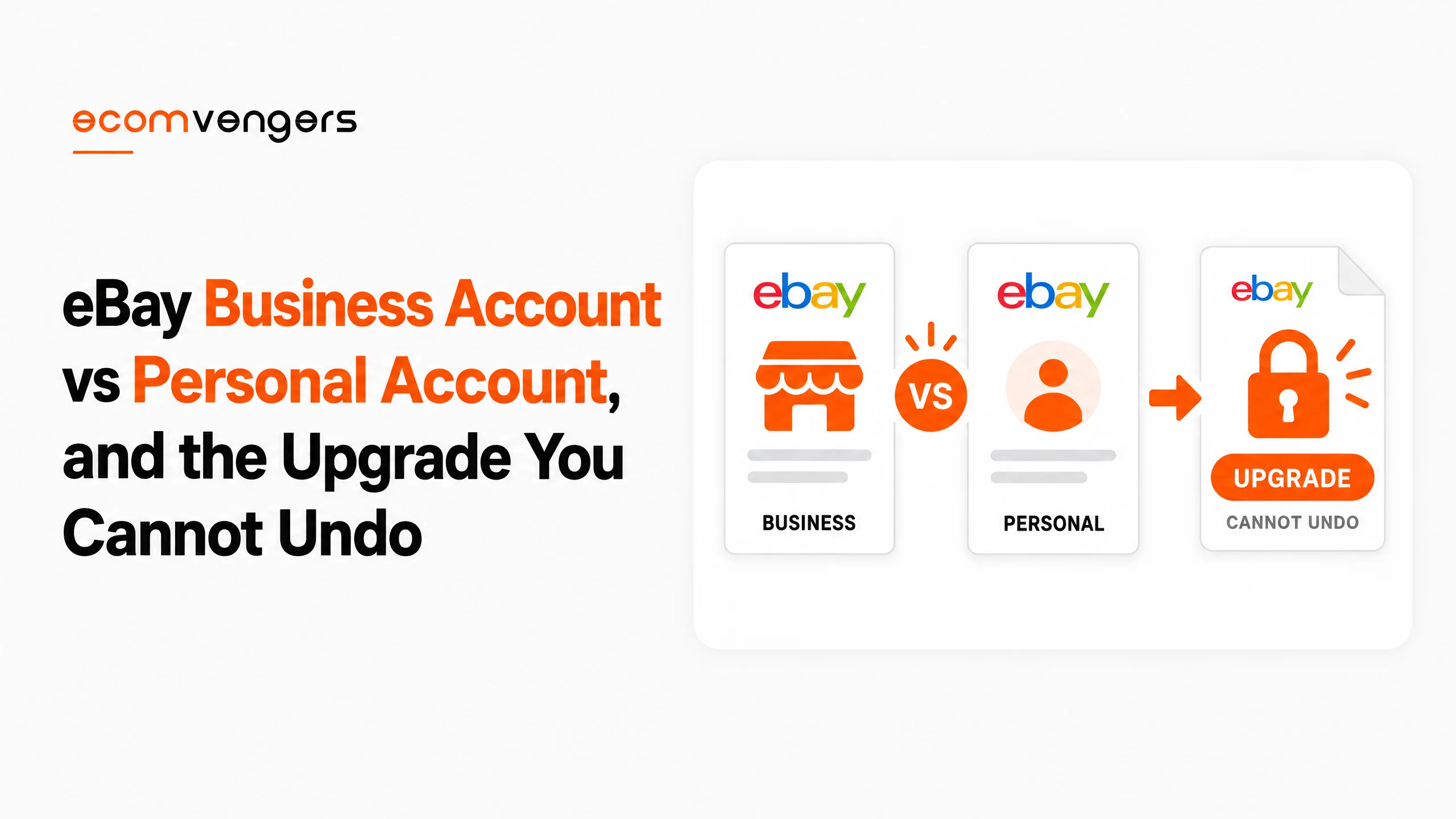
It is the quickest decision in the whole registration flow, and one of the very few that cannot be reversed.
eBay says so plainly. Once a personal account becomes a business account, it does not go back.
That would matter less if the choice were genuinely yours. It largely is not.
eBay does not ask what you would like to be called. It looks at what you sell and where it came from, then applies a policy that decides on your behalf.
Get that mismatch wrong in the direction sellers usually get it wrong, and the consequence eBay lists is not a polite email. Account suspension appears in the policy text itself.
Key Takeaways
- The upgrade is one way. eBay states that once a personal account has been upgraded to a business account, it is not possible to revert.
- eBay decides, not you. You must register as a business if you resell, make items to sell, or buy stock for a business.
- In the United States, account type does not change your selling fees. eBay lists price, format, category, upgrades and seller conduct as the things that set the fee. Account type is absent.
- In the United Kingdom it changes everything. Private sellers have paid no final value fees since October 2024. Business sellers still do.
- A business account needs a business bank account. eBay requires the account types to match, and a mismatch blocks payouts rather than listings.
- United States business registration wants an EIN plus the legal business name and identification for every beneficial owner, director and partner.
- Personal accounts need a Social Security Number in the United States, and a date of birth and address elsewhere.
- Business sellers in the UK must publish contact details in every listing, along with a VAT number where the activity is subject to VAT.
- A UK business account hands buyers a 14 day right to withdraw under the Consumer Contracts Regulations, whatever your own returns policy says.
- Business sellers cannot charge restocking fees, cannot keep the original postage on a return, and cannot charge for return postage.
- Third party tools and APIs are business only. If you want listing software, the account type is the gate.
- Posing as a private seller is a policy breach. eBay names warnings, listing removal, restrictions and suspension as the available responses.
Which eBay Account Type Do You Actually Need?
If you bought it to sell it, you need a business account. If you are clearing out a loft, you do not.
That single sentence settles the question for the large majority of sellers, and it is eBay’s own test rather than ours.
eBay’s business seller policy says a seller must register as a business if they sell items they have bought to resell, if they make items in order to sell them, or if they buy items for their business.
Notice what is missing from that list. There is no revenue figure, no listing count and no threshold to creep under.
The test is about the origin of the stock, not the size of the operation. Someone selling four handmade candles a month is a business seller. Someone selling a two thousand pound camera they inherited is not.
Sellers look this up as eBay business vs personal account one week and as eBay personal account vs business account the next. The word order changes nothing, because the test underneath it is the same.
This is where the eBay business account vs personal account question usually goes wrong. Sellers treat it as a tier they graduate into once they feel established, when it is closer to a declaration of what they already are.
Key point: the trigger is where the stock came from, not how much of it you shift. There is no sales figure you can stay beneath to remain a private seller if you are buying to resell.
What an eBay Business Account Requires That a Personal Account Does Not
A business account asks for company paperwork and identification for everyone behind the company. A personal account asks for you.
The gap is wider than most sellers expect before they start the form.
What a personal account has to provide
An individual seller in the United States gives a full name, an address that is not a PO box, a date of birth and a Social Security Number.
In the United Kingdom the list is a full name, nationality, address and date of birth.
That is the whole of it. One person, four facts.
What a business account has to provide
A registered business in the United States must supply the legal business name exactly as it appears on the registration documents, any trading name, an Employer Identification Number and a physical business address.
It must then identify every stakeholder. eBay names beneficial owners, directors, partners, principal officers, trustees and anyone else with control of the business.
UK registered businesses face the same shape of request, with a company or charity registration number in place of the EIN.
Limited liability companies in the United States can also set a tax designation, declaring whether the company is owned by an individual, owned by an entity, or has filed Form 8832 with the IRS.
None of this is difficult if the company already exists. It is close to impossible if it does not, which is the practical reason the upgrade catches people out.
Does an eBay Business Account Cost More in Fees Than a Personal Account?
In the United States, no. In the United Kingdom, very much so.
This is the most misunderstood part of the comparison, and the answer genuinely depends on which marketplace you sell in.
Why account type does not move the fee in the United States
eBay publishes one selling fees page for the United States, and it applies to everyone.
More usefully, that page lists what does set your fee. It names the item’s price, the format and category you choose, any optional listing upgrades, and your seller conduct and performance.
Account type is not on the list. That is a stated set of variables rather than a gap in the documentation, which is why it can be relied on.
So an American seller upgrading to a business account should expect the same final value fee on the same item in the same category.
The insertion fee allowance of 250 free listings a month does not move either. Only a Store subscription changes those numbers, and a Store is available on both account types.
If you want to model what a given sale actually costs, our eBay profit calculator runs the category rates and thresholds without asking your account type, for exactly that reason.
Why account type is the whole fee in the United Kingdom
eBay UK publishes two separate fee pages, one for private sellers and one for business sellers, and the difference between them is not a percentage point or two.
Since 1 October 2024, UK based private sellers pay no final value fees and no regulatory operating fee at all. Cars, motorcycles and vehicles are excluded.
Private sellers get 300 free listings a month, rising to 400 with a Shop subscription, and pay 35p per listing after that.
Fees still exist at the edges. There is a 3% international fee when the delivery address is outside the UK, a dispute fee of 16.80 per chargeback, and a 2.5% currency conversion charge.
Business sellers on the same marketplace pay final value fees on every sale. Upgrading a UK account is therefore a decision with a direct and permanent cost attached, which is an unusual thing to click Confirm on.
Worth knowing: the Buyer Protection fee is added to the item price and paid by the buyer to eBay, so a private seller who lists at 10 still receives 10.
It runs at 10p per item plus 7% of the price up to 20, 4% from 20 to 300, and 2% from 300 to 4,000. Business listings carry Buyer Protection at no additional cost to buyers, so the surcharge is a private seller feature rather than a business one.
| Point of comparison | Personal or private account | Business account |
|---|---|---|
| Who eBay expects to use it | Selling items you already owned | Reselling, making to sell, buying stock |
| US final value fee | Same as business | Same as personal |
| UK final value fee | None since October 2024 | Charged on every sale |
| UK free listings per month | 300, or 400 with a Shop | Set by the selling plan |
| Bank account required | Personal, name must match | Business, name must match |
| Contact details in listings | Not required | Required in the UK |
| Returns policy | Optional | Required |
| Restocking fees | Not applicable | Prohibited |
| Third party tools and APIs | Not eligible | Eligible |
| Reversible | Upgrade available | No route back |
What an eBay Business Account Owes Buyers That a Personal Account Does Not
A business account carries consumer law obligations that a private account does not attract, and eBay enforces them as platform policy.
This is the part sellers tend to discover after the upgrade rather than before it.
UK business sellers must tell buyers they have 14 days to withdraw from the transaction where the Consumer Contracts Regulations apply. That right exists whatever your own returns window says.
They must also accept the return of faulty items within 30 days with a full refund, under the Consumer Rights Act 2015.
Three practices are then closed off entirely. Business sellers cannot charge restocking fees, cannot keep the original postage when an item comes back, and cannot charge buyers for return postage.
Each listing must also carry full contact details for the business, any trade organisations it belongs to, any relevant authorisation scheme, clear pricing including postage and tax, and a VAT number where the activity is subject to VAT.
Listings must not be misleading, which sounds like boilerplate until a dispute turns on the wording of a description. The boundaries of what protection covers are worth reading in full, and we have set them out in our guide to eBay seller protection.
There is something a business account gains here too. Only business sellers are eligible to use third party tools and APIs, so every piece of listing, repricing or inventory software on the market sits behind this one setting.
Key point: the 14 day withdrawal right and the 30 day faulty goods right are statutory. Writing a shorter window into your listing does not shorten them, it simply puts your policy at odds with the law.
How to Change an eBay Personal Account to a Business Account
The upgrade takes about two minutes and lives in account settings rather than anywhere obviously seller related.
eBay’s own sequence runs as follows.
- Go to Account settings in My eBay.
- Select Personal information.
- Select Edit next to Account type. You may be asked to sign in again.
- Select Confirm to upgrade to a business account.
- Specify whether you operate as a legal entity or as a sole proprietor, then continue.
- Enter your business information, including name, contact information and returns policy, then save.
Step four is the point of no return, and it is worth pausing on. eBay states that once you have upgraded a personal account to a business account, it will not be possible to revert back to a personal account.
Your feedback history comes with you, which is the main reason upgrading beats starting fresh.
Opening a second account instead is a tempting shortcut and a poor one, because eBay links accounts by shared details and treats them as connected. We have written about what happens when that goes wrong in linked account suspensions.
The bank account trap that blocks payouts
eBay requires your bank account type to match your eBay account type, and it checks the names.
A business eBay account needs a business bank account, with the business name on the bank account matching the name used to register on eBay.
A personal account needs the first and last name to match instead.
Get this wrong and the failure is quiet in the worst way. Listings keep running and sales keep completing, while the payout sits behind a verification banner until the mismatch is resolved.
It is the sort of problem that looks like a hold and is really a form field, which we cover in our guide to eBay payout holds.
Why Selling as a Business on a Personal Account Risks Suspension
eBay’s business seller policy states that business sellers cannot represent themselves as private individuals, and it lists account suspension among the responses available when activity breaches the policy.
The other listed responses are removing the listing or content, issuing a warning, and restricting activity.
Most sellers meet the middle of that range first. A warning, then a restriction, then a harder stop if nothing changes.
What makes this category of enforcement awkward is that the underlying problem is structural rather than behavioural. A seller with a mismatched account type has not done anything wrong on any individual transaction.
They are simply trading in a costume that no longer fits, and every listing repeats the claim.
In the UK the incentive to stay private is now considerably stronger than it was, because private selling is free. That makes deliberate misclassification more tempting and, predictably, easier for eBay to justify acting on.
The fix, when eBay does act, is usually the upgrade itself rather than an appeal about a single listing. If an account has already been restricted, our guidance on what to do when an eBay account is suspended sets out the order to work in.
Worth knowing: volume attracts attention, but it is not the test. A small seller buying stock to resell is as far outside the private seller definition as a large one.
Does an eBay Account Type Change the Tax You Pay?
No. Tax follows your sales and your circumstances, not the label on the account.
This one causes real anxiety, so it is worth stating plainly.
In the United States, eBay issues a Form 1099-K when you reach certain sales amounts set by the government.
That threshold is about how much you sold. It is not about whether you hold a personal account or a business one.
A personal account can trigger a 1099-K. A business account can sell very little and never see one.
What the account type does change is the tax identifier eBay holds for you. Individuals give a Social Security Number. Registered businesses give an EIN.
Limited liability companies get one extra choice here. They can declare whether the company is owned by an individual, owned by an entity, or has filed Form 8832 with the IRS.
That designation decides how eBay issues your tax forms. It does not decide how much tax you owe.
The practical upshot is simple. Upgrading your account does not create a tax bill, and staying private does not avoid one.
We are not tax advisers, and the thresholds move. Treat the account setting as an administrative choice and take the tax question to an accountant.
Key point: sales volume drives the 1099-K. The account type drives only which identifier eBay has on file.
When an eBay Personal Account Is Still the Right Answer
A personal account remains correct for anyone selling things they already owned, and there is no advantage in upgrading early.
eBay’s own guidance says a private account is the best option for casual selling, such as selling items you no longer want.
Upgrading before you need to costs you something in every market. In the UK it costs you final value fees on every sale. Everywhere it costs you the option to change your mind.
It also brings forward obligations you do not yet owe, including the returns policy, the published contact details and the statutory withdrawal right.
The sensible sequence is to upgrade at the point the business exists, not in anticipation of one. You need the company paperwork and the business bank account to finish the form anyway, so the account type tends to follow the business rather than lead it.
Selling limits are worth separating from this question, because sellers often conflate them. Limits move with your selling history and performance rather than your account type, and we have covered how to lift them in our guide to eBay selling limits.
Key point: upgrading does not raise your selling limits, and staying private does not protect them. The two systems are unrelated.
FAQs About eBay Business and Personal Accounts
Can you change an eBay business account back to a personal account?
No. eBay states that once you have upgraded a personal account to a business account, it will not be possible to revert back to a personal account.
Do I need a business account to sell on eBay?
Only if you resell, make items to sell, or buy items for a business. Selling things you already owned does not require one.
Does an eBay business account pay higher fees than a personal account?
In the United States, no. eBay applies the same selling fees to both, and lists price, category, format, upgrades and seller performance as the variables. In the United Kingdom, yes, because private sellers pay no final value fees.
How much does a business account on eBay cost?
Opening one is free. The running cost is the final value fee on each sale, plus any Shop or Store subscription and any optional listing upgrades you choose.
Do I need an LLC or a limited company for an eBay business account?
No. eBay asks whether you operate as a legal entity or as a sole proprietor, so sole traders can register a business account without forming a company.
Do I need an EIN for an eBay business account?
Registered businesses in the United States are asked for an EIN. eBay also accepts a Social Security Number or an Individual Tax Identification Number where that is what applies to you.
Will I lose my feedback if I upgrade my eBay account?
No. The account is upgraded rather than replaced, so feedback, account age and selling history all carry across.
Can I open a separate business account instead of upgrading?
You can hold more than one eBay account, but a new one starts with no feedback and no selling history. eBay also links accounts that share details, so a restriction on one can reach the other.
Does an eBay business account need a business bank account?
Yes. eBay requires the bank account type to match the eBay account type, and the business name on the bank account must match the name used to register.
Do business sellers have to accept returns on eBay?
UK business sellers must publish a returns policy, honour a 14 day right to withdraw under the Consumer Contracts Regulations, and refund faulty items in full within 30 days under the Consumer Rights Act 2015.
Can business sellers charge restocking or return postage fees?
No. eBay prohibits business sellers from charging restocking fees, from keeping the original postage on a return, and from charging buyers return postage.
Do UK private sellers really pay nothing to sell?
For most listings, yes. Since October 2024 UK private sellers pay no final value fees and no regulatory operating fee, with vehicles excluded and fees still applying to overseas delivery, optional upgrades and listings beyond 300 a month.
Can personal accounts use eBay listing software?
No. eBay states that only business sellers are eligible to benefit from third party tools and APIs.
Does upgrading to a business account raise my selling limits?
No. Selling limits respond to your selling history and performance, not to the account type you hold.
Pick the eBay Account That Matches the Stock
The eBay business account vs personal account decision is not really a choice between two products. It is a description of what you are already doing, and eBay has written the definition down.
Buy to resell, make to sell, or buy stock for a business, and the business account is the correct one. Clear out a cupboard, and it is not.
The cost of getting it wrong runs in both directions. Upgrade too early and you take on fees in the UK, obligations everywhere, and a door that locks behind you.
Leave it too late and you are trading against a policy that lists suspension among its remedies.
Work through it in this order.
- Ask where your stock came from. Bought or made to sell means business.
- Check which marketplace you sell on, because the fee consequence is UK specific.
- Confirm the business exists on paper before you start the form, with a registration number or EIN to hand.
- Open the matching business bank account first, in the same name.
- Prepare a returns policy and the contact details every listing will have to carry.
- Only then run the upgrade in account settings, knowing it does not reverse.
If an account has already been restricted over how it is classified, the account type is the thing to fix first. An appeal that leaves the underlying mismatch in place tends to buy time rather than a reinstatement.
Sources
- The Business seller policy, for the definition of business selling, the requirement not to represent a business as a private individual, the listing disclosure requirements, the 14 day withdrawal right, the 30 day faulty goods refund, the prohibition on restocking and return postage fees, the third party tools eligibility, and the enforcement responses including suspension.
- Guidance in Creating an eBay account, for the personal to business upgrade steps and the statement that the change cannot be reverted.
- Requirements set out in Registering as a seller, for the identity requirements by account type, the EIN and stakeholder information, the LLC tax designation, and the requirement that the bank account type match the eBay account type.
- The United States Selling fees, for the United States fee structure and the list of variables that determine the final value fee.
- The United Kingdom Fees for private sellers, for the removal of final value fees for UK private sellers from 1 October 2024, the 300 free listings allowance, the international fee, the dispute fee and the currency conversion charge.
- Mechanics of the surcharge come from Buyer Protection information for sellers, covering the fee being added to the item price and paid by the buyer, its banded calculation, and the fact that business listings carry Buyer Protection at no additional cost to buyers.
- Seller Centre guidance on eBay Business Accounts, for the guidance on when a private account is the better option.
Zaman Khan is the eBay and TikTok Shop expert at EcomVengers. He covers the commercial side of selling: fees, pricing, profit tracking, shipping, listing tools and the account decisions that shape a store. He writes our guides on what eBay actually charges and how to run a catalogue efficiently.
View all posts by Zaman Khan