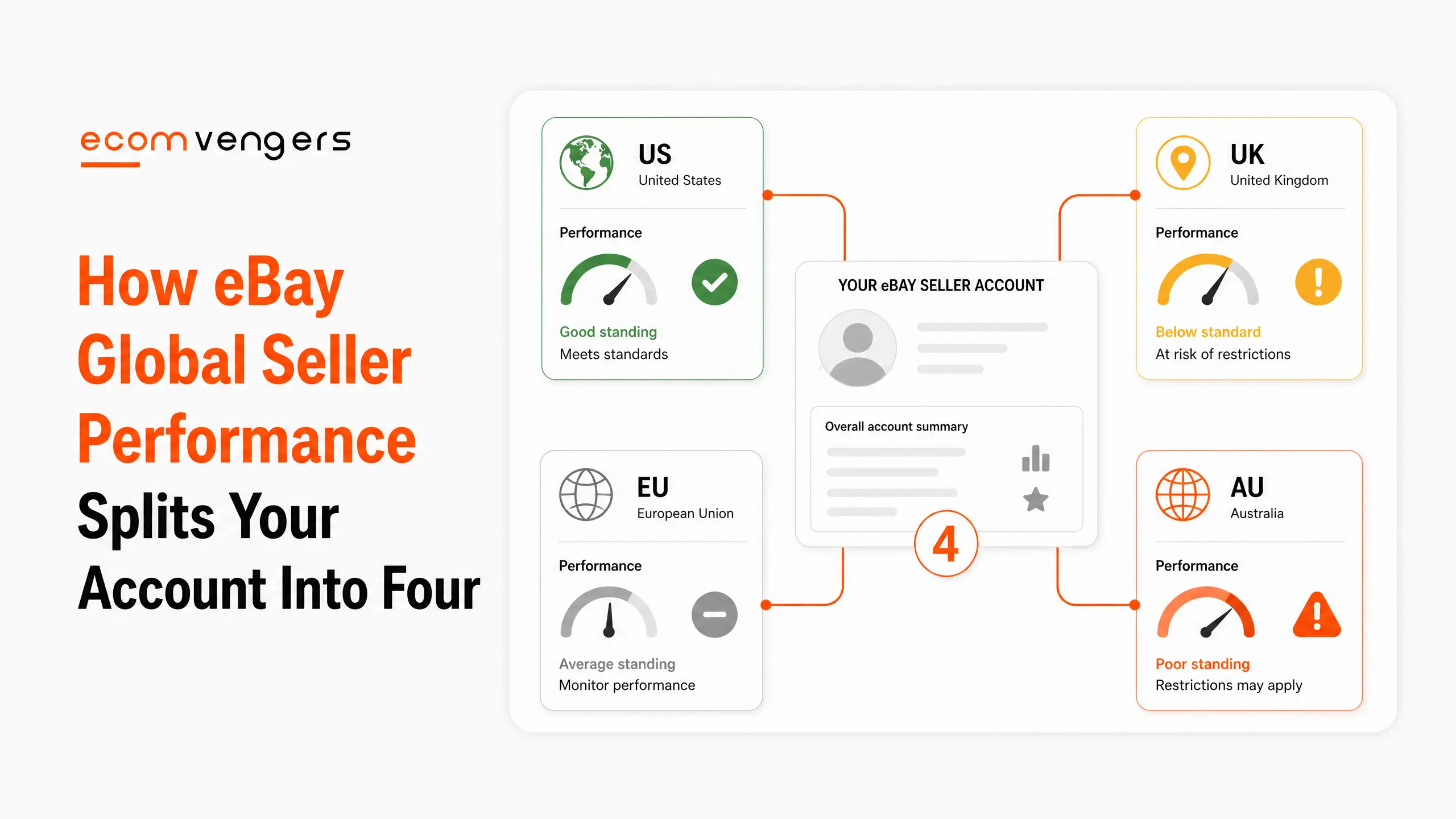
You can be Top Rated on one eBay site and Below Standard on another, at the same time, from the same warehouse.
eBay uses that exact example itself.
Your seller level is not one number. It is four, and which one a sale feeds depends on where the parcel went, not where you listed it.
Service metrics work the other way round, and are sorted by the site you listed on instead.
Two systems, two different sorting keys, and one seller wondering why the dashboards disagree.
Key Takeaways
- There are four seller standards programmes. US, UK, German and Global.
- Destination decides which one counts a sale. Not the site you listed on.
- Your level does not carry between them. eBay states this outright.
- Service metrics sort by listing site instead. List on several sites and you get several sets.
- The same three metrics apply everywhere. Cases closed, defect rate and late shipment rate.
- Below Standard thresholds are identical across all four. Two cases or 0.3%, and 2% defects.
- Defects need more than four buyers to demote you. A published floor most sellers have never seen.
- Top Rated differs in exactly one place. The late shipment allowance.
- Global allows 5% late, the rest allow 3%. That is the only threshold that moves.
- Penalties can vary too. eBay says additional fees differ between sites.
- Service metrics exist on nine sites. Not on every eBay site you can list on.
- One dashboard shows them all. The seller standards dashboard breaks down every programme you trade in.
How eBay Sorts Sales Into Two Different Systems
This is the part that makes the dashboards look broken when they are not.
eBay runs two kinds of evaluation, and it says so plainly. A seller standards evaluation applies to every seller worldwide, with transactions assessed on the country the item is sent to. A service metrics evaluation runs on most sites, benchmarked against sellers listing on the same site with a similar profile.
Read those two sentences against each other. One sorts by destination. The other sorts by the site you listed on.
A single sale can therefore feed the UK seller standards programme while sitting inside your eBay.com service metrics.
Nothing is wrong when that happens. It is the design.
The Four eBay Seller Standards Programmes Explained
Destination country, every time.
eBay gives a worked example. List on eBay.com and post only within the United States, and every transaction counts into the US programme. Send some orders to the UK as well, and those transactions count into the UK programme, deciding your level on eBay.co.uk.
So a seller who never opened eBay.co.uk in their life can hold a seller level there.
The Global programme is the catch all, covering every destination outside the six named countries. Australia, Canada, France, Italy and Spain all land there.
Key point: eBay states your seller level does not carry over between programmes, and offers the example of Top Rated on eBay.com alongside Above Standard in the Global programme. Two true statements about one account.
A Worked Example: One UK Seller, Three Seller Levels
One seller, one listing site, four different outcomes.
Take a UK business listing only on eBay.co.uk, posting to buyers in the UK, Ireland, the United States and Australia.
| Where the parcel goes | Which programme counts it | Which level it sets |
|---|---|---|
| United Kingdom | UK programme | eBay.co.uk and eBay.ie |
| Ireland | UK programme | eBay.co.uk and eBay.ie |
| United States | US programme | eBay.com |
| Australia | Global programme | All other eBay sites |
That seller now holds three separate seller levels. They have never listed on eBay.com, and they hold a level there anyway.
And exactly one set of service metrics
Because service metrics follow the listing site, not the destination.
Every one of those orders was listed on eBay.co.uk, so all four feed a single eBay.co.uk service metrics set. The Australian parcels sit in the Global seller standards programme and in the UK service metrics at the same time.
Three levels, one benchmark, and one seller reasonably confused.
Where it gets uncomfortable
The small programmes carry the risk.
Say the UK business posts 840 domestic orders and 60 to Australia in a year. The Global programme is measured on those 60, not on the 900.
Two defects there is 3.3%, comfortably over the 2% ceiling, while the UK numbers look immaculate.
The buyer floor is the saving grace, since defects spread across four or fewer buyers cannot demote you. Beyond that, a small region is a fragile one.
Do eBay Seller Standards Change Between Countries?
Barely. One number moves, and everything else is identical.
eBay states the evaluation cycle and the three metrics are the same across all programmes. Cases closed without seller resolution, transaction defect rate, and late shipment rate.
The Below Standard line is the same everywhere
All four programmes use the same two minimum requirements.
Two cases closed without seller resolution within an evaluation period, or 0.3% of transactions, whichever is higher. And a transaction defect rate of up to 2%. Those are the eBay.com figures, and the seller level calculator lets you swap them for whichever programme you are checking.
Late shipment carries no minimum requirement in any programme, which is consistent with what we set out in fixing an eBay late shipment rate.
The buyer floor on defects
This one is published and rarely quoted.
eBay states you will only be evaluated as Below Standard if your transaction defects are associated with more than 4 different buyers.
So a defect rate over 2% caused by four buyers or fewer does not demote you. That protects small sellers from a single difficult customer, and it is the counterpart to the rule on cases, which carries no such floor.
We take the defect side apart in the transaction defect rate.
The single number that differs
Top Rated late shipment, and only that.
The US, UK and German programmes allow no more than 5 late shipments, or 3% of transactions. The Global programme allows no more than 5, or 5% of transactions.
Two percentage points, in the one programme covering the longest journeys. That is eBay acknowledging that international post takes longer and goes wrong more often.
Everything else about Top Rated is identical. No more than 2 cases or 0.3%, and a defect rate no higher than 0.5% across no more than 3 different buyers.
But the penalties can vary
Same thresholds does not mean same consequences.
eBay notes that the limitations applying when you miss a site’s minimum requirements, such as additional final value fees, can also vary between programmes.
So check the fee consequence on the site itself instead of assuming your home market’s rules travel with you.
Top Rated Is Also Per Programme
The status splits the same way the level does, and so do the benefits.
eBay sets Top Rated requirements per programme, and the only one that varies is the late shipment allowance. Everything else matches across all four.
So you can hold the badge on one site and not on another, from one warehouse and one dispatch process.
Which means the fee discount splits too
The 10% saving attaches to the site where you hold the status.
A seller who is Top Rated in the UK programme gets the eBay Premium Service benefits on eBay.co.uk listings that qualify. Losing Top Rated in the Global programme does not touch that.
The reverse is also true, and it is the version that costs money without anyone noticing. We set out the two gates in what Top Rated actually requires.
The Global concession is deliberate
Five per cent instead of three, on the programme covering the longest journeys.
That is eBay pricing in the reality of international post. It is not generosity. A parcel crossing two customs borders is late more often than one crossing a county.
It is still a ceiling, not a target, and the tracking rules that protect you are identical everywhere.
Where Service Metrics Actually Exist
On nine sites, and not on every site you can list on.
eBay lists them directly. eBay.com, eBay.ca and its French Canadian version, eBay.co.uk, eBay.com.au, eBay.de, eBay.fr, eBay.it and eBay.es.
List on several of those and you see separate service metrics for each one. The calculation and the peer benchmark work identically on all of them.
eBay repeats its data caveat here too. It only calculates service metrics where it has enough data, so you may not see them for every site or category.
How that system works is covered in eBay service metrics.
Why eBay Policies Differ Between Sites
Performance is not the only thing that varies once you sell across borders.
eBay recommends reading the seller standards and service metrics policies on each relevant site instead of assuming your home market’s version applies.
It goes further. It tells you to familiarise yourself with the selling policies that apply on sites other than eBay.com, and with the requirements and time frames for the eBay Money Back Guarantee when the buyer is using a different eBay site.
For that, eBay points you at its International selling policy, which is the document most cross border sellers have never opened. We walk through it, with the fees and protections on a cross-border sale, in our guide to selling internationally on eBay.
Why the Money Back Guarantee point matters
Because the clock you are working to may not be the one you know.
Time frames govern when a buyer can open a request and how long you have to respond. Those decide whether a case ends resolved or unresolved, and an unresolved one lands on two metrics at once.
We cover that double hit in getting off eBay Below Standard.
Working to the wrong deadline on an overseas order is an easy way to lose a case you would have won at home.
What eBay Global Seller Performance Means If You Ship Abroad
Your worst region cannot drag down your best, and your best cannot rescue your worst.
Isolation cuts both ways
A clean domestic operation stays clean while an international one struggles.
That protects you. A seller whose overseas parcels go missing keeps their domestic level intact, and keeps the fee discount and placement that come with it on that site.
The reverse is the trap. Excellent domestic numbers do nothing for a Global programme that is slipping unnoticed.
Small volumes get judged hardest
Splitting your sales across programmes splits your denominators too.
A seller doing 900 orders a year with 60 going overseas is not measured on 900. They are measured on 840 in one programme and 60 in another, and 60 orders is a very small base for a 2% ceiling.
Two defects in that Global slice is 3.3%, which is over the line while the main account looks perfect.
The buyer floor helps here, since fewer than five buyers cannot demote you, but it is not a licence to ignore the region.
Decide whether the region earns its place
Some sellers should stop posting to some countries, and that is a legitimate answer.
Where a destination produces a fraction of your revenue and most of your problems, excluding it protects a level with real money attached. Blocking a shipping location is a setting, not a surrender.
The alternative is fixing the postage, which usually means tracked services and realistic delivery estimates on the long routes.
What Stays the Same Across eBay Programmes
Rather a lot, and it is the reassuring half of this.
The three metrics are the same in every programme. So is the evaluation cycle, and so are the two minimum requirements that decide Below Standard.
That means the work is the same wherever the parcel went.
The same fixes travel
Resolving a request before eBay steps in protects you in the Global programme exactly as it does at home.
So does a carrier scan inside your handling time, an accurate listing, and refunding early instead of arguing. None of that is regional.
The removals work the same way too. A defect eBay lifts comes off the programme it landed in, at the next evaluation.
And so do the protections
Reporting an abusive buyer, and the removals for events outside your control, apply to the transaction, not the region.
What we set out in eBay seller protection is best applied to the weakest programme first, because that is where each removal moves the number furthest.
A single removal in a 60 order programme is worth several in an 840 order one. Small denominators cut both ways.
Three eBay Seller Standards Checks Worth Doing
None of them takes long, and most sellers have done none of them.
Count how many programmes you are actually in
Open the seller standards dashboard and read every programme listed against your account.
eBay says that dashboard shows your level and a detailed breakdown of your metrics for each applicable programme. If you post abroad at all, expect more than one entry.
Sellers are routinely surprised by the second and third rows. Screenshot the dashboard the first time you look, because the breakdown changes every month.
Find your smallest programme
That is where the next problem will come from.
A programme fed by a handful of orders has a tiny denominator, so one bad week reads as a terrible quarter. Check whether the volume there justifies the exposure.
Sometimes it does, because those orders are high margin. Sometimes it plainly does not.
Then check the postage on that route
Almost every weak programme is a postage problem wearing a performance label.
Tracked services, accurate delivery estimates and a handling time you can hold on the long routes fix more than any appeal will. The scan rules that protect you work identically in every programme.
Where the route cannot be fixed, excluding the destination is a setting. It is not a defeat.
Frequently Asked Questions
Why is my seller level different on two eBay sites?
Because they are separate programmes. eBay states your level does not carry over, and gives Top Rated on eBay.com alongside Above Standard in the Global programme as its own example.
Which programme does a sale count into?
The one matching the buyer’s delivery address. Listing site is irrelevant to seller standards, though it is exactly what decides your service metrics.
I only list on one site. Do I still have several levels?
If you post abroad, yes. Sending orders to the UK gives you a UK seller level whether or not you ever listed on eBay.co.uk.
Are the Below Standard thresholds different by country?
No. Cases closed and transaction defect rate use identical minimums in all four programmes, and late shipment carries no minimum anywhere.
What is different about the Global programme?
One threshold. Top Rated there allows no more than 5 late shipments or 5% of transactions, where the other three allow 5 or 3%.
Can a few bad buyers make me Below Standard?
Not on defects alone. eBay only evaluates you as Below Standard where the defects involve more than 4 different buyers. Cases closed without resolution carry no equivalent floor.
Do Australian and Canadian sales have their own programme?
No, they sit inside the Global programme along with every other destination outside the six named countries. Both sites do have their own service metrics though.
Where do I see all of this?
The seller standards dashboard shows your level and a detailed breakdown for every programme that applies to you. Service metrics live on their own dashboard, per site.
Do the penalties differ between programmes?
They can. eBay states the limitations that apply, including additional final value fees, can vary between sites even where the thresholds match.
Should I stop shipping to a difficult country?
It is a legitimate option where that destination is a small share of revenue and a large share of problems. Excluding a shipping location is a setting you can reverse once the postage is fixed.
Does the evaluation date change by programme?
No. eBay states the evaluation cycle is the same across all programmes, so every one of them is assessed on the same monthly schedule.
Do France, Italy and Spain have their own programme?
Not for seller standards. Those destinations sit in the Global programme, though all three sites do carry their own service metrics.
Which policy should I actually read?
The one on the site in question. eBay recommends reading the seller standards and service metrics policies on each relevant eBay site, not a single version.
Can a strong programme rescue a weak one?
No. Each programme is evaluated on its own transactions, so excellent domestic numbers do nothing for a Global programme that is slipping.
Where should I spend removal effort first?
On the smallest programme carrying a problem. One removal against a small transaction count moves the percentage far further than the same removal against a large one.
When should I bring in help?
When one programme has slipped and you cannot tell which orders are feeding it. Untangling that split is where our account recovery service starts on an international account.
Read Four Dashboards, Not One
The account you think you have is an average of four you have never looked at separately.
First, open the seller standards dashboard and read every programme it lists for you.
Second, work out which destinations feed the weakest one.
Third, fix the postage on those routes or stop serving them.
A level you cannot see is still a level, and it is still charging you.
Most sellers reading this will find a programme they did not know they were being scored in. That is the normal outcome, not a sign something has gone wrong.
Sources
We manage accounts across several of these programmes at once, and the documented outcomes sit in the case study archive. More on seller performance across the rest of the EcomVengers blog.
Three checks, in this order, if you sell across borders.
First, open every programme, not only the one you recognise. A clean domestic record tells you nothing about the others, and each is evaluated separately.
Second, find which destinations feed the weakest one. A single lane with slow delivery can pull a whole programme down while the rest look healthy.
Third, decide whether that lane earns its place. Turning off a destination is a legitimate answer, and it is cheaper than carrying a restriction for it.
Hold on to this: one account, several verdicts. eBay judges you once per programme, so the question is never just how you are doing.
Sources
- eBay, Global seller performance policy, on how eBay evaluates a seller separately by programme and the thresholds each one uses.
- The seller standards policy, for the domestic evaluation this sits alongside.
- Our own figures come from published client cases with the eBay messages attached, collected in our eBay case study library.
Abdul Mannan is the eBay account health expert at EcomVengers. He works on the numbers that decide a seller's standing: transaction defect rate, late shipment rate, cases closed without seller resolution, service metrics, returns and feedback. He writes our guides on keeping an account out of Below Standard and on finding out why sales have dropped.
View all posts by Abdul Mannan