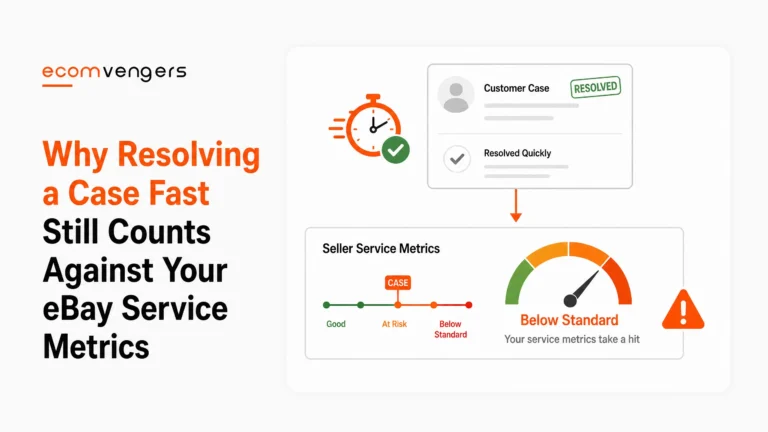
One unresolved case damages two metrics, not one.
eBay says so directly, and it is the sentence that explains why accounts fall to Below Standard faster than their owners expected.
A case closed without seller resolution also counts as a transaction defect. Those are the only two minimum standards there are.
So a single order you failed to sort out lands on both of them at the same time.
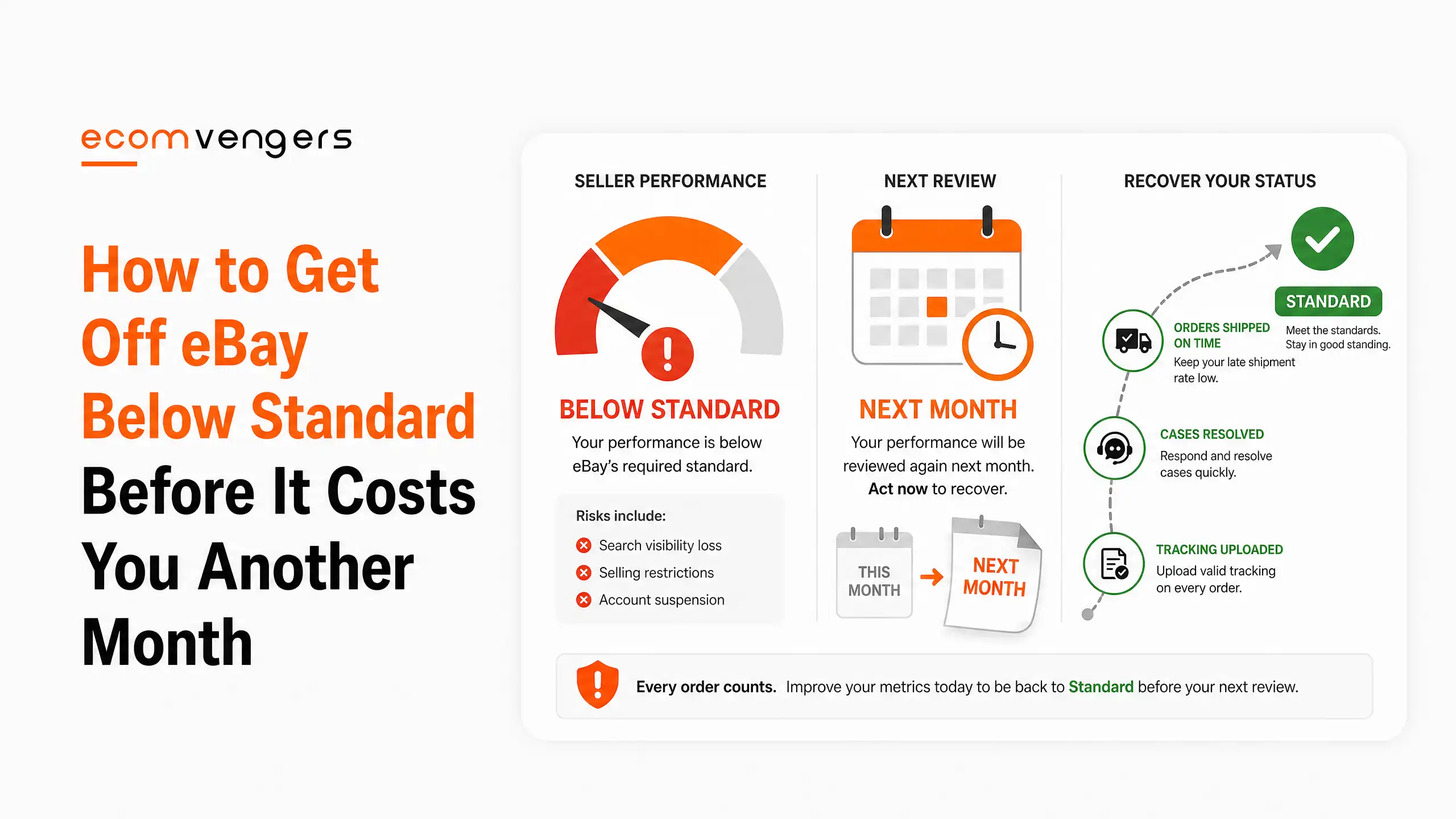
Here is the recovery sequence, and the two habits eBay puts real numbers against.
Key Takeaways
- One case can hit both minimum standards. eBay states a case closed without seller resolution also counts as a transaction defect.
- Only two metrics decide the level. Cases closed without resolution, and the transaction defect rate.
- Cancellations feed the defect rate. eBay names running out of stock as the example.
- Evaluation is the 20th, every month. Nothing you do after it counts until the next one.
- Penalties arrive on two clocks. Some straight after the evaluation, fees from the 1st.
- They lift on the same two clocks. eBay applies the same time frames in reverse.
- Tracking is worth up to 60%. eBay says adding it may cut item not received requests by that much.
- Handling time is worth up to 65%. Sending inside your agreed window may cut them further still.
- There are two dashboards, not one. Seller standards and service metrics report separately.
- Service metrics cannot make you Below Standard. They carry their own consequences instead.
- Below Standard costs you protections too. The damaged return deduction goes with the level.
- A long run reaches your other accounts. eBay may restrict related accounts as well.
What Does eBay Below Standard Actually Mean?
That you failed at least one of two published minimum requirements.
eBay describes the level as performance falling below its minimum standards, with limitations applied to your selling activity until it improves.
The list of requirements is short. No more than 2 cases closed without seller resolution, or 0.3% of transactions, and a transaction defect rate no higher than 2%.
Late delivery is not on that list, which surprises most sellers who arrive here worried about couriers.
Failing one is enough
They are not averaged, and a strong number on one does not rescue the other.
A seller with a spotless defect rate and three unresolved cases is Below Standard. So is a seller with no cases at all and a defect rate of 2.1%.
Work out which one took you down before you spend a month improving the other. Our eBay seller level calculator checks both thresholds against your own volume and names the one that breached.
The Double Hit That Sends Sellers Below Standard
The two metrics are not independent, and eBay flags this itself.
It states plainly that a case closed without seller resolution also counts as a transaction defect, because resolving problems for buyers matters that much to it.
So the arithmetic is worse than the two thresholds suggest. An order you let escalate consumes part of a very small case allowance and part of your defect budget together.
Two or three of those in a quiet quarter is genuinely enough.
We take the case side apart in cases closed without seller resolution, and the defect side in the transaction defect rate.
Key point: resolving a case yourself protects both metrics at once, because a case you settled never becomes a defect either. Speed is worth double here, and that is not a figure of speech.
Which Metric Sent You Below Standard?
Answer this before you change anything, because the two fixes look nothing like each other.
Open the seller standards dashboard and read the two numbers against their limits. One of them will be over.
If it is the case count
Your problem is response speed rather than product quality.
Cases only count where you failed to resolve the issue and eBay found against you. That means the orders went wrong and then sat there, which is a process failure you can fix inside a week.
Check who handles requests, how quickly, and what they are authorised to refund without asking.
If it is the defect rate
Look at cancellations first, because that is the half you control completely.
eBay counts orders you chose to cancel, and running out of stock is the example it gives. A defect rate driven by cancellations is an inventory problem wearing a performance label.
Where cancellations are not the cause, the unresolved cases are feeding it instead, and you are back to the first answer. An eBay Below Standard rating almost always traces to one of those two doors.
If both are over
Treat the cases as the root and the defects as the symptom.
Since every unresolved case also lands as a defect, clearing the case habit pulls both numbers down together. Fixing them separately duplicates the work.
What Below Standard Costs You
Five things immediately, one from the 1st, and more if it persists.
Straight after the evaluation your items may sit lower in Best Match, your selling limits may fall, Promoted Listings closes to you, funds may be held until tracking moves, and the refund deduction on used or damaged returns disappears.
From the 1st day of the following month, higher final value fees.
That split is why the damage feels like it keeps arriving. The visibility hit lands on the 20th and the money lands eleven days later.
The protection you quietly lose
This one rarely appears in the panic, and it compounds everything else.
eBay reserves the used or damaged return protection for sellers who are not Below Standard. So the level that costs you money also removes your defence against the buyers most likely to cost you more.
We set out what goes with it in eBay seller protection.
And if it runs on
An extended stay changes the conversation entirely.
eBay states that where an account has been Below Standard for an extended period it may downgrade the Store to Basic, place selling restrictions on your account and related accounts, or block you from registering a new one.
That is the point where a metrics problem becomes an account problem, and a linked account suspension follows the same sentence.
How Long Does Below Standard Recovery Take?
One evaluation at the very best, and the penalties lift on the clocks that applied them.
eBay evaluates on the 20th of each month. Where your level improves at a future evaluation, it states the same time frames apply for limitations to be removed.
So the search and advertising penalties come off on the 20th, and the fee penalty comes off on the 1st.
Why it usually takes longer than one month
The denominator moves slowly, and that is the real constraint.
Your evaluation period is three months at 400 or more transactions in the previous three, and twelve months below that. A defect sits inside that window until it ages out.
Lower volume sellers therefore carry a bad fortnight for a year, and the only lever that helps is clean transactions arriving underneath it.
Which is awkward, because your listings just fell down search.
Step #1: Stop Producing New Defects and Cases
Nothing else matters until the inflow stops.
eBay is direct about the priority. Where your current or projected level has dropped to Below Standard, it says to focus on minimising cases closed without seller resolution and order cancellations as soon as possible.
Two things, and they map exactly onto the two metrics that decide the level.
Resolve every open request today
Refund, replace, accept the return, whichever ends it.
A request you settle never becomes a case, and never becomes the defect that rides alongside it. On a Below Standard account that is the cheapest work available to you.
Margin is a next quarter problem. The level is this month’s.
Stop cancelling for stock
eBay names this example itself when explaining the defect rate.
An order you cancel because you ran out is a defect you chose. Out of stock control on the listing, honest quantities, and a stock count that matches reality all remove that choice before you have to make it.
Buy the item at a loss and send it, on anything close to the line. It is almost always cheaper than the defect.
Use Time Away instead of cancelling
eBay names this itself, and hardly anyone uses it until the second bad month.
Time Away lets you pause or adjust sales during a break or an unexpected disruption, so buyers are not left waiting for something you cannot send. eBay presents it as the alternative to disappointing them.
A week of no sales costs you a week. A week of cancellations costs you a quarter.
eBay adds one condition worth respecting. Fulfil any orders and answer any buyer requests for items sold before your time away starts.
And require immediate payment
The quietest fix on eBay’s own list.
Setting payment preferences to require immediate payment on Buy It Now and auction listings removes the unpaid order, which is the order you would otherwise end up cancelling.
That is one fewer defect from a setting you change once.
Step #2: Remove the Defects That Already Qualify
Some of what took you down can come back off, and removals apply at the next evaluation.
eBay removes defects automatically where it finds a buyer breached the abusive buyer policy, and where events outside your control caused the problem. Severe weather and carrier disruptions are its own examples.
You can appeal a case closed without seller resolution within 30 days of eBay’s decision, and a defect where the grounds fit.
Work the whole queue before the 20th, because a removal granted on the 22nd waits a full cycle to help you.
The submission itself is where most of this fails, and why most eBay appeals fail covers the reasons.
Step #3: Fix the Two Habits eBay Puts Numbers Against
Most advice on this subject is generic. These two are not, because eBay publishes an effect size for each.
eBay states that adding tracking information may reduce your chances of getting item not received requests by up to 60%. It states that sending the item within the handling time you agreed may decrease them by up to 65%.
Both are eBay’s own figures and both carry an up to, so treat them as direction rather than as a promise.
The direction is still the point. Item not received requests are the raw material for cases, and cases are the raw material for defects.
Fix the top of that chain and the rest drains on its own. The dispatch mechanics sit in fixing an eBay late shipment rate.
eBay’s Own Five Priorities
Worth reading because it is what eBay tells sellers to do first.
- Take the time to improve your listings.
- Streamline your shipping.
- Keep stock levels updated.
- Be ready to handle returns.
- Resolve buyer issues promptly.
Three of those five are about preventing the request. Two are about ending it quickly. Nothing on the list is about arguing.
eBay adds several smaller ones alongside. Charge reasonable postage, set up Time Away rather than disappointing buyers, require immediate payment on Buy It Now and auction listings, pack securely, and keep proofs of authenticity where they apply.
The immediate payment setting is the quiet one. It removes the unpaid order that would otherwise become a cancellation.
Why eBay Gives You Two Performance Dashboards
Sellers check one and assume they have seen everything.
eBay runs a seller standards dashboard and a service metrics dashboard, and they answer different questions. The first decides your level. The second compares you to sellers like you.
Late shipment rate, transaction defect rate and cases closed without resolution all live on the first one.
Item not received and item not as described rates live on the second, and cannot make you Below Standard at all. We cover that separation in eBay service metrics.
Worth knowing: read the projected level rather than the current one. eBay shows what your level would be if it evaluated you today, and that is the only number you can still do anything about.
Aim at Above Standard, Not Top Rated
The urgent target is the middle rung, and sellers routinely reach past it.
Above Standard simply means you are meeting the minimum standards. It has no sales thresholds, no business registration requirement, and no listing conditions attached to it.
Getting there is what restores your fees, your placement, your Promoted Listings access and the damaged return protection.
Everything painful about the situation ends at Above Standard. Nothing waits until Top Rated.
Why the distinction matters this month
Because the two goals pull in different directions when money is tight.
Top Rated asks you to add free returns and same day dispatch, which cost real money on a squeezed account. Above Standard asks you to stop producing unresolved cases and cancellations, which saves money.
Chasing the badge while Below Standard is the wrong order of operations, and an expensive one.
Get back to Above Standard first. Then read what Top Rated actually requires and decide whether the second gate is worth buying.
Can You Appeal an eBay Below Standard Rating?
No, and that is the wrong target anyway.
An eBay Below Standard rating is arithmetic. It is the output of two numbers against two published limits, so there is no judgement in it to contest.
What you can contest is the individual defects and cases underneath it. Remove enough of those and the arithmetic changes on its own at the next evaluation.
eBay states that where a removal means you meet the minimum standards again, your seller level is adjusted at the next evaluation.
So the appeal that works is narrow and transactional. The one that fails describes how hard the month was.
Frequently Asked Questions
How do I get out of Below Standard on eBay?
Bring both minimum standards back inside their limits before an evaluation. eBay tells you to focus on minimising cases closed without seller resolution and order cancellations as the priority.
How long does Below Standard last?
Until an evaluation shows you meeting the standards again, which is one month at the very earliest. The defects behind it stay in your evaluation period for three or twelve months depending on volume.
Does a case closed without resolution really count twice?
It counts on both metrics. eBay states that a case closed without seller resolution also counts as a transaction defect, which is why unresolved orders are the most expensive kind.
Can late deliveries make me Below Standard?
No. Late delivery carries no minimum requirement, so it costs you Top Rated rather than your standing. It still matters, because late parcels generate the requests that do count.
Do service metrics affect my seller level?
No. eBay states your seller performance standards rating is not impacted by your item not as described or item not received rates. They carry separate consequences instead.
Will buyers see that I am Below Standard?
No. eBay shows Top Rated status on a feedback profile and states other members cannot see your seller level otherwise. Buyers will notice the search placement rather than the label.
Can I still use Promoted Listings?
No, and that block lands straight after the evaluation. eBay stops you creating new campaigns and editing existing ones, so you cannot advertise your way out of the visibility drop.
When exactly do the higher fees start?
From the 1st day of the month following the evaluation. That gives you a short window between the 20th and the 1st where the level has dropped but the fee has not yet moved.
Does cancelling one order really matter?
On a low volume account, yes. With a twelve month evaluation period and a 2% ceiling, a single cancellation is a meaningful share of a small denominator.
Should I stop selling until it clears?
No, and stopping actively hurts. Clean transactions are the only thing that dilutes the rate, so selling carefully is the recovery rather than a risk to it.
What if I disagree with a defect?
Appeal it on a named ground rather than on fairness. Removals apply at the next evaluation, so anything granted after the 20th waits a cycle before your level moves.
How many defects does 2% actually allow me?
Multiply the transactions in your evaluation period by 0.02. On 200 transactions that is four defects, and on 1,000 it is twenty.
Low volume accounts therefore have very little room, which is the same trap the twelve month evaluation period creates.
Does Below Standard affect my other eBay accounts?
Only where it runs on. eBay states that an extended period Below Standard may bring selling restrictions on your account and related accounts, or block you from registering a new one.
Can I use Time Away while Below Standard?
Yes, and it beats cancelling. eBay presents Time Away as the way to pause sales during a disruption, provided you fulfil orders placed before it starts.
When should I bring in help?
When you have a queue of appealable defects and an evaluation date inside a fortnight, because the value is in working the batch before the 20th. That is where our account recovery service starts.
Work Backwards From the 20th
Below Standard is a monthly verdict, and the month is the only unit that matters.
First, settle every open request today, because each one you end protects two metrics rather than one.
Second, appeal what qualifies and get it in before the 20th.
Third, add tracking and hold your handling time, which are the two habits eBay puts real numbers against.
Then keep selling. The denominator is the only thing on your side.
Sources
Recoveries we have documented with the eBay messages attached sit in the case study archive. More on seller performance across the rest of the EcomVengers blog.
Four moves, in this order, if you are Below Standard right now.
First, stop producing new defects today. Nothing else you do matters while the numerator is still climbing.
Second, remove what already qualifies. Some defects come off automatically and others need an appeal, and both routes have deadlines attached.
Third, fix the habit behind them. A cleared defect on an unchanged process is a defect you will collect again next month.
Fourth, work backwards from the 20th. Anything cleared in the week before an evaluation buys you a whole month you would otherwise spend paying higher fees.
Worth holding on to: Below Standard is reassessed every month. That is pressure and permission at the same time, because a bad month is not a sentence.
Sources
- eBay, Seller standards policy, for the minimum standards, the monthly evaluation on the 20th and the limitations that follow a Below Standard rating.
- Seller Center, Defect removal, on what eBay clears automatically and what it will consider on appeal.
- Practical steps sit in How to monitor and improve your seller performance.
- Anything already flagged appears in Seller Help.
- Our own figures come from published client cases with the eBay messages attached, collected in our eBay case study library.
Abdul Mannan is the eBay account health expert at EcomVengers. He works on the numbers that decide a seller's standing: transaction defect rate, late shipment rate, cases closed without seller resolution, service metrics, returns and feedback. He writes our guides on keeping an account out of Below Standard and on finding out why sales have dropped.
View all posts by Abdul Mannan