You refunded the buyer within the hour.
On one eBay metric that saves you completely. On another it changes nothing at all.
Both live in Seller Hub. Both get evaluated on the 20th. They work on opposite principles, and almost nobody is told which one they are looking at.
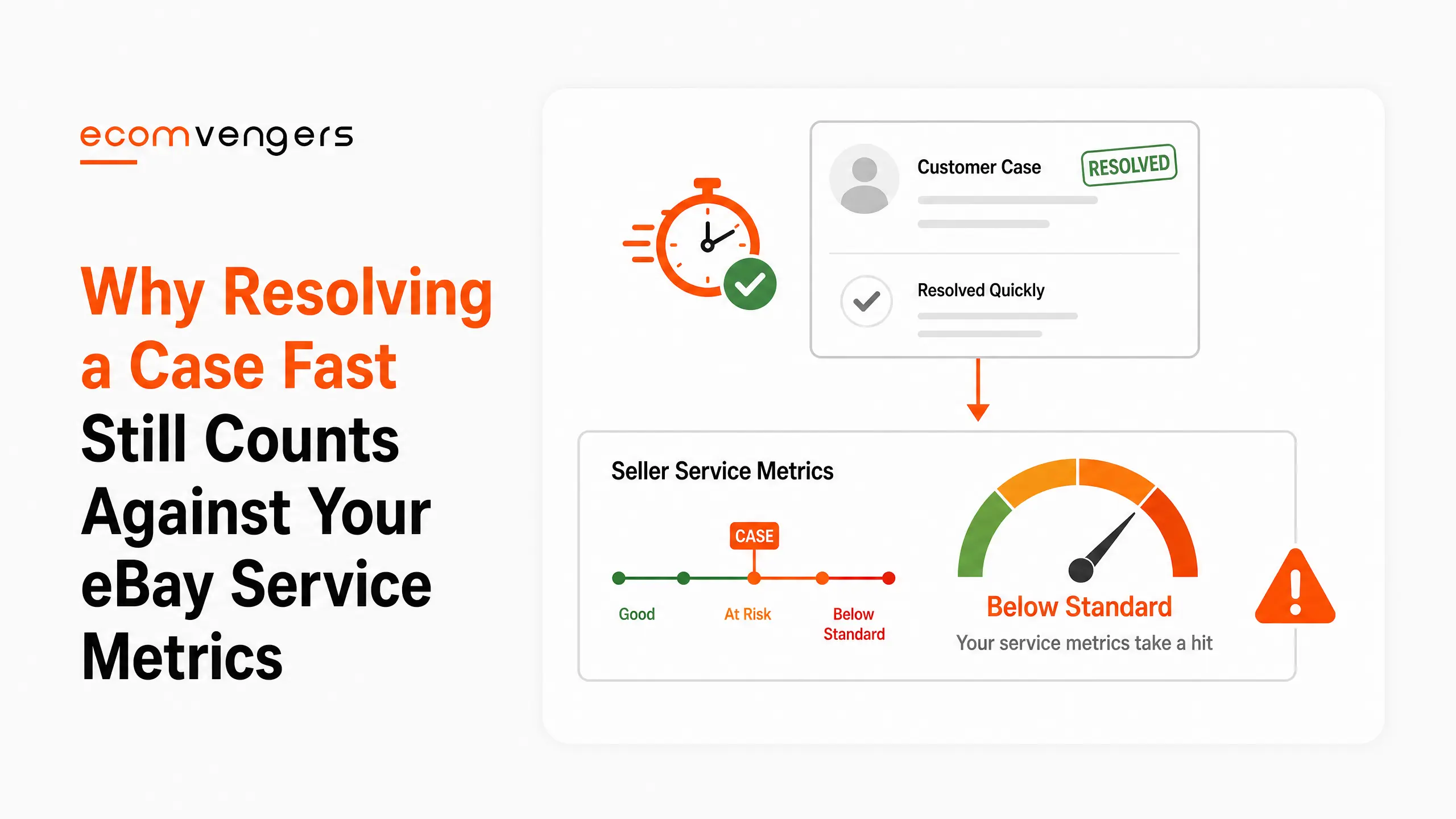
eBay service metrics count every case a buyer opens, resolved or not.
Here is what that actually costs, and the two floors that stop it hurting most sellers.
Key Takeaways
- Resolving a case fast does not help here. eBay counts all opened cases, because the transaction still went badly for the buyer.
- There is no threshold to stay under. eBay sets no limits and grades you against peers instead.
- Two rates are measured. Item not received, and item not as described returns.
- Your peers are narrowly defined. Similar volume, same site, similar price, and similar shipping destinations.
- Four ratings exist. Low, Average, High and Very High.
- Under 1% is always Average. A High or Very High rating below that rate gets adjusted back down.
- Very High needs scale to bite. It cannot affect your account without at least 10 reports from 10 unique buyers.
- Very High item not as described raises your fees. That lands from the 1st of the month after evaluation.
- Very High item not received stretches your delivery dates. eBay may add time to what buyers see.
- It does not touch your seller level. eBay states these rates do not affect your seller performance standards rating.
- The dashboard shows a projection. Seller Hub, Performance tab, Service metrics.
- You may see nothing at all. eBay only calculates these where it has enough data.
What Are eBay Service Metrics?
A separate performance system that measures how often buyers had a problem, rather than how well you fixed it.
eBay describes the purpose plainly. Every month it looks at how many times your buyers reported that they did not receive an item, or requested a return because the item was not as described.
Those two counts become your two service metrics.
Why resolving it quickly does not save you
Because the metric is about the buyer’s experience, not about your response to it.
eBay states it counts all opened cases, because even where you resolved the issue promptly, it indicates that the transaction did not go as smoothly for the buyer as it could have.
Read that against the metric most sellers know. A case closed without seller resolution only counts when you failed to resolve it, so refunding early keeps it off your record entirely.
Here, the same refund keeps the case on the count. Two systems, opposite logic, one dashboard.
How Does eBay Decide What Counts as Bad?
By comparing you to other sellers, because it refuses to set a number.
eBay says many factors influence how many cases a seller gets, naming item type and seasonality, so it does not set limits for these metrics. It takes the average rates from sellers with similar sales activity as a benchmark instead.
That is a genuinely different design. Seller standards give you a fixed line to stay under. Service metrics grade you on a curve.
You can improve every month and still slide, if your peers improved faster.
Who counts as your peers
A narrower group than the phrase suggests.
eBay compares you against sellers who have a comparable volume of transactions on the same evaluation period, who sell on the same eBay site at a similar price, and who ship to the same destinations with similar expected delivery timeframes.
So a cheap high volume seller is not measured against a low volume seller of expensive goods.
That cuts both ways. The comparison is fairer, and it also means you cannot escape it by changing category alone.
The three shipping groups
On item not received, where you post to changes who you are measured against.
- Domestic. The item location and the shipping address sit in the same country.
- International, matured region. Destinations including the United States, Canada, Australia, Japan, New Zealand, Singapore and most European countries.
- International, emerging region. Everything that is neither of the above.
Your rating is calculated per shipping group, which matters when eBay applies consequences. It states that delivery date padding applies to the shipping categories where you are currently evaluated as Very High.
A problem on emerging market post does not automatically punish your domestic sales.
The evaluation period, again
The same volume rule that governs your seller level governs this.
Sellers with 400 or more sales transactions in the previous three months get a three month evaluation period. Everyone below that is measured across twelve months.
Low volume sellers therefore carry a bad month for a year, which is the single harshest feature of the whole system.
The arithmetic is worth seeing once. A seller taking 300 orders across a year gets measured on all 300, so ten not as described returns give a rate of 3.3%. That figure then stays put for twelve months.
A seller taking 400 orders in three months gets measured on those 400 instead. The same ten returns give 2.5%, and the whole thing clears in a quarter.
Volume does not only dilute the rate. It shortens the memory.
What Do the Four eBay Service Metrics Ratings Mean?
They describe your position against peers, not your competence.
| Rating | What eBay says it means |
|---|---|
| Low | You are performing better than most of your peers |
| Average | You are performing as well as your peers |
| High | You are not performing as well as your peers |
| Very High | Your rate is significantly worse than your peers |
Low is the good end. That trips people up every single time, because every other eBay metric reads the other way round.
The Two Floors That Protect Most eBay Sellers
Both are published, and neither is widely known.
Under 1% is always Average
The percentage overrides the peer comparison.
eBay states that where a service metric is High compared to your peers but the rate is under 1%, the rating gets adjusted to Average. It says the same thing again for Very High.
So a seller at 0.8% cannot be marked down for it, no matter how good the peer group is.
Very High needs ten reports and ten buyers
Scale has to be there before anything happens to you.
eBay states that a Very High rating will not affect your account unless it involves at least 10 reports or requests, from 10 unique buyers.
Both halves matter. Ten requests from four buyers does not reach it, and neither does one difficult buyer opening a run of cases.
Key point: a Very High rating on the dashboard is not automatically a Very High rating with consequences. Check the rate against 1% and count the unique buyers before you spend a week redesigning your listings.
Why Two Sellers With the Same Rate Get Different Ratings
Because the number on your dashboard is only half of the calculation.
Picture two sellers, both sitting at an item not as described rate of 2%. One sells phone cases cheaply and in volume. The other sells vintage clothing, where condition is subjective and returns are ordinary.
The phone case seller stands against peers who almost never see that return, so 2% marks them out. Against vintage clothing peers, who see it constantly, the same figure reads as unremarkable.
Same rate. Different rating. Nothing either seller did explains the gap.
What follows from that
Two things, and both run against instinct.
You cannot benchmark yourself against a figure somebody quotes in a forum, because that seller has a different peer group. Improving your own rate also fails to guarantee a better rating, since the comparison moves underneath you.
Your own dashboard projection is the only reliable read.
Worth knowing: because the benchmark moves, your rating can change while your behaviour does not. Track your own rate over time, and treat the rating itself as weather rather than as a score.
Where the 1% floor rescues you
That floor exists precisely because a curve can produce silly outcomes.
A seller in a category with almost no returns could otherwise reach Very High at a rate most people would call excellent. The under 1% adjustment stops that happening.
For a careful seller in a clean category, it is the most useful sentence in the whole policy.
What Happens If Your Service Metrics Are Very High?
Different consequences for each metric, on two different clocks.
Very High item not received
Three things, and eBay applies them straight after the evaluation.
- eBay may add extra time to the expected delivery date buyers see, in the shipping categories where you are Very High.
- Funds from your orders may sit on hold until tracking shows the item is on its way.
- You may lose the ability to deduct from a refund when an item returns used or damaged.
The delivery date padding is the quiet one. A longer estimated arrival makes your listing less attractive than a rival’s, and nothing on the page explains why.
The funds hold behaves like the one we cover in surviving an eBay payout hold.
Very High item not as described
This is the one that costs money directly.
Straight after the evaluation you may lose the deduction on used or damaged returns. Then, from the 1st day of the month following the evaluation, eBay states you may be charged higher final value fees.
eBay points to its fees pages for the figures rather than publishing a rate in the policy, so check yours there rather than trusting a number from a forum.
Note the split. One penalty lands on the 20th, the other on the 1st.
And it can reach the account itself
eBay reserves broader powers for rates above the peer market average.
It states that sellers whose rates are higher than the peer market average may be subject to a range of actions. Ending or removing listings, enforcing buying or selling restrictions, adjusting selling limits, and suspending all relevant accounts.
That is the sentence linking a service metric to a suspension, and it is worth taking literally. Our guide to every eBay restriction type and how each one is lifted covers where that leads.
Consequences lift when the rating improves, and eBay says the removal timeframes mirror the ones that applied them.
Do Service Metrics Affect Your Seller Level?
No, and eBay says so in one flat sentence.
The policy states that your seller performance standards rating is not impacted by your item not as described or item not received evaluation rate.
So a Very High rating cannot make you Below Standard. Only two metrics do that, and we cover both in the transaction defect rate and cases closed without seller resolution.
The reverse is also true. Clean seller standards do not protect you from a service metrics fee.
Sellers arrive at us convinced eBay has made an error, because the dashboard says Above Standard while the fees went up. Both things are correct at once.
Step #1: Check Whether You Have Service Metrics at All
Plenty of sellers have no service metrics at all.
eBay states it only calculates these where it has enough data. Depending on how much you sell, you may not see metrics for all your categories, or you may see no data on the dashboard whatsoever.
Open Seller Hub, go to the Performance tab, and choose Service metrics from the left menu.
The dashboard shows your projected rate for the next evaluation, which is the number worth watching. eBay warns that projection moves if more cases open.
Step #2: Prevent Buyer Requests Rather Than Fixing Them
Since resolution does not remove the count, prevention is the only lever that works.
For item not received
Tracking, honest dispatch times, and services that scan.
A buyer opens an item not received request when the parcel is late enough to worry them. Every day you shave off the gap between the estimated date and the real one removes a reason to open one.
The dispatch habits that drive this are the same ones behind an eBay late shipment rate.
For item not as described
The gap between your listing and the object in the box.
Photograph the actual item rather than a catalogue image. Name the flaw in the description instead of hoping nobody notices. Fill in the item specifics that describe size, colour and compatibility.
Most of these returns are description problems wearing a quality complaint, and better eBay listings close the gap directly.
Then look at what you sell
Some stock generates returns whatever you do.
Because the comparison is against peers selling similar items at similar prices, a line that returns twice as often as everything else you stock is dragging the whole account. Work out which SKUs produce your requests before you change anything else.
Sometimes the answer is to stop selling it.
What Protections Apply to eBay Service Metrics?
eBay frames the whole system around context rather than around individual transactions.
It states that service metrics look at your performance in context, and it accepts that some item types see more returns than others. It also accepts that international deliveries usually take longer than domestic ones.
Peer benchmarking is how eBay says it finds statistical outliers, rather than ordinary sellers having a difficult month.
Two further policies sit behind this
eBay names both, and it is worth knowing they exist.
A service standard policy governs what eBay calls the bad buyer experience rate. It absorbed an earlier shipping performance policy in August 2025, and that older policy is now retired.
It sits apart from the service metrics page and carries its own actions. Note the scope though, because eBay evaluates it only for sellers registered in certain regions rather than worldwide.
When to raise it with eBay
Where the count looks wrong, rather than where the rating feels harsh.
A request logged against the wrong order, or a case counted twice, is a factual error worth reporting. A rating you simply dislike is not, and arguing it burns the goodwill you may need later.
The failure modes in why most eBay appeals fail apply here exactly as they do elsewhere.
Seller Standards Versus Service Metrics
Two systems, one dashboard, and almost every rule differs.
| Seller standards | Service metrics | |
|---|---|---|
| Does a fast refund help? | Yes, it prevents the mark | No, all opened cases count |
| Is there a fixed threshold? | Yes, 2% and 2 cases | No, you are compared to peers |
| What is measured? | Defects and unresolved cases | Item not received and item not as described |
| Can it make you Below Standard? | Yes | No |
| Can it raise your fees? | Yes | Yes |
| Is good a high number or low? | Low rate is good | Low rating is good |
Only the last row agrees, and even then the word Low means something different on each side.
Frequently Asked Questions
What are eBay service metrics?
A monthly measure of how often buyers reported an item as not received, or returned one as not as described. eBay compares your rates against sellers with similar sales activity rather than against a fixed limit.
Does refunding quickly improve my service metrics?
No. eBay counts all opened cases, on the basis that the transaction still did not go smoothly for the buyer. Speed protects your seller level, not this.
Is Low good or bad on service metrics?
Low is the best rating available. It means you are performing better than most of your peers, which reads backwards against every other eBay metric.
Why is my rating High when my rate looks tiny?
Because it is a comparison, not a threshold. If your rate sits under 1% though, eBay adjusts a High or Very High rating back to Average.
Can a Very High rating suspend my account?
eBay states that sellers whose rates exceed the peer market average may face actions including restrictions, reduced selling limits and suspension of all relevant accounts. It is not the usual outcome, but the policy reserves it.
Why can I not see any service metrics?
eBay only calculates them where it has enough data. Lower volume sellers often see metrics for some categories only, or nothing at all.
Does one bad buyer wreck my service metrics?
Not on their own, because a Very High rating cannot affect your account without at least 10 reports from 10 unique buyers. Both conditions have to be met together.
How long does a bad month stay with me?
For the length of your evaluation period. That is three months at 400 or more transactions in the previous three, and twelve months below that.
Do international sales get judged separately?
On item not received, yes. eBay groups shipments as domestic, international matured region and international emerging region, and rates you within each.
Will my fees go back down?
Yes, once the rating improves. eBay states consequences stop applying when your rating recovers, on the same timeframes that imposed them.
Can I appeal a service metrics rating?
The policy sets out fair evaluation and seller protections alongside appeals, so raise anything you believe eBay counted wrongly. There is no equivalent of the 30 day case appeal window here.
When should I get help with this?
When the fee increase has landed and you cannot identify which stock is producing the requests. Working out that pattern is where our account recovery service starts on a metrics problem.
Prevent, Because You Cannot Repair
Everything else on your dashboard rewards a fast fix. This one does not, and that single difference explains most of the confusion around it.
First, check whether you are even rated, and read the projection rather than the current figure.
Second, check your rate against 1% and count the unique buyers, because both floors may already protect you.
Third, find the listings producing the requests and fix the description or the postage.
You cannot refund your way out of this one. You can only stop the case being opened in the first place, and that work happens in the listing rather than in the message thread.
Sources
More on seller performance across the rest of the EcomVengers blog, including the removals we have won on documented accounts.
Three checks, in this order, when a service metric turns amber.
First, separate the two evaluations in your head. Your seller level and your service metrics are scored differently and on different comparisons, so a warning on one says nothing about the other.
Second, find the peer group before the fix. You are being measured against sellers with a similar profile, which means the target moves even when your own numbers hold still.
Third, work the cause rather than the rate. A rate is a summary, and summaries do not tell you which listings or which couriers produced them.
Worth holding on to: service metrics count problems buyers reported, whether or not you resolved them. Speed protects the buyer relationship, and it does not protect the number.
Sources
- eBay, Service metrics policy, on the peer benchmarking evaluation, the item not received and not as described rates, and the limitations eBay may apply.
- A plainer summary sits in Service metrics and peer benchmarking.
- The seller standards policy, for the separate seller level evaluation this is often confused with.
- Our own figures come from published client cases with the eBay messages attached, collected in our eBay case study library.

Ali Khan is the founder of EcomVengers, the eBay growth and account recovery agency. He has spent the better part of a decade pulling suspended sellers back from MC011 and MC999 notices, repairing wrecked defect rates, and turning buried listings into ranked ones. When eBay's villains show up, he is the one sellers call. You handle the millions, he handles the villains.
View all posts by Ali Khan