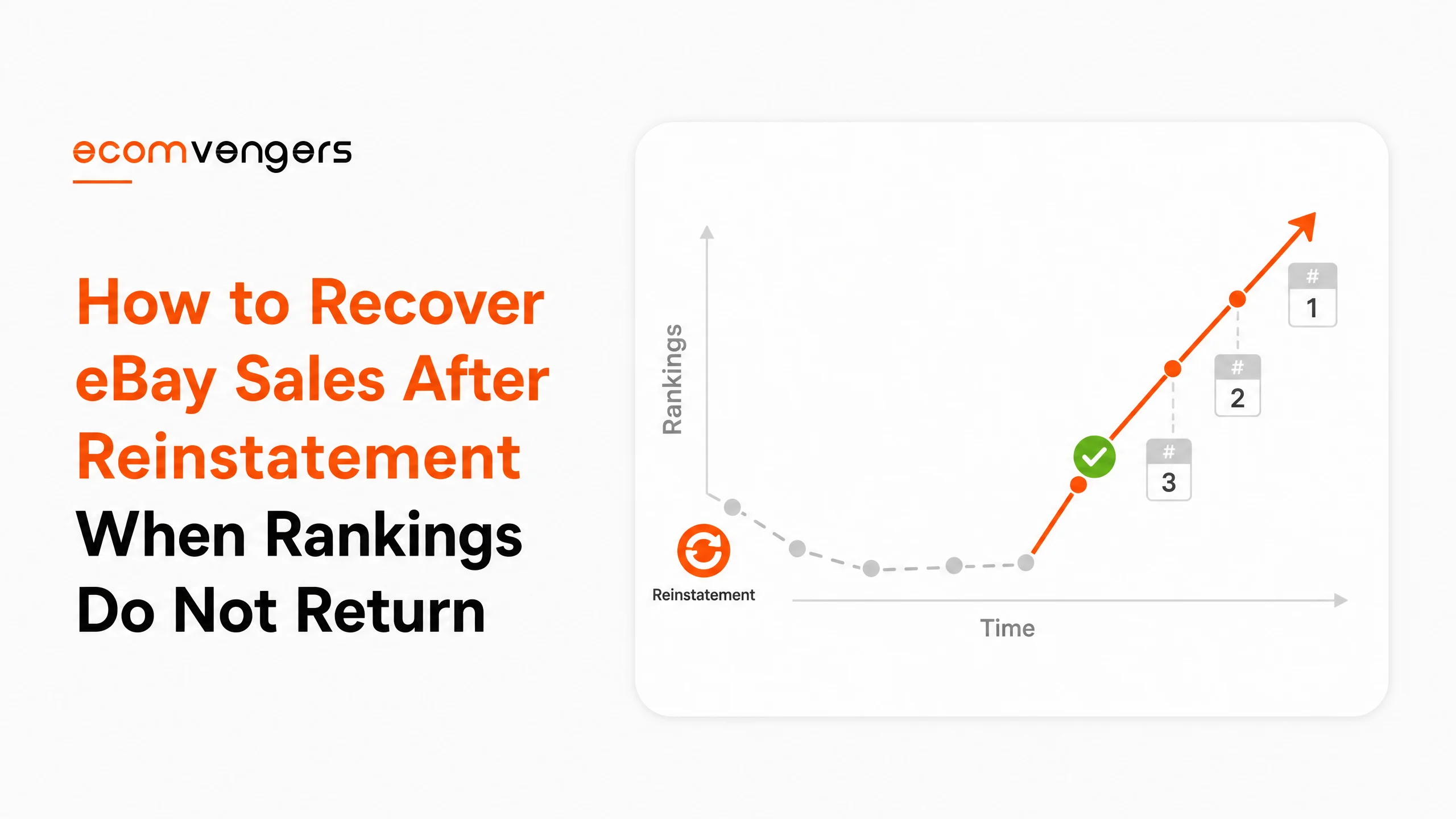
Reinstatement gives you back the right to sell.
It does not give you back your place in search.
Those are two different things, and only one of them arrived in the email.
Our second call from a seller, a few weeks after a reinstatement, is nearly always the same. The account is back. The listings are live. There are no sales. They all describe it the same way: eBay sales dropped after suspension and never came back.
That is not bad luck, and it is not eBay punishing you twice.
Three signals decide it.
Key Takeaways
- Reinstatement restores permission, not placement. Recovering sales after reinstatement is a separate job from getting the account back.
- Below Standard penalties land in stages, and they lift in stages too. eBay states the same time frames apply when limitations come off as when they went on.
- Best Match placement is one of the penalties. eBay states items may be placed lower in Best Match search results directly after a Below Standard evaluation.
- Below Standard blocks Promoted Listings entirely. Below Standard sellers cannot create new campaigns or edit existing ones, so paid recovery is closed off too.
- Evaluation happens on the 20th. A restriction cleared on the 3rd may not show improvement in placement until the following cycle.
- Ended listings lose their accumulated history. Relisting creates a new item with none of the watchers, views or sales signals of the original.
- Impressions and conversion are separate problems. One account we grew was failing on both at once, and fixing either alone would have moved nothing.
- Eligibility comes before ranking. Item specifics and category placement decide which searches a listing can appear in at all.
- Ads amplify a working listing, they do not repair a broken one. On one account we manage, organic traffic converted at 0.1% while promoted traffic converted at 12.1%.
- Paid recovery creates a dependency you have to plan out of. Another account we manage takes 98.1% of revenue through Promoted Listings.
- Higher fees can arrive a month later. eBay may charge Below Standard accounts higher final value fees from the 1st of the following month.
- Sustained Below Standard reaches related accounts. eBay may restrict your other accounts and block you from registering a new one.
What Does an Account Actually Get Back After Reinstatement?
Your ability to list, sell and take payment. That is the whole list.
It does not restore your seller level, your Best Match position, your listing history or the momentum those things were built on. Cassini, the engine behind Best Match, reads those signals to decide search placement.
Those recover separately, on eBay’s schedule rather than yours.
The gap nobody warns you about
The message you get after reinstatement reads like a conclusion. It is closer to a starting gun.
Sellers read “your selling privileges have been restored” and reasonably expect trading to resume where it stopped. Then the first week produces a fraction of the orders, and the natural conclusion is that eBay is still holding something back.
Usually it is not. The account is fine. The signals that used to earn placement are not.
If you are still working out which restriction you had in the first place, our guide to every eBay restriction type and how each one is lifted covers the diagnosis.
Key point: eBay states that when a seller level improves at a future evaluation, “the same time frames will apply for limitations to be removed”. Penalties that landed in stages come off in stages. Nothing about that is negotiable, and nothing about it is personal.
Why Do Your Listings Rank Lower After Reinstatement?
Because a restriction damages the inputs Best Match reads, and reinstatement does not reset them.
eBay is explicit about what a Below Standard evaluation does. Directly after it, “your items may be placed lower in Best Match search results”, selling limits may decrease, and funds may be held until tracking shows the item is on its way.
All of that is quoted from the eBay seller standards policy.
The penalty you cannot buy your way out of
Below Standard also blocks Promoted Listings outright.
eBay states you will be “blocked from using Promoted Listings, and won’t be able to create new campaigns or edit existing campaigns”. So the obvious lever for restarting sales after reinstatement is unavailable to exactly the sellers who need it most.
That is worth knowing before you build a recovery plan around ad spend.
And a cost that arrives late
Higher final value fees do not land with the other penalties.
eBay applies them from the 1st day of the month following the evaluation, which means a seller can be trading again, feeling recovered, and then absorb a fee increase they had stopped expecting. Our eBay fee calculator will show you what that does to a month.
Model that before you reprice anything.
Signal One: Are Your eBay Listings Still Eligible?
After reinstatement, ranking is the second question. Eligibility is the first.
A listing only competes in searches it qualifies for, and qualification is decided by category placement and item specifics rather than by how good the listing is.
A listing missing a required field is not ranked low. It is filtered out.
What a restriction does to eligibility
Ending and recreating listings is where the damage happens.
eBay may end listings early during a restriction. Sellers then rebuild them in a hurry, often through bulk tools, and fields that were populated on the original are blank on the replacement.
The listing looks identical to you. It is invisible to half the filters a buyer uses.
What to check first
Take your ten highest value listings and compare them against the category’s required and recommended fields.
Brand, model, size, colour, condition and product identifiers do most of the work. The craft side of this is a subject on its own, and our eBay listing optimization guide covers the fifteen changes that actually move placement.
This article assumes the listings were fine before. The question here is what changed.
Signal Two: What Did Your Seller Level Do While You Were Restricted?
After reinstatement, check the dashboard before you touch a single listing.
A restriction does not create defects by itself, but the weeks around one usually do. Cancellations because stock moved, cases because buyers waited, late despatches because payouts were frozen.
Those land on the metric that feeds placement.
Why the timing feels arbitrary
eBay evaluates on the 20th of each month, so the damage and the consequence are separated by weeks.
A restriction in early March can produce a Below Standard evaluation on 20 March, penalties from that date, and a fee increase from 1 April. By the time a seller is trading normally again the account is absorbing consequences from a problem they consider closed.
Recovery runs on the same calendar, which is the genuinely useful part. Improve the metrics and the limitations come off at a future evaluation on the same time frames.
Clean the metric, not the symptom
Some of what landed during the restriction can come back off.
eBay removes defects on defined grounds, and late despatch flags on tracking evidence. Working through those before the next evaluation is worth more than any listing change you could make in the same hours.
Our guide to transaction defect rate removal sets out what qualifies, and one Australian account we manage now reports 0.00% across defect rate, late despatch and cases closed without resolution after exactly that exercise.
Worth knowing: if you are Below Standard, removals matter twice. They lift the metric, and lifting the metric is what unblocks Promoted Listings and Best Match placement together. One exercise, three consequences.
Signal Three: How Much Momentum Did Your Listings Lose?
More than sellers expect, and momentum is the hardest of the three to rebuild after reinstatement.
Recent sales, watchers, views and click behaviour all accumulate against a listing. A restriction stops that accumulation, and ending the listing discards what had accrued.
A relisted item is a new item. It starts from nothing.
Revive rather than recreate
Where a listing still exists, revise it back into shape instead of ending it and starting again. Revising keeps the sales velocity the listing already earned.
Out of stock control does the same job for items you cannot fulfil yet, keeping the listing and its history intact rather than throwing both away for the sake of a tidy account.
Tidiness is expensive here.
What rebuilding momentum actually looks like
Slowly at first, then all at once, and only if every metric moves together.
On one eBay AU account we grew over 90 days, impressions, listing views, units sold, click-through rate and conversion all rose in the same window. That pattern is the tell that placement is genuinely returning rather than being bought.
One metric moving alone is usually spend, not recovery.
Structural recovery moves every metric, not just one
Percentage change across 90 days on an eBay AU account we grew, measured against the prior 90 days in Seller Hub.
Figures from the eBay AU visibility growth case study. This was a growth engagement, not a reinstatement.
What Does a Rebuilt eBay Sales Funnel Look Like?
It narrows hard, and the narrowing is where the money is.
The account above finished the period on 829,607 impressions, 4,020 listing views and 109 units sold. Those three numbers describe two entirely separate problems.
Impressions to views is a listing problem. Views to sales is an offer problem.
Read the two rates separately
A low click-through rate means buyers are seeing the listing and choosing something else, which is a title, photo or price problem.
A low conversion rate means they clicked and then left, which is postage, returns, condition detail or trust. Sell-through rate is the blunt version of the same question, and it is the one Best Match cares about.
Recovering eBay sales after reinstatement means knowing which of those two you are fixing, because the work is completely different and doing both at once tells you nothing about what worked.
The full breakdown, including every comparison eBay reports, sits on the eBay AU visibility growth case study.
Where the views came from, and why that is not where the sales came from
The 4,020 listing views on the same eBay AU account, split by source.
Source split from the eBay AU visibility growth case study. Areas are proportional and sum to the stated total.
Should You Use Promoted Listings to Restart?
Yes, if you can, and with a plan for turning the dependency back down.
Ads are the fastest way to put a recovered account back in front of buyers, because they buy visibility that organic placement has not yet re-earned.
They are also the easiest way to hide the fact that it never came back.
What ad dependency looks like on a real account
One eBay Canada store we manage took C$1,991.69 across 31 days, up 166.0% on the prior month.
Promoted Listings produced C$1,954.67 of that, which is 98.1% of everything sold. Organic contributed C$37.02.
The growth rate is real. So is the concentration behind it, and both belong in the same sentence.
Growth and risk can be the same number
Revenue by source across 31 days on an eBay Canada account we manage.
Figures from the eBay Canada sales growth case study. Totals are read directly from Seller Hub.
Why that matters more after a restriction
An account with no organic floor has no shock absorber.
If a second restriction lands, or the account drops to Below Standard, Promoted Listings is blocked outright and revenue does not fall, it stops. A store carrying 98.1% of sales on ads has almost nothing underneath.
That is why rebuilding organic after reinstatement is the next job rather than a finished one, even when the ads are working.
Spend where the traffic already converts
Budget follows evidence, not hope. Set the ad rate per listing rather than across the catalogue, and check each one against the ad rate your margin supports before you raise it.
On the Australian account, promoted traffic converted at 12.1% while organic traffic converted at 0.1%, so 106 of the 109 units sold arrived through Promoted Listings. Concentrating spend on listings that already close is what made that work.
Spreading budget evenly across a catalogue after a restriction is how sellers turn a visibility problem into a margin problem. If the campaign structure is the part you are unsure about, that is what our Promoted Listings management exists for.
What Should You Do in the First 30 Days After Reinstatement?
Work in this order, because each step changes what the next one should be.
- Read the seller dashboard before anything else. Your level, your defect rate and your next evaluation date set the ceiling on everything that follows.
- Appeal what qualifies for removal. Defects and late despatch flags with evidence behind them are worth more than a week of listing edits.
- Audit eligibility on your top listings. Compare required and recommended fields against what actually survived the restriction.
- Revive rather than relist. Edit surviving listings back into shape and keep their history instead of starting new items.
- Fix despatch before you chase volume. A second wave of late flags during recovery is what turns a bad month into a bad quarter.
- Restart ads narrowly, if you are allowed to. A small number of proven listings, not the whole catalogue.
- Separate your two rates weekly. Track click-through and conversion apart, so you know which problem you are actually solving.
- Diary the 20th. That is when the next evaluation decides whether the limitations start coming off.
Nothing in that list is dramatic. All of it compounds.
Do the arithmetic once: if your restriction cleared on the 3rd, the next evaluation is the 20th and any fee change lands on the 1st. That is up to four weeks of trading under the old penalties while doing everything right. Plan cash flow for the calendar, not for the reinstatement date.
How Long Should Recovery Take After Reinstatement?
Think in evaluation cycles rather than days, because that is the unit recovery after reinstatement actually runs on.
Placement penalties come off when your level improves at an evaluation, and evaluations are monthly. That makes the realistic unit of recovery one month, not one week.
Sellers who expect a week give up in the second one.
What progress looks like before revenue moves
After reinstatement, impressions move first, then views, then orders.
If impressions are climbing and sales are flat, the recovery is working and the listings are the bottleneck. If nothing is climbing, eligibility or seller level is still holding you down.
Either way you have an answer, which is more than a revenue figure gives you.
Here is how to read the pattern after reinstatement.
| What you see | Where the problem is | What to work on |
|---|---|---|
| Impressions still flat | Eligibility or seller level | Item specifics first, then the dashboard |
| Impressions up, views flat | Buyers see it and scroll past | Title, lead photo, price |
| Views up, sales flat | They clicked, then left | Postage, returns, condition detail |
| Everything up together | Placement is genuinely returning | Nothing. Keep going |
If the numbers behind the account are the real question, our eBay ROI calculator will tell you what a flat month actually costs while you wait for the next evaluation.
When Does Each eBay Penalty Lift?
On three different schedules, which is why recovery feels uneven.
| Penalty | When it lands | When it lifts |
|---|---|---|
| Lower Best Match placement | Directly after the evaluation | At a future evaluation, once your level improves |
| Promoted Listings blocked | Directly after the evaluation | At a future evaluation, on the same time frame |
| Selling limits reduced | Directly after the evaluation | At a future evaluation, on the same time frame |
| Funds held until tracking shows despatch | Directly after the evaluation | At a future evaluation, on the same time frame |
| Higher final value fees | 1st of the month following | 1st of a month following an improved evaluation |
| Store downgraded, related accounts restricted | After sustained Below Standard | Not automatic, and much harder to reverse |
Every row above is drawn from the eBay seller standards policy, which states that when a level improves, “the same time frames will apply for limitations to be removed”.
Read the last row twice. Sustained Below Standard is the one that stops being a schedule and starts being a decision.
Frequently Asked Questions
How long do sales take to recover after reinstatement?
Plan in evaluation cycles rather than days, because the placement penalties lift when your seller level improves at a monthly evaluation rather than when the restriction closes. That makes a month the realistic unit, and sellers expecting a week usually abandon a recovery that was working.
Does eBay permanently lower your ranking after a suspension?
No. eBay describes the Best Match penalty as a limitation tied to Below Standard status, and states the same time frames apply for limitations to be removed once your level improves. What can persist is the lost listing history, which is a consequence of ending listings rather than a penalty eBay applies.
Should I relist everything after reinstatement?
No, and this is the most common self-inflicted wound in the whole recovery. Editing a surviving listing keeps its watchers, views and sales history, while ending and recreating it produces a brand new item that starts from zero.
Why are my impressions still low when my account is fine?
Either the listings are not eligible for the searches you expect, or your seller level is still carrying a placement penalty. Losing Top Rated costs you the badge and the placement benefit that came with it. Check item specifics first because that is free and immediate, then check the dashboard, because those two answers lead to completely different work.
Can I use Promoted Listings while Below Standard?
No. eBay states that Below Standard sellers are blocked from using Promoted Listings and cannot create new campaigns or edit existing ones, which removes the paid recovery route from the sellers who most want it. Getting the level back up is therefore the prerequisite, not an alternative.
Do defects removed after the fact restore my placement?
They improve the metric that decides your level, and the level is what carries the placement penalty, so the effect is real but indirect. Removals apply at the next evaluation rather than immediately, which is why the timing of an appeal matters as much as its content.
Is it worth dropping prices to restart sales?
Only if your problem is conversion rather than visibility, and most post-restriction accounts have the opposite problem. Cutting price on a listing nobody is seeing lowers your margin without changing your traffic, so read the two rates before you touch the price.
Will a new account rank better than my recovered one?
Almost certainly not, and registering one can end both. eBay states it may restrict related accounts and block you from registering a new account where Below Standard status has been sustained, so the shortcut carries the highest downside of anything on this page.
How do I know whether recovery is working?
Watch impressions, listing views and units sold moving together rather than watching revenue alone. On the eBay AU account we grew, every headline metric rose in the same window, and that simultaneous movement is what separates structural recovery from bought traffic.
What if my payouts are still on hold after reinstatement?
That is normal and usually separate from the restriction itself, since eBay may hold funds until tracking shows an item is on its way to the buyer. The hold shortens as delivery confirmations accumulate, which we walk through in our guide to clearing an eBay account verification hold.
Does this apply after an MC011 or MC999 restriction too?
Yes, because the recovery mechanics depend on what happened to your metrics rather than which notice code you received. The notices themselves behave differently, which we cover separately in the MC011 recovery guide and the MC999 suspension guide.
When should I bring in help?
When two evaluations have passed without the limitations lifting, because at that point something structural is holding the level down rather than the recovery simply being slow. Our eBay SEO service handles the visibility rebuild, and suspension removal handles the account side when the restriction itself is still live.
Rebuild the Signals, Not the Storefront
The instinct after reinstatement is to change everything. Change the smallest number of things that move a measured signal.
First, open the seller dashboard and write down your level, your three rates and the date of the next evaluation. That date is the one your recovery actually runs on.
Second, appeal every defect and late despatch flag that has evidence behind it, before that evaluation rather than after it.
Third, audit eligibility on your best listings and edit them back into shape instead of relisting them.
Then wait for the 20th, and judge the month on impressions rather than on revenue.
Sources
- Seller standards policy, eBay Help
- Account restrictions and suspensions, eBay Help
- Selling limits, eBay Help
Every account figure on this page comes from Seller Hub screenshots in the case study archive. More on account health and visibility across the rest of the EcomVengers blog.
Three checks, in this order, before you decide the recovery has stalled.
First, confirm your listings are actually eligible again. A reinstated account can still hold listings that never came back, and no amount of promotion fixes a listing search cannot see.
Second, read your seller level rather than your sales. The level moved while you were restricted, and it is the thing deciding placement now.
Third, give it a full evaluation cycle before judging any of it. Recovery is measured on the 20th, not on the day you feel impatient.
Worth holding on to meanwhile: reinstatement returns your access, not your position. Those are two different things, and only one of them arrives by email.

Ali Khan is the founder of EcomVengers, the eBay growth and account recovery agency. He has spent the better part of a decade pulling suspended sellers back from MC011 and MC999 notices, repairing wrecked defect rates, and turning buried listings into ranked ones. When eBay's villains show up, he is the one sellers call. You handle the millions, he handles the villains.
View all posts by Ali Khan