The dropdown decides it.
Not the circumstances, not what you told the buyer, and not how reasonable you were being. The reason you select when you cancel is what determines whether a transaction defect lands on your account.
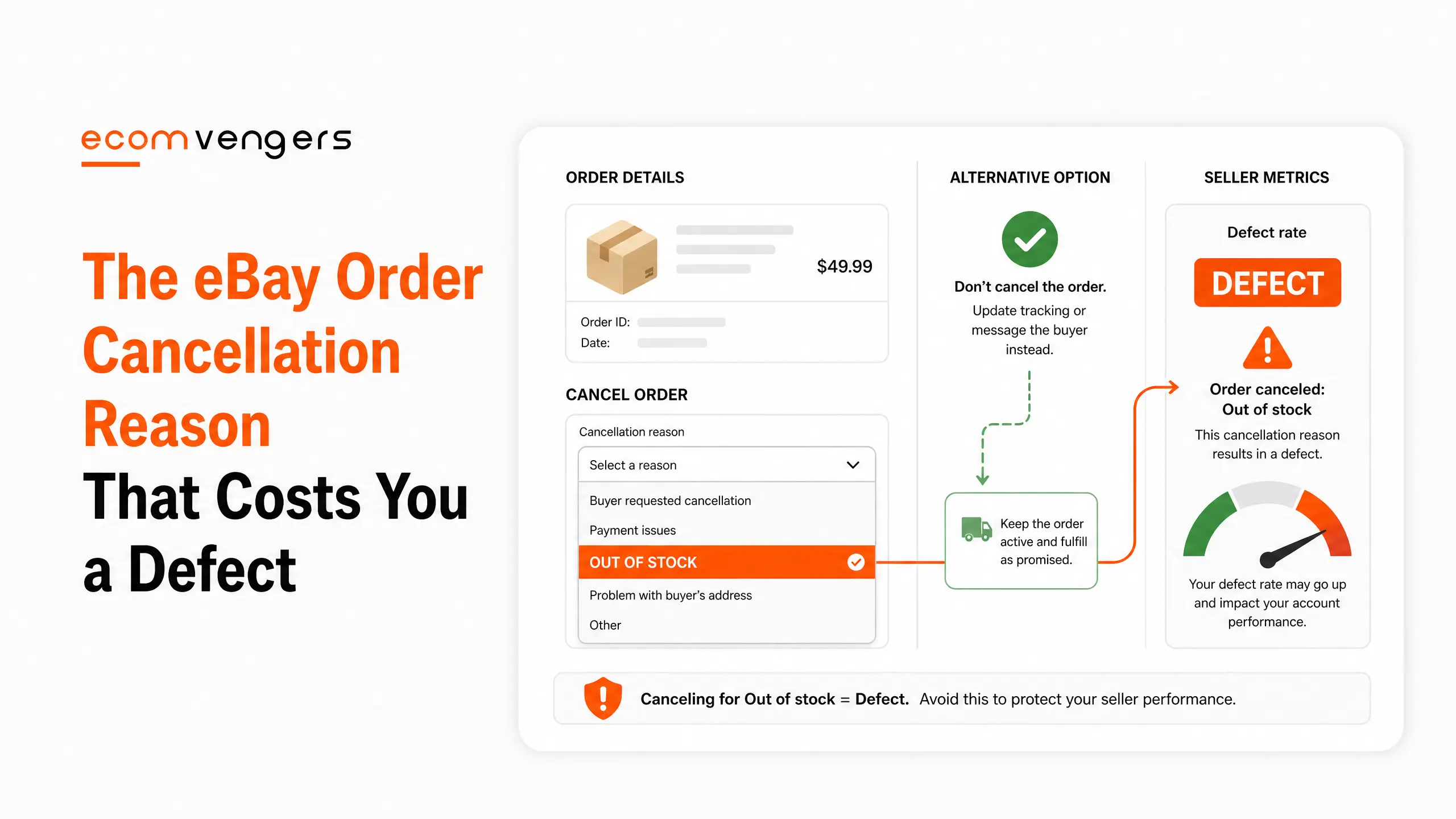
Out of stock costs you one. eBay says so on the same screen.
Which is exactly why the temptation to pick a different reason is so strong, and why eBay treats that as a policy violation rather than a fib.
Here is which reasons are safe, and the four clocks that govern the whole process.
Key Takeaways
- Out of stock is the one that costs you. eBay states it results in a transaction defect and affects your seller level.
- A buyer request does not. Accepting one is the cleanest cancellation available.
- Feedback goes either way. eBay removes related negative or neutral feedback whether you accept or decline.
- You get the whole fee back. Approving a buyer request refunds the entire final value fee, per order portion included.
- Buyers have 60 minutes to request. After that they have to ask you directly.
- You have 3 calendar days to respond. What happens if you do not depends on whether they paid.
- Unpaid unlocks at 4 calendar days. The buyer has not paid reason appears only then.
- You can cancel for 30 days. Even after the buyer has paid.
- Two situations lock you out. An item not received report, or an open return request.
- Multi item orders cancel whole. You cannot cancel one line from a combined order.
- A false reason is a policy breach. eBay lists suspension among the possible consequences.
- Cancellations cannot be undone. eBay states this plainly.
Which Cancellation Reasons Cost You a Defect?
One of the four, and eBay flags it in the policy itself.
eBay lists the situations where a seller can cancel. The buyer asked and you have not posted yet, the buyer has not paid in time, the buyer used the wrong delivery address, or the item is out of stock.
Only the last one carries a warning, and eBay puts it in brackets on the same line. It results in a transaction defect and affects your performance and seller level.
That is the whole rule. The other three are administrative, and the fourth is a mark on your account.
Why the defect is fair, even when it feels harsh
Because it is the only one of the four you caused.
A buyer changing their mind is the buyer’s doing. A wrong address is the buyer’s doing. Non payment is the buyer’s doing. Running out of stock is inventory you were responsible for.
eBay frames the whole policy the same way, stating that sellers are obligated to complete the sale when a buyer makes a purchase.
The defect rate that absorbs it is covered in the transaction defect rate.
Why You Must Never Pick a False Cancellation Reason
eBay anticipated this, and named it directly in the policy.
Sellers are not allowed to abuse the order cancellation process. eBay says a seller should never cancel an order and select an incorrect cancellation reason, and calls out falsely claiming that the buyer failed to pay.
That specific example exists because it is the specific thing sellers do.
What it can cost
Considerably more than the defect you were avoiding.
- Cancelling your listings, or hiding and demoting all of them in search results.
- Blocking some or all of your messages to other members.
- Lowering your seller rating.
- Buying or selling restrictions, and account suspension.
- Applying fees, and recovering the cost of monitoring and enforcement.
eBay adds that fees paid or payable on listings or accounts it takes action against are not refunded or credited.
Trading one defect for that list is a poor exchange, and it is also a pattern eBay can see across months rather than in a single order.
Key point: take the defect and fix the stock control. One defect ages out of your evaluation period. A history of false cancellation reasons is the kind of thing that turns up in a suspension review later.
When Can You Cancel an eBay Order, and When Can You Not?
Two situations shut the door completely.
eBay states a seller cannot cancel where the buyer has reported that the item has not arrived, or where the buyer has opened a return request.
Both make sense once you see them. A cancellation at that point would close a case the buyer opened, which is not a cancellation at all.
So the moment a request exists, you are in the returns process rather than the cancellation one. That process is covered in eBay seller protection.
Multi item orders cancel as one
There is no partial option, and it catches sellers combining postage.
Where a buyer purchases more than one item, eBay cancels the entire order. Sellers cannot cancel individual items bought as part of the same order.
So one out of stock line takes the whole basket with it, which turns a small inventory error into a much larger refund.
Check the rest of the order before you cancel anything.
The Four Clocks That Govern an eBay Cancellation
Cancellation is governed almost entirely by timing, and each window belongs to a different party.
Sixty minutes for the buyer
Shorter than most sellers realise.
A buyer can request a cancellation up to 60 minutes from the moment they committed to buy. eBay counts that from paying on a Buy It Now, committing to buy, winning an auction, or either side accepting an offer.
Past that hour the formal route closes and they have to message you instead. eBay says so explicitly, and encourages you to accept anyway while the item is unposted.
Three calendar days for you
And the consequence of silence depends entirely on whether money changed hands.
Where the buyer has paid and you do not respond, eBay closes the request and the order is not cancelled. You still owe them the item.
Where the buyer has not paid and you do not respond, eBay automatically accepts the cancellation instead.
That asymmetry is worth committing to memory. Ignoring a paid buyer creates an obligation, and ignoring an unpaid one resolves itself.
Four days before unpaid unlocks
The reason code does not exist until the wait is over.
eBay states the buyer has not paid reason becomes available after 4 full calendar days, and that buyers should pay within that window or the seller can choose to cancel.
So there is no way to cancel an unpaid order early, and no reason to try. Waiting the four days gets you the clean reason code.
Thirty days for everything
The outer limit, and it applies even after payment.
You can cancel an order up to 30 calendar days after the sale, whether or not the buyer has paid. A cancellation started but not resolved inside 30 days gets closed automatically.
Once it is done it is done. eBay states that a cancelled order cannot be undone.
What If You Already Posted the eBay Order?
The request arrives an hour after the parcel leaves, which is how these things go.
eBay conditions its encouragement carefully. It asks sellers to accept a buyer’s cancellation request as long as they have not yet shipped the item.
Once it has gone, that condition no longer holds, and accepting leaves a parcel travelling towards a buyer with no order behind it.
The practical route
Tell the buyer it has been posted, decline the request, and offer a return on arrival.
Declining still removes any related negative or neutral feedback, because eBay applies that either way. So you keep the protection and hand the buyer a route that actually works.
A return you accept willingly rarely becomes a case, and a case is the expensive outcome.
This is judgement rather than policy, and it is the sequence that produces fewest marks on the accounts we manage.
Answer either way, and answer fast
Silence is the only genuinely bad option here.
A paid buyer whose request you ignore keeps the order and loses three days of goodwill, and that is the buyer who opens an item not received request next.
Declining with an explanation costs you nothing and buys you the rest of the transaction.
What Happens to a Buyer Who Does Not Pay?
More than sellers assume, and it is worth cancelling properly so the record exists.
eBay treats buying an item or bidding on an auction as a commitment to complete the purchase. Buyers should pay within 4 calendar days, and after that the seller can choose to cancel.
Where a buyer collects excessive cancelled orders for unpaid items, eBay states they may face consequences under its unpaid item policy and its abusive buyer policy.
Which is why the reason code matters
Cancelling an unpaid order under the correct reason puts it on the buyer’s record rather than yours.
Not paying for items is one of the behaviours eBay names in the abusive buyer policy. A pattern only becomes visible if sellers keep logging it accurately, which is a small act of housekeeping with a real effect.
Cancel it as unpaid, wait the four days, and let the system count.
What that policy covers is set out in eBay seller protection.
Stop the problem at the listing
The four day wait is avoidable entirely.
Requiring immediate payment means the sale only completes when the money does, so there is no unpaid order to chase and no cancellation to file.
Auction listings are the exception where that setting cannot always apply, which is where the four day clock earns its keep.
What You Get Back When You Accept a Buyer Request
More than most sellers expect, which is why declining is usually the wrong instinct.
eBay refunds the entire final value fee, including the per order portion, when you approve a buyer’s cancellation request.
It also removes any related negative or neutral feedback, and it does that whether you approve the request or decline it.
So the feedback risk is off the table either way, and the fee comes back only if you say yes.
And the refund happens on its own
Provided the money went through eBay checkout.
Where the buyer paid through eBay and you cancel, a full refund goes to their original payment method automatically. Where payment did not go through eBay checkout, by cheque or cash for instance, refunding the buyer is your responsibility.
That second case is rare now, and it is the one that produces an item not received claim months later.
How Do You Cancel an eBay Order Safely?
The mechanics take a minute. The judgement takes longer.
- Open Orders in Seller Hub or My eBay and find the order.
- Choose Cancel order from More actions.
- Select the reason that is actually true.
- Check whether other items sit on the same order before you submit.
- Submit, and expect the refund to issue automatically.
Step three is the only one that matters to your account. Everything else is clicking.
Four checks before you hit submit
- Is the reason you are about to select actually true?
- Does this order contain other items you still intend to send?
- Has the buyer already opened a return or reported a non arrival?
- Would buying the stock elsewhere cost less than the defect will?
Any yes on the last question and you should not be on this screen at all.
Before you cancel for stock, price it up
Buying the item elsewhere at a loss is often the cheaper option.
On a low volume account the defect allowance is tiny, because 2% of a small number is a small number. Losing a few pounds on one order protects a rate that takes months to repair. Where you are unsure how much room is left, the seller level calculator gives you the figure for your own volume.
Run that calculation before you reach for the dropdown, not after.
Where the account is already struggling, the arithmetic is set out in getting off eBay Below Standard.
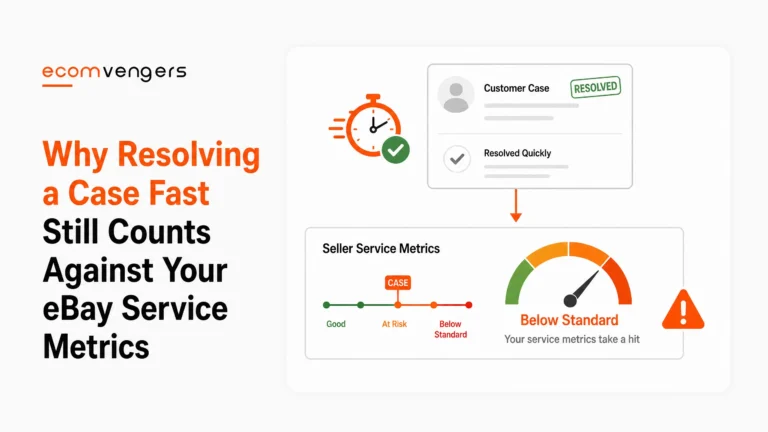
Does a Cancellation Touch Your Service Metrics?
No, and the distinction is worth holding onto.
Service metrics count two things. Buyers reporting an item did not arrive, and buyers returning something as not as described.
A cancellation is neither. It happens before any of that, which is precisely why cancelling early is cleaner than letting an order run into trouble.
So a cancellation is one problem, not two
Compare it with an unresolved case, which lands on both minimum standards at once.
An out of stock cancellation costs you a defect and nothing else. An order you let escalate costs you a case and a defect together, and can reach your service metrics as well.
Cancelling early is therefore the least damaging way for an order to fail, once failure is certain.
We take that comparison apart in eBay service metrics.
How Do You Avoid eBay Order Cancellations?
Three settings, and all of them are things you change once.
Require immediate payment
The unpaid order disappears if payment is a condition of buying.
eBay recommends setting payment preferences to require immediate payment on Buy It Now and auction listings, precisely so you avoid cancelling for non payment later.
That removes an entire category of cancellation from your account.
Use out of stock control
A listing that hides itself cannot sell something you do not have.
Out of stock control keeps the listing and its history while making it unavailable, which is the difference between a paused listing and a cancelled order.
It also preserves the sales history that rebuilding placement depends on.
Set Time Away before you need it
eBay offers this as the alternative to disappointing buyers during a disruption.
Pausing sales for a week costs you a week of orders. Cancelling a week of orders costs you a quarter of a defect rate, and possibly your seller level with it.
Fulfil anything sold before the break starts, which is the one condition eBay attaches.
Frequently Asked Questions
Does cancelling an eBay order always give me a defect?
No. eBay attaches the defect warning to the out of stock reason specifically, and treats buyer requests, wrong addresses and non payment as administrative.
The buyer asked me to cancel. Am I penalised?
Not for accepting a buyer request. eBay also refunds the entire final value fee including the per order portion when you approve one.
Can I select buyer has not paid when they actually did?
No, and eBay names that exact scenario as abuse of the cancellation process. Consequences run up to buying or selling restrictions and account suspension.
How long do I have to respond to a cancellation request?
Three calendar days from the request date. If the buyer paid and you stay silent the order stands, and if they have not paid eBay accepts the cancellation for you.
When can I cancel for non payment?
After 4 full calendar days, which is when the reason code becomes available. You then have until day 30 to use it.
Can I cancel after the buyer has paid?
Yes, up to 30 calendar days after the sale. A full refund issues automatically where the buyer paid through eBay checkout.
Why can I not cancel this order?
Almost certainly because the buyer has reported the item as not arrived, or opened a return request. Either one moves you out of the cancellation process entirely.
Can I cancel one item from a multi item order?
No. eBay cancels the entire order where a buyer bought several items together, and sellers cannot cancel individual lines.
Will I get my fees back?
On an approved buyer request, eBay refunds the whole final value fee. On other cancellations you may be eligible for a fee credit once the buyer has been refunded.
Can a buyer still cancel after 60 minutes?
Not through the formal request. eBay says that once the window has expired the buyer can contact you directly and ask, which leaves the decision with you.
Does declining a request count against me?
No. eBay removes related negative or neutral feedback whether you approve or decline, so a reasoned decline carries no penalty.
Does a cancellation remove negative feedback?
On a buyer requested cancellation, yes. eBay removes related negative or neutral feedback whether you approve the request or decline it.
Can I undo a cancellation?
No. eBay states that once an order has been cancelled it cannot be undone, so check the rest of the order before submitting.
The buyer asked after I posted. What do I do?
Decline and offer a return once it arrives. eBay conditions its advice to accept on the item not having shipped yet, and declining still triggers the feedback removal.
Do cancellations affect my service metrics?
No. Service metrics count item not received reports and not as described returns, and a cancellation is neither of those.
When should I bring in help?
When cancellations have already pushed your defect rate near the limit and an evaluation is close. Working the removals as a batch before the 20th is what our account recovery service does.
Tell the Truth in the Dropdown
Cancellation is one of the few places on eBay where honesty and self interest point the same way.
First, work out who caused it, because that decides whether a defect is coming.
Second, accept buyer requests while the item is still unposted, since the fee comes back whole.
Third, take the defect when it is genuinely yours, and fix the stock control that produced it.
One defect ages out. A pattern of false reasons does not.
Sources
More on seller performance across the rest of the EcomVengers blog, with documented recoveries in the case study archive.
Two questions decide whether a cancellation costs you anything.
First, who caused it. A buyer request and a seller decision are recorded differently, and only one of them lands on your defect rate.
Second, is cancelling actually necessary. Updating tracking, messaging the buyer or shipping late usually beats cancelling, because a late parcel is a smaller problem than a defect.
Worth holding on to: the reason you pick is the whole decision. eBay is not judging the cancellation, it is reading the dropdown, and one entry on that list carries a cost the others do not.
Sources
- eBay, How sellers can cancel an order, on the cancellation reasons available and what each one does.
- The order cancellation policy, on the rules governing when an order may be cancelled.
- Details in the seller standards policy, on cancellations counting as transaction defects.
- Removal grounds sit in Defect removal.
- Our own figures come from published client cases with the eBay messages attached, collected in our eBay case study library.
Abdul Mannan is the eBay account health expert at EcomVengers. He works on the numbers that decide a seller's standing: transaction defect rate, late shipment rate, cases closed without seller resolution, service metrics, returns and feedback. He writes our guides on keeping an account out of Below Standard and on finding out why sales have dropped.
View all posts by Abdul Mannan