There is a handbag price on eBay where charging one dollar more earns you a hundred and twenty dollars.
Not because the buyer pays more. Because eBay charges you less.
Four categories re-rate the entire sale once it crosses a threshold, and in every one of them the higher band carries the lower percentage.
Almost every pricing guide written for eBay sellers misses this, because they treat fees as a flat deduction and pricing as a popularity contest.
A real eBay pricing strategy has to clear three bars at once. It must cover your costs, it must sit on the right side of the fee table, and it must survive comparison with whatever eBay shows next to it.
The third bar is the one everybody writes about. The second is the one that pays.
Key Takeaways
- Four US categories re-rate the whole sale at a threshold, and in each the higher band charges a lower rate.
- A handbag at 2,001 pays about 120 less in fees than one at 2,000. Same item, one dollar apart.
- Athletic shoes at 150 drop to 8% and lose the per order fee entirely. A penny more than 149.99 leaves you 8.81 better off.
- No price at or below a threshold can net what just above it nets. The gap is arithmetic, not opinion.
- Most categories do not work this way. They re-rate only the portion above 7,500, where the saving is trivial.
- Price against sold data, not active listings. Active prices tell you what sellers hoped for.
- Product research reports the real sold price even when a Best Offer was accepted, so you see what buyers paid.
- The public search history does not. It shows only the original Buy It Now price, whatever the item sold for.
- The minimum offer discount is 5% across all item prices.
- An open offer does not lock the item. Someone else can still buy it, and pending offers are then cancelled.
- Advertising fees can follow a buyer who arrived through a promoted listing, so a discount may cost more than it appears.
- Price is one Best Match input among many. The cheapest listing does not automatically win the placement.
What an eBay Pricing Strategy Actually Has to Do
A price has to clear your costs, land on the right side of the fee table, and still look reasonable beside the listings eBay shows next to it.
Most advice handles the first and third and ignores the second entirely.
That omission is expensive, because eBay’s selling fees are not a flat percentage. They are a table with bands, and the bands do not all behave the same way.
In most categories, crossing a threshold re-rates only the portion above it. That is the familiar shape and it barely affects pricing.
In four categories, crossing the threshold re-rates the entire sale. That shape changes pricing completely, and pricing guides skip it.
Before any of this, you need a defensible starting number. That comes from what items sold for, not from what other sellers are asking.
Price Against Sold Data, Never Against Asking Prices
Active listings record hope, and sold listings record agreement, so only one of them is evidence.
This is the single most repeated piece of eBay pricing advice, and it is right. The interesting part is which sold data you look at.
eBay’s Product research tool holds three years of sales data and reports average sales price, sold price range and sell-through rate, filtered by category, condition and location.
It also does something the free completed listings view cannot. It reports the actual price an item sold for even when a Best Offer was accepted.
That gap matters enormously in negotiated categories. The free view shows you asking prices dressed up as outcomes.
Price a listing from those inflated figures and you will sit above the real market, wondering why the watchers never convert.
The same tool and the same filters do the wording job as well, which we cover in our guide to eBay keyword research.
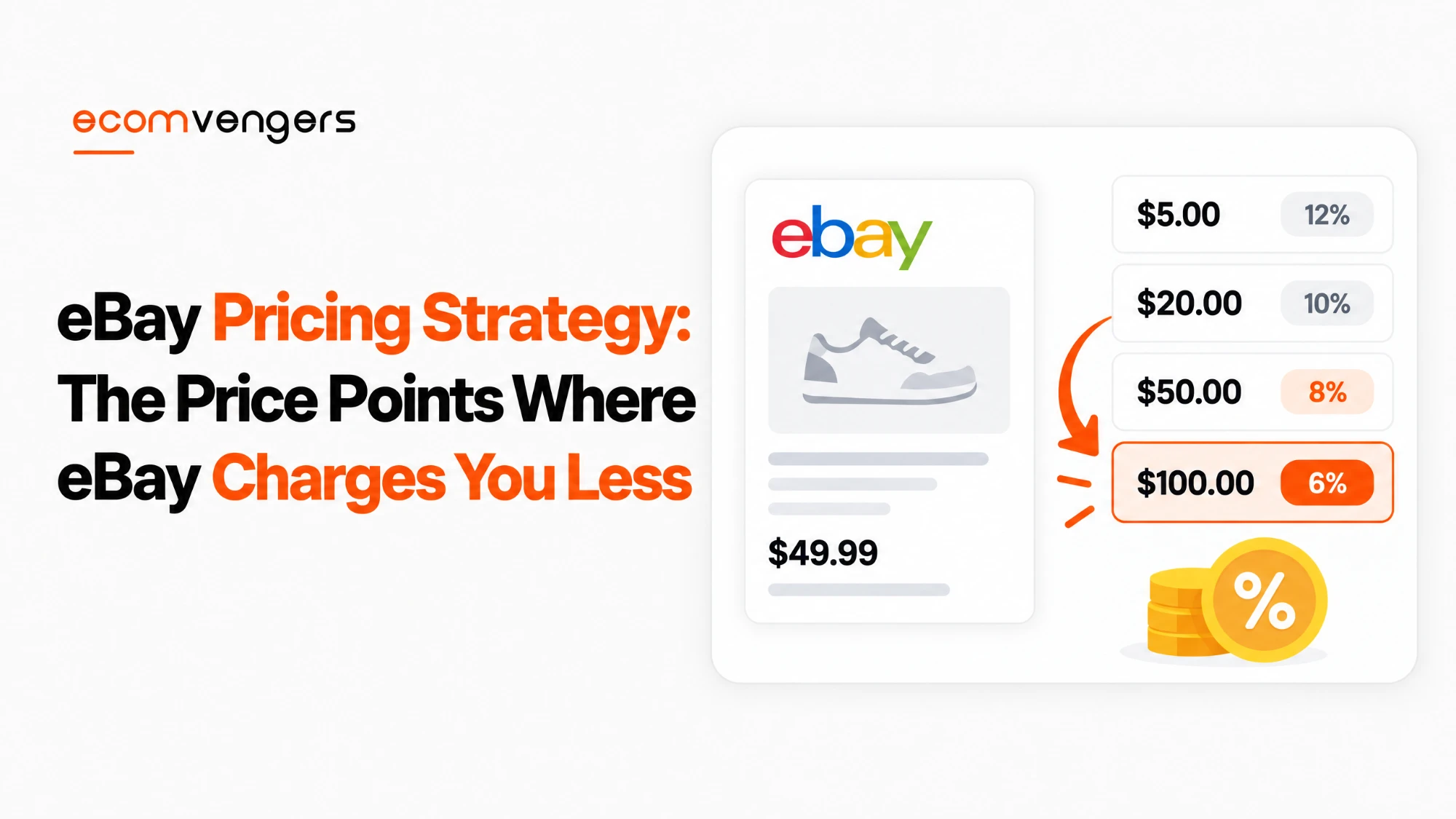
The eBay Price Points Where Charging More Costs You Less
Four US categories re-rate the whole sale when it crosses a threshold, and in each one the higher band carries the lower rate.
So a sale one unit above the line pays a smaller fee than a sale one unit below it, in cash terms, not just as a percentage.
The tell is grammatical, and you can learn to read it. When eBay writes about the portion of the sale over a figure, only the excess re-rates. When it writes about the total amount of the sale being over a figure, the whole sale re-rates.
| Category | Rate below | Threshold | Rate at or above | Fee saved at the line |
|---|---|---|---|---|
| Womens Bags and Handbags | 15% | 2,000 | 9% | about 119.91 |
| Jewelry and Watches | 15% | 5,000 | 9% | about 299.91 |
| Coins and Paper Money, Bullion | 13.6% | 7,500 | 7% | about 494.93 |
| Athletic Shoes | 13.6% plus 0.40 | 150 | 8%, no per order fee | about 8.80 |
Take the handbag. At 2,000 you pay 15% plus the per order fee, which is 300.40.
At 2,001 you pay 9% plus the per order fee, which is 180.49.
You charged one dollar more and kept roughly 120 more, because the rate applies to everything, not just the excess.
Athletic shoes are the version most sellers will meet, because the threshold is 150 instead of thousands. At 150 the rate drops to 8% and eBay stops charging the per order fee at all.
A pair at 149.99 leaves you 129.19. The same pair at 150.00 leaves you 138.00.
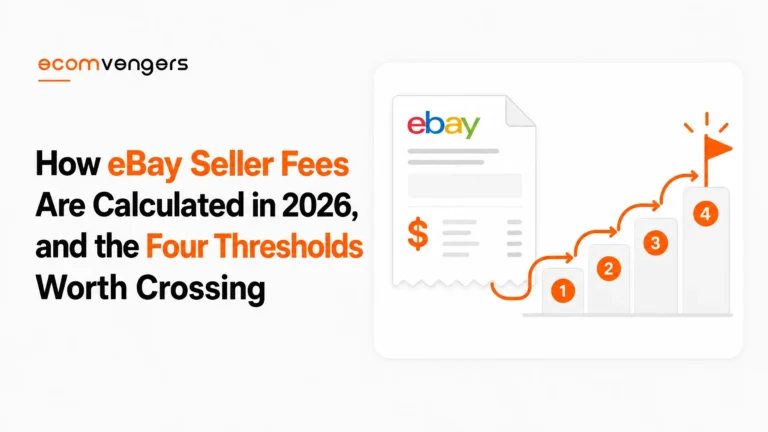
One penny, 8.81 in your pocket. You can model any of this in our eBay profit calculator, and the full table sits in our guide to how eBay seller fees are calculated.
Key point: this applies to four categories only. In most categories the threshold re-rates the excess alone, the saving is pennies, and pricing to the line does not justify distorting your offer.
The Dead Zone Sitting Just Below Every Threshold
No price at or below one of these thresholds can net you what a price just above it nets, which makes the band underneath a zone to avoid entirely.
That is a strong claim, so check the arithmetic.
A handbag at 2,001 leaves you 1,820.51 after fees.
The best you can do below the line is 2,000, which leaves you 1,699.60.
To match 1,820.51 at the 15% rate you would need to charge about 2,142, which is above the threshold and therefore impossible. There is no price under 2,000 that competes.
Athletic shoes behave the same way at a scale most sellers meet weekly. At 150 you keep 138.00, and matching that below the line would need about 160, which is also above it.
So the practical rule is short. If an item could plausibly fetch the threshold, price it there or above, and never park it just underneath.
The classic 149.99 is the worst number on the page in that category. It looks like sharp pricing and costs you nearly nine dollars against a round 150.
Note: charm pricing and threshold pricing fight each other here. Ending in .99 is a habit borrowed from retail, and in these four categories it can sit you on the expensive side of a line for the sake of a penny.
Work Out the Floor Before You Argue About the Ceiling
Your break-even price is cost of goods plus postage plus every eBay fee, and no competitive argument survives below it.
Sellers usually calculate this once, badly, and then price from memory for a year.
Two fees apply. An insertion fee when you list, free for the first 250 listings a month and 0.35 after that, and a final value fee when the item sells.
The final value fee is where pricing assumptions break, because it applies to the total amount of the sale, which includes postage, handling and any tax collected from the buyer.
Free shipping is fee neutral, not fee free
Because postage collected from the buyer counts toward the fee, charging postage separately does not dodge anything.
A 40 item with 10 postage and a 50 item with free shipping are charged on the same 50.
So choose between them on buyer appeal and on how the price displays in results, never on fees. The old advice about hiding cost in postage saves nothing at all.
Bundling saves the per order fee, and only that
eBay counts an order as any number of items bought by the same buyer at checkout with the same postage method.
Three items sold separately carry three per order fees. The same three in one order carry one.
That is a real saving and a small one, so bundle for postage economics and buyer convenience. The fee is a minor reason.
Key point: work your floor from the total amount of the sale, not from the item price. Pricing against a fee you calculated on the item alone understates your costs on every order that carries postage.
How Best Offer Changes Your eBay Pricing Strategy
Best Offer turns your listed price into an opening position instead of a decision, which is useful precisely when you cannot read the market.
eBay describes it as a way to make a faster sale and test the pricing, and that second purpose is the underused one.
You can accept, decline or counter, and eBay lets you set rules to auto decline or approve so the routine offers handle themselves.
Set the auto-accept level at the lowest number you would take without thinking, and the auto decline level below anything that deserves a reply. The band between them is the only part that needs you.
One detail changes how freely you should use it. Once a listing has ended, eBay shows only the original Buy It Now price in the search history, whether the buyer paid it or not.
So your discounting does not depress the visible price record for your own items. To run a timed discount across many listings, see how to use eBay Markdown Manager, now called sale events.
It also means the public record understates how much negotiating happens in your category, which is exactly why Product research repays the extra step.
An open offer does not reserve anything either. Someone else can buy the item while an offer sits with you, and unaccepted offers are cancelled when it sells.
Offers to Buyers, and the Advertising Cost Nobody Counts
Offers to Buyers lets you send a private discount to people already watching a listing or holding it in a cart.
It is a different tool from Best Offer, and the distinction matters when you plan a pricing campaign.
Best Offer is something you switch on when you list. Offers to Buyers is something you send afterwards to a buyer who has already shown interest.
You can run both, with one exception. You cannot send an offer to a buyer who has already sent you a Best Offer on that listing.
The minimum discount is 5% across all item prices, so this is not a tool for shaving a dollar.
Sending offers carries no extra fee beyond the standard fixed price fees, though automating them on a schedule requires a Store subscription.
Store subscribers can also build rules by category, price range and condition, with an offer duration of up to 150 days and the option to allow counteroffers.
Now the part that eats margins. eBay advises you to account for advertising fees before making an offer, because if the buyer found your listing through eBay Advertising those fees may still apply depending on how long ago that was.
So a 10% offer to a watcher who arrived through a promoted listing is not a 10% discount. It is 10% plus the ad rate, and our guide to eBay Promoted Listings covers how to judge that spend.
Key point: discounting a listing you are also advertising stacks two costs on the same sale. Check whether the watcher arrived through an ad before you decide the offer is cheap.
Auction Starting Bid or Fixed Price, and When Each Wins
Use a fixed price when you know what the item will fetch, and an auction when the market will tell you better than you can guess.
That split matters more than any clever number, because the two formats price in opposite directions.
eBay notes that a low starting price can help attract bidders, which is the whole mechanism of an auction working in your favour.
It is also the mechanism of an auction working against you when the item is ordinary and only one bidder turns up.
So set your starting bid at the lowest figure you would accept, not at a number designed to look tempting.
You can add a Buy It Now price to an auction, and it shows until the first bid lands. eBay requires it to sit at least 30% above the starting price.
Reserve prices exist for vehicles, so for most categories the starting bid is your only floor and it has to carry that job alone.
For a seasonal or truly scarce item an auction can find a price no competitive analysis would have suggested. For a commodity it usually just discovers the floor you set.
Why the Cheapest eBay Listing Does Not Automatically Win
Price is one input into which listing eBay shows, not the whole calculation, so undercutting does not reliably buy placement.
Sellers discover this the expensive way, by cutting until the margin is gone and the position has not moved.
Best Match weighs listing quality and seller performance alongside relevance and value, which we set out in our explainer on how eBay Best Match works.
A cheaper listing with weaker photographs, a thinner title and a slower dispatch time is not a better listing. It is a cheaper one.
There is a floor under this too. A price that cannot cover your costs turns a visibility problem into a solvency one.
Work out what the sale leaves you before you decide the price is the problem at all.
When to Reprice, and What to Change First
Reprice when the sold data moves, not when the listing feels slow, because impatience is not evidence.
Three triggers justify a change, and the rest are nerves.
A shift in the sold price range for your category over a recent window is the clearest one.
Next comes a successor product launching, which moves the whole curve for the outgoing model.
Last is a seasonal turn, which the three year history in Product research will show you, so there is no need to guess.
When you do change something, change one thing. A price cut made at the same time as a new main photograph teaches you nothing about either.
And before cutting, check the cheaper option. Enabling Best Offer tests the market without touching the number that sits in the search results.
FAQs About eBay Pricing Strategy
What is the best eBay pricing strategy for a new seller?
Price from sold data in your own category and condition, then check whether your category has a whole sale fee threshold nearby. Those two steps beat any rule of thumb.
Does raising my price ever reduce my eBay fees?
Yes, in four US categories. Handbags, jewellery, bullion and athletic shoes re-rate the entire sale at a threshold, and the higher band is cheaper.
Should I price at 149.99 or 150 for athletic shoes?
150. At that point the rate drops to 8% and the per order fee disappears, leaving you about 8.81 better off than at 149.99.
Does this threshold trick work in every category?
No, and that is the important caveat. Most categories re-rate only the portion above 7,500, where the saving is too small to price around.
Where do I find what items really sold for?
Product research in Seller Hub. It reports the actual sold price even when a Best Offer was accepted, which the free completed listings view does not.
Will accepting low offers damage my price history?
Not in the public record. Once a listing ends, eBay shows only the original Buy It Now price regardless of what the buyer paid.
What is the minimum discount on an offer to a buyer?
5%, across all item prices. There is no smaller token discount available.
Does an open Best Offer hold the item for that buyer?
No. Another buyer can purchase it while the offer sits with you, and any unaccepted offers are then cancelled.
Do offers to buyers cost extra?
Sending them does not, beyond the standard fixed price fees. Automating them on a schedule requires an eBay Store subscription.
Why did my discount cost more than I expected?
Advertising fees may still apply if the buyer originally found the listing through eBay Advertising, so the discount and the ad rate land on the same sale.
Will undercutting everyone get me to the top of search?
Not reliably. Best Match weighs listing quality and seller performance alongside value, so a cheaper but weaker listing can still lose.
How often should I change my prices?
When the sold data moves, a successor model launches, or a season turns. Change one variable at a time or the result tells you nothing.
Is charm pricing worth it on eBay?
Usually harmless, but not in the four threshold categories. Ending in .99 there can park you on the expensive side of a line for the sake of a penny.
Does offering free shipping reduce my eBay fees?
No. The final value fee applies to the total amount of the sale including postage collected, so charging postage separately is fee neutral.
Is bundling items worth it for the fees?
Slightly. One order carries one per order fee however many items it contains, provided the buyer checks out together with the same postage method.
What should I set my starting bid at?
The lowest figure you would accept. A low start attracts bidders, but on an ordinary item it may only find the floor you chose.
Where should I set auto-accept and auto decline?
Auto-accept at the lowest price you would take without hesitating, auto decline below anything that merits an answer. Leave only the debatable offers for yourself.
Price to the Table, Then to the Market
An eBay pricing strategy is usually taught as a negotiation with buyers. Half of it is a negotiation with the fee table.
The buyer half is well covered everywhere. The table half has specific, checkable numbers behind it and almost nobody uses them.
Work through it in this order.
- Pull sold data for your category and condition, and use the view that shows accepted Best Offer prices.
- Check whether your category re-rates the whole sale at a threshold, or only the portion above it.
- If it re-rates the whole sale, find the threshold and never price just beneath it.
- Work out what the sale leaves you after fees, postage and cost of goods.
- Compare that floor with the sold range before deciding whether the listing is viable at all.
- If you cannot read the market, list higher and enable Best Offer instead of guessing low.
- Before discounting a watcher, check whether they arrived through a promoted listing.
- Reprice on evidence, one variable at a time, and give each change a fortnight.
If sales stay flat after all of that, the price was probably never the problem. A listing nobody is shown cannot be fixed by discounting it.
Sources
- Category rates, thresholds and the two threshold models come from eBay’s selling fees page, read for the US schedule and last checked on 18 August 2026. The grammatical tell between a portion re-rate and a whole sale re-rate is taken from the same page.
- Sold price evidence, the three year window, the category, condition and location filters, and the reporting of accepted Best Offer prices are documented on the product research page.
- Seller Center’s Offers to Buyers and Best Offer guidance provides the 5% minimum discount, the search history showing only the original Buy It Now price, offers not locking the item, the absence of extra fees for sending offers, the Store requirement for automation, rule based offers up to 150 days, and the warning that advertising fees may still apply.
- Auction starting prices, the Buy It Now relationship and reserve prices are set out in selling through auctions.
Zaman Khan is the eBay and TikTok Shop expert at EcomVengers. He covers the commercial side of selling: fees, pricing, profit tracking, shipping, listing tools and the account decisions that shape a store. He writes our guides on what eBay actually charges and how to run a catalogue efficiently.
View all posts by Zaman Khan