eBay evaluates your seller level on the 20th of every month.
If that evaluation drops you to Below Standard, one of the things eBay takes away immediately is advertising.
Worth knowing: ad eligibility is a performance question first. eBay opens Promoted Listings to Above Standard and Top Rated accounts. A slipping level closes the option.
Not your listings. Not your account. Your ability to promote anything at all.
So eBay removes the lever most sellers reach for at exactly the moment they reach for it. Retail management by way of locking the fire extinguisher inside the burning room.
Sellers call us when the ad spend climbed and the revenue did not follow. The cause turns out to be a seller level far more often than a bidding strategy. Our eBay SEO services work starts by checking which of the two it is, because the fixes share nothing.
Two strategies. Two completely different bills. One eligibility rule that decides whether either is available to you.
Key Takeaways
- eBay Promoted Listings buys ad placement in front of relevant buyers. It does not change the listing, the price or your record.
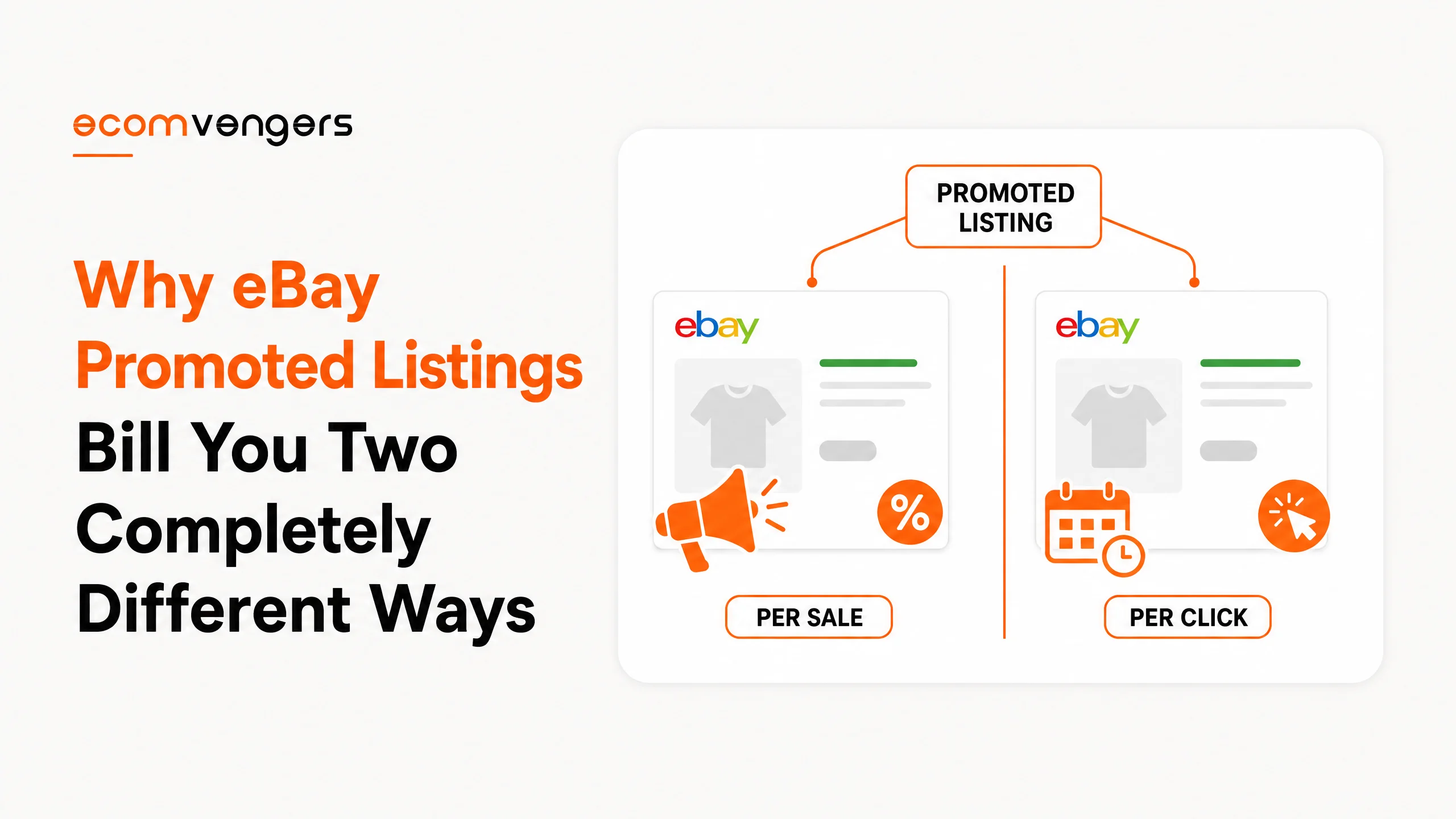
- There are two campaign strategies, general and priority, and they bill on completely different events.
- The general strategy is cost per sale, so you pay only when a promoted item sells after a click on your ad.
- The priority strategy is cost per click, so every click costs whether or not it converts.
- Priority buys priority access to placements plus advanced targeting and bidding controls.
- Only the priority strategy carries video ads. The general strategy does not offer them.
- General setup runs to four steps. Priority runs to six, adding video, targeting and a daily budget.
- You build campaigns in Seller Hub, on the Advertising dashboard, under Create new campaign.
- A Below Standard seller level blocks Promoted Listings outright, directly after the monthly evaluation.
- That block covers editing existing campaigns, not just creating new ones.
- eBay names budget monitoring and performance tracking as best practice, which is a polite way of saying campaigns drift.
- Advertising a listing that does not convert organically usually just buys you a more expensive version of the same problem.
What eBay Promoted Listings Actually Buys You
Placement. Nothing else changes.
eBay describes the product as putting your listings in front of relevant buyers through access to ad placements. So the mechanism is straightforward, and it is worth being precise about what sits inside that sentence and what does not.
Your title still says what it said. Your photographs look the same, your price reads the same, and your seller record walks into the ad slot beside you.
You have bought one thing: a chance to reach someone who would otherwise scroll past. Everything the ad never touched still decides whether they buy.
That is the whole reason experienced sellers advertise their best converting listings rather than their worst performing ones. Promotion multiplies whatever the listing already does, and multiplying a poor conversion rate is an expensive hobby.
The Two eBay Promoted Listings Strategies and How Each Bills
One charges you for results. The other charges you for attention.
The general strategy is cost per sale. eBay charges you only when your promoted item sells after a click on your ad, which means a click that goes nowhere costs you nothing at all.
The priority strategy is cost per click. eBay bills every click, and states plainly that you pay for clicks rather than for outcomes.
Do the arithmetic once: divide your cost per click by your conversion rate. That gives what a sale really costs. At 2% conversion, a 20p click is a 10 pound sale cost.
Read that difference carefully, because it decides who should use which. Cost per sale parks the risk of a wasted click with eBay. Cost per click parks it with you, and hands you the controls in exchange.
Those controls are the actual trade. Priority gives you priority access to ad placements plus advanced targeting and bidding options, while general gives you standard controls and general access.
One more asymmetry matters. Only the priority strategy carries video, so eBay has already made the choice for any seller who wants to show a product actually moving.
Is eBay Promoted Listings Worth It for Your Catalogue?
The honest answer starts with a subtraction most sellers skip.
Some of the sales a campaign reports would have happened anyway. The buyer searched, found you, and bought. The ad got there first and took a cut on the way past.
eBay counts that as an ad sale. Your margin counts it as a discount.
The number that decides it
Work out your break-even ad rate before you pick a rate. That is the point where the ad fee swallows the whole profit on the sale.
Take the sale price. Subtract the final value fee, the postage and the cost of goods. What is left is your profit, and that profit as a share of the sale price is your ceiling.
Go above it and you are paying to lose money on every sale the ad wins. Our eBay profit calculator prints that ceiling for you.
When advertising is usually the wrong call
- The listing already sits on page one for its main term. You are buying placement you had for nothing.
- The margin is thin. A 6% ad rate against a 9% margin leaves almost nothing, and one return wipes it out.
- The listing does not convert. Advertising a listing nobody buys just buys more people not buying it.
When it usually pays
- New stock with no sales history, because Best Match has nothing to rank you on yet.
- Seasonal stock with a deadline, where waiting for organic placement costs more than the ad rate.
- A deep catalogue where a few listings carry the margin and the rest need discovery.
Key point: the question is never whether the campaign produced sales. It is whether it produced sales you would not have had anyway, at a rate your margin could carry.
Which eBay Promoted Listings Strategy Suits Your Catalogue
Start with how well the listing already converts, not with the budget.
When the general strategy is the safer choice
Pick it when you cannot yet predict what a click is worth to you.
Because eBay only charges on a sale, a cold catalogue cannot quietly drain money while you learn. New sellers, seasonal stock and long tail items all sit comfortably here.
It also suits anyone running a large catalogue with thin margins per unit. You keep the exposure and skip the risk of paying for browsers.
When the priority strategy earns its cost
Pick it when you already know your numbers and want the controls.
Priority makes sense on listings that convert well, in categories you understand, where the extra targeting can find the buyer faster. The advanced bidding options only help someone who knows what a click is worth.
Video pushes the same way. If a product benefits from movement, and plenty do, priority is the only door into that format.
Still, treat the daily budget as a real constraint rather than a formality. Cost per click punishes inattention in a way cost per sale never can.
How to Set Up an eBay Promoted Listings Campaign
Seller Hub, then the Advertising dashboard, then Create new campaign.
From there you choose Promote your listings, and eBay asks which strategy you want. The two paths then diverge, and the shape of that divergence tells you a lot about what each product expects from you.
General asks for four things. You add the listings, choose an ad rate strategy, name the campaign and set its duration.
Priority asks for six. The listings and the naming stay, but you also add video where you want it, set your targeting and bidding, and commit to a daily budget.
Notice which extras appear. Every one of them is a spending control, which fits a model that charges on clicks rather than sales.
eBay then lists four habits as best practice, and they read like a warning from experience. Track performance to find the campaigns that work, refresh campaigns as the market moves, experiment across strategies, and set a clear budget you actually monitor.
That last one deserves its bluntness. Campaigns drift, seasons turn, and the winning campaign from March will happily keep spending your money in September.
Why Below Standard Sellers Cannot Use eBay Promoted Listings
eBay blocks the whole product, and it happens the moment your level drops.
The seller standards policy sets this out directly. A Below Standard seller gets blocked from using Promoted Listings and cannot create new campaigns or edit existing ones.
Two details in that sentence catch people out. First, the block covers editing, so a live campaign freezes exactly where it stood. Second, eBay applies it directly after the evaluation rather than waiting for the new month, unlike the higher fees that arrive on the 1st.
Meanwhile your placement takes its own hit. eBay states that Below Standard items may sit lower in Best Match results, so organic visibility and paid visibility fall away together.
That combination is why advertising cannot rescue a slipping account. The only route back runs through the metrics, and getting off eBay Below Standard covers what to fix and in what order.
Sellers coming out the other side hit a related trap. Ranking does not simply snap back on reinstatement, and recovering eBay sales after reinstatement explains why the ad account often restarts before the organic one does.
What an eBay Promoted Listings Ad Rate Actually Charges
A percentage of the whole sale, not the item price.
eBay defines the ad rate as a percentage of an item total sale amount, and it spells out what that includes: the item price, the shipping, the taxes and any other applicable fees.
So a seller who budgets against the item price alone has underestimated the bill. On a low value item with heavy postage, the gap between those two numbers gets uncomfortable quickly.
The 30 day window most sellers miss
eBay charges the fee when the promoted item sells within 30 days of a click on your ad.
Read that again, because it is not the same as charging on an immediate purchase. Someone can click your ad, wander off, think about it for three weeks and come back through a completely ordinary search, and the sale still carries the ad fee.
That window explains a lot of confused seller maths. Fees keep appearing after a campaign looks quiet, which feels like a billing error and is simply the tail of clicks you already bought.
Dynamic and fixed ad rates
A dynamic ad rate updates itself daily to whatever eBay suggests for that listing. A fixed rate stays exactly where you left it until you move it.
Dynamic keeps you competitive without daily babysitting, though it also hands eBay the dial on your costs. For that reason eBay lets you set an ad rate cap, which is the maximum percentage you will pay on a sale.
Use the cap. A rate that adjusts every day with no ceiling is a subscription you did not quite mean to take out.
Who is even eligible to advertise
eBay states it in one line: Above Standard or Top Rated sellers with enough account activity can promote fixed price listings in most categories.
Three conditions hide in that sentence. Your seller level has to clear Above Standard, your account needs enough trading history behind it, and auction listings are not part of the deal.
How eBay Calculates the Suggested Ad Rate
From four groups of signals, and two of them are your own listing quality.
eBay publishes the inputs, which is unusually generous of it. Competition covers what rivals bid, how many listings sit in the category, and whether demand is rising or falling.
Listing attributes cover price, quantity available and item details such as category and brand. Past performance covers seasonality, days listed, quantity sold, and both your organic and your ad traffic.
Then comes the group that ought to change how sellers think. Listing quality feeds the calculation directly, and eBay names the variety and quality of your photos alongside how clear and detailed your description is.
In other words, the organic work and the ad cost are wired together. A thin listing does not simply advertise badly, it advertises expensively, because the same weaknesses that suppress it organically also shape what eBay suggests you pay.
eBay is also careful to say that applying the suggested rate guarantees nothing. Instead it points you back at the listing, recommending better photos, at least four of them, a helpful title with relevant keywords, a clear description, full item details and a competitive price.
nnnnWorth remembering what the suggestion is made of. It reads the market and your listing, never your costs, so a rate the whole category is bidding can still sit above what your margin can carry. Our eBay Promoted Listings calculator works out that ceiling from your own numbers.
That is an advertising product telling you to go and fix your listing first. Worth noticing.
Choosing eBay Promoted Listings in Bulk With Rules
Rule based selection lets a campaign pick its own listings, forever.
Rather than ticking items by hand, you define criteria and eBay maintains the list. Six inputs are available: category, price range, brand, condition, days on site and quantity available.
eBay reviews your inventory daily against that rule. Listings that qualify get added automatically, including brand new ones, and listings that stop qualifying drop out on their own.
You can exclude specific items so they never enter, whatever the rule says. That matters more than it sounds, since a rule written around price will happily scoop up the one product you sell at cost.
The rule you cannot edit later
Here is the sharp edge. eBay states that your listing selection strategy cannot be edited after launch, so changing the criteria means ending the campaign and building a new one.
Write the rule as though it is permanent, because for that campaign it is. Sellers who treat it as a first draft end up running three overlapping campaigns and wondering where the budget went.
One more detail catches out anyone selling variations. Every variation price has to fall inside your selected price range before the listing qualifies at all, so a single expensive size can keep the whole item out of the campaign.
How to Read eBay Promoted Listings Performance
eBay gives you a central dashboard with real time campaign data. The trick is knowing which number answers which question.
Separate ad impressions from organic impressions
Otherwise you cannot tell growth from substitution.
A campaign that lifts total impressions while organic impressions sag is not really growing your reach. It is renting back traffic you already had, which is the most common way sellers convince themselves advertising works.
Judge each strategy on its own billing event
Because the two products charge differently, one shared success metric will mislead you.
On the general strategy, clicks are free, so click volume alone proves nothing. Watch the ad fee against the sale value instead. On priority, clicks are the cost, so a listing with a healthy click rate and a poor conversion rate is quietly the most expensive thing you own.
Give a campaign a fixed review date
Put it in the diary when you launch, not when something looks wrong.
eBay explicitly names regular updates and budget monitoring as best practice. A fixed date turns that from good intentions into a task somebody actually does.
Sellers often ask which listings deserve promotion at all. A useful filter is to look at what already sells without help, then promote a slice of that rather than the shelf nobody visits.
Your best converting items are also the ones where the suggested rate tends to sit lower, since eBay is reading the same quality signals you are. Good listings advertise cheaply, which feels unfair until you remember why.
When to Turn an eBay Promoted Listings Campaign Off
Sooner than most sellers do, and for reasons they rarely write down first.
Decide the exit before you launch. A campaign with no stopping rule tends to survive purely because nobody wants to admit it failed.
Three conditions are worth writing into that rule. Stop when the ad fee stops leaving a margin you would accept on an ordinary sale. Pull it too when organic impressions fall as ad impressions rise, since you are then paying for traffic you already had. Finally, stop when stock runs low, because promoting an item you cannot ship is how cancellations start.
That last one connects to the rest of your account. An out of stock cancellation carries a defect, and enough of those move the seller level that decides whether you can advertise next month.
Remember the 30 day tail as well. Fees can land after you switch a campaign off, so a clean stop today does not mean a clean invoice tomorrow.
What eBay Promoted Listings Cannot Fix
Anything that made the listing weak in the first place.
An ad puts your listing in front of a buyer. It does not rewrite a title that misses the search, and eBay listing titles decide whether you match at all.
Empty attribute fields survive promotion too. A listing that filtered buyers cannot reach still cannot reach them from an ad slot, which is why eBay item specifics come first.
Then there is the conversion side. A dark, cluttered photograph loses the click just as reliably at the top of the page, so eBay listing photos earn their attention before any budget does.
Get those right, then advertise the listings that already convert. That order is not a preference, and eBay Best Match explains why the seven organic factors keep working underneath the ad regardless.
Frequently Asked Questions
Can I run both eBay Promoted Listings strategies at once?
eBay presents them as separate campaign types you choose between at setup, and it encourages sellers to experiment across strategies to find what suits their listings.
Does eBay Promoted Listings improve organic ranking?
eBay makes no such claim, so treat anyone who does with suspicion. Advertising buys placement, while the organic result stays governed by the factors eBay names for Best Match.
What happens to my campaigns if I go Below Standard?
They freeze. You cannot create new campaigns and you cannot edit the ones already running, and eBay applies that directly after the evaluation.
Which eBay Promoted Listings strategy is cheaper?
Neither, reliably. General costs nothing on wasted clicks but charges on outcomes, while priority charges early and can cost less per sale when the targeting works.
Should I promote every listing in my catalogue?
No. Promotion amplifies whatever a listing already does, so blanket campaigns mostly amplify your weakest conversion rates at scale.
Can I promote an eBay auction listing?
No. eBay limits promotion to fixed price listings, for sellers at Above Standard or Top Rated with enough account activity behind them.
Why am I still being charged after ending a campaign?
Because the fee attaches to a sale that happens within 30 days of a click on your ad. Clicks bought last month can still bill you this month.
Can I change the rule that picks my campaign listings?
Not after launch. eBay requires you to end that campaign and create a new one, so write the criteria as though they are permanent.
Where do I find my eBay Promoted Listings reports?
On the advertising dashboard in Seller Hub, which eBay describes as centralised reporting with real time performance data across all your campaigns.
How does eBay decide my priority cost per click?
Through a second price auction. eBay says the fee depends on listing quality, keyword relevance, your bid, competition from other sellers, and a reserve price it sets.
Do I pay if somebody clicks today and buys next week?
On the general strategy, yes. eBay charges when a promoted item sells within 30 days of a click, and the item must be promoted at both the click and the sale.
What counts as a click on my eBay ad?
More than a visit. eBay includes any interaction with the ad, naming add to watchlist, add to cart and quick view as examples.
Earn the Placement, Then Buy More of It
Advertising is a multiplier, and multipliers are honest. They enlarge whatever you point them at.
Four steps, in this order, before you raise a single bid.
First, check your seller level. eBay opens Promoted Listings to Above Standard and Top Rated accounts with enough trading history, so a Below Standard account is not making an advertising decision at all. It is making a performance one.
Second, work out your own break even ad rate. That is your profit before ads divided by the amount eBay applies the fee to, and it is the only rate on the page that knows anything about your costs.
Third, pick the strategy that matches your conversion rate rather than your instinct. Paying per sale protects you while clicks go nowhere. Paying per click wins once enough of those clicks turn into orders.
Fourth, promote listings that already convert. Blanket campaigns amplify your weakest pages at scale, which is an expensive way to discover which ones they were.
Worth holding on to while you spend: an ad buys placement and nothing else. It does not rewrite a title that misses the search, sharpen a dark photograph, or repair a record that slipped last month. Point a campaign at any of those and you are paying eBay to show more people the same problem.
Above all, keep the seller level healthy. Every other decision here assumes you still have access to the product, and that assumption expires on the 20th of the month.
Sources
- eBay, Promoted Listings overview, on the two campaign strategies, the second price auction behind priority pricing, last click attribution, and the fact that priority charges for valid clicks whether or not a sale follows.
- The general campaign strategy page, on the ad rate applying to the total sale amount including postage and taxes, the 30 day window after a click, dynamic and fixed ad rates, rule based listing selection, and the Above Standard or Top Rated eligibility requirement.
- Seller Center, Promoted Listings, on campaign setup, video on the priority strategy, daily budgets and the reporting dashboard.
- Our own examples come from campaigns we manage, and the wider guides sit in the EcomVengers blog.
One number to settle first. Ours is free, and it compares both strategies on what each costs per sale at the eBay Promoted Listings calculator, including the ad rate above which a promoted sale stops making money.
Where the campaigns are running and the sales are not, that is usually the listings rather than the bids, and it is the work we do. Tell us your ad rate and your conversion rate and we will tell you which one is wrong.

Ali Khan is the founder of EcomVengers, the eBay growth and account recovery agency. He has spent the better part of a decade pulling suspended sellers back from MC011 and MC999 notices, repairing wrecked defect rates, and turning buried listings into ranked ones. When eBay's villains show up, he is the one sellers call. You handle the millions, he handles the villains.
View all posts by Ali Khan