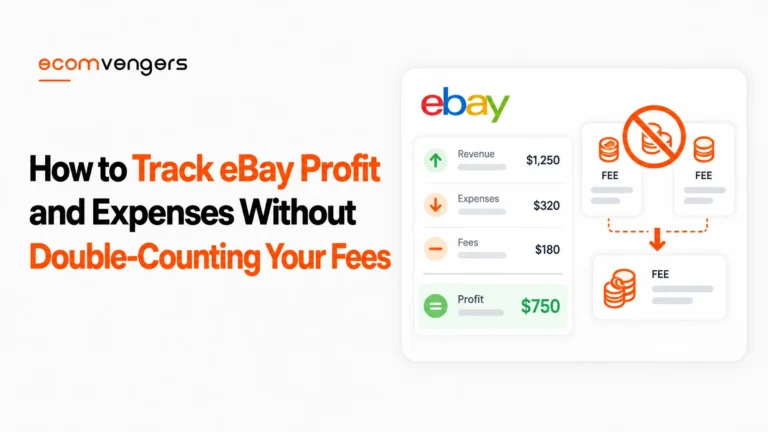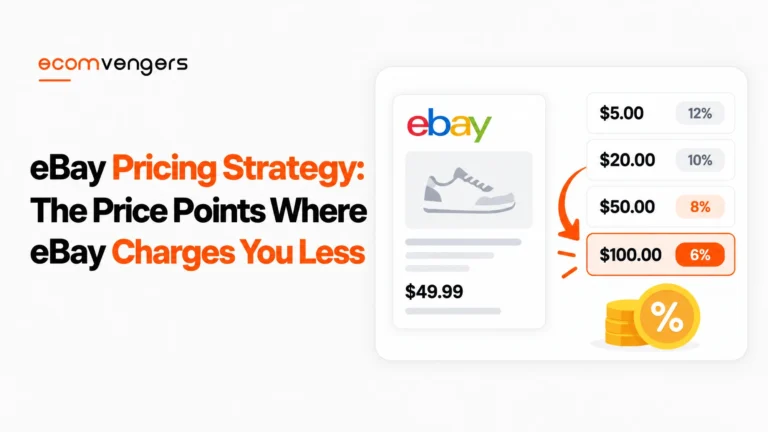
Every eBay seller knows the headline number. Thirteen point six percent, plus a small fee per order, and most people stop reading there.
That number is correct and it is also not the whole picture.
eBay charges different rates by category, and it handles the boundaries between those rates in two completely different ways.
In four categories, pricing an item one dollar higher can leave you over a hundred dollars better off.
We spend most of our week inside accounts that are in trouble, which means we read the fee schedule more often than anyone should. This is what it actually says, and where the money hides.
Key Takeaways
- Two fees, not one. eBay charges an insertion fee when you list and a final value fee when you sell.
- The final value fee has a percentage and a flat part. The per order fee is 0.30 on orders of 10.00 or less, and 0.40 above that.
- Most categories run at 13.6% on the total amount of the sale up to 7,500, then 2.35% on the portion above.
- The fee covers more than the item price. Handling, postage collected from the buyer and sales tax all count.
- An order is per buyer, not per item. Several items bought together with one postage method are one order, so one per order fee.
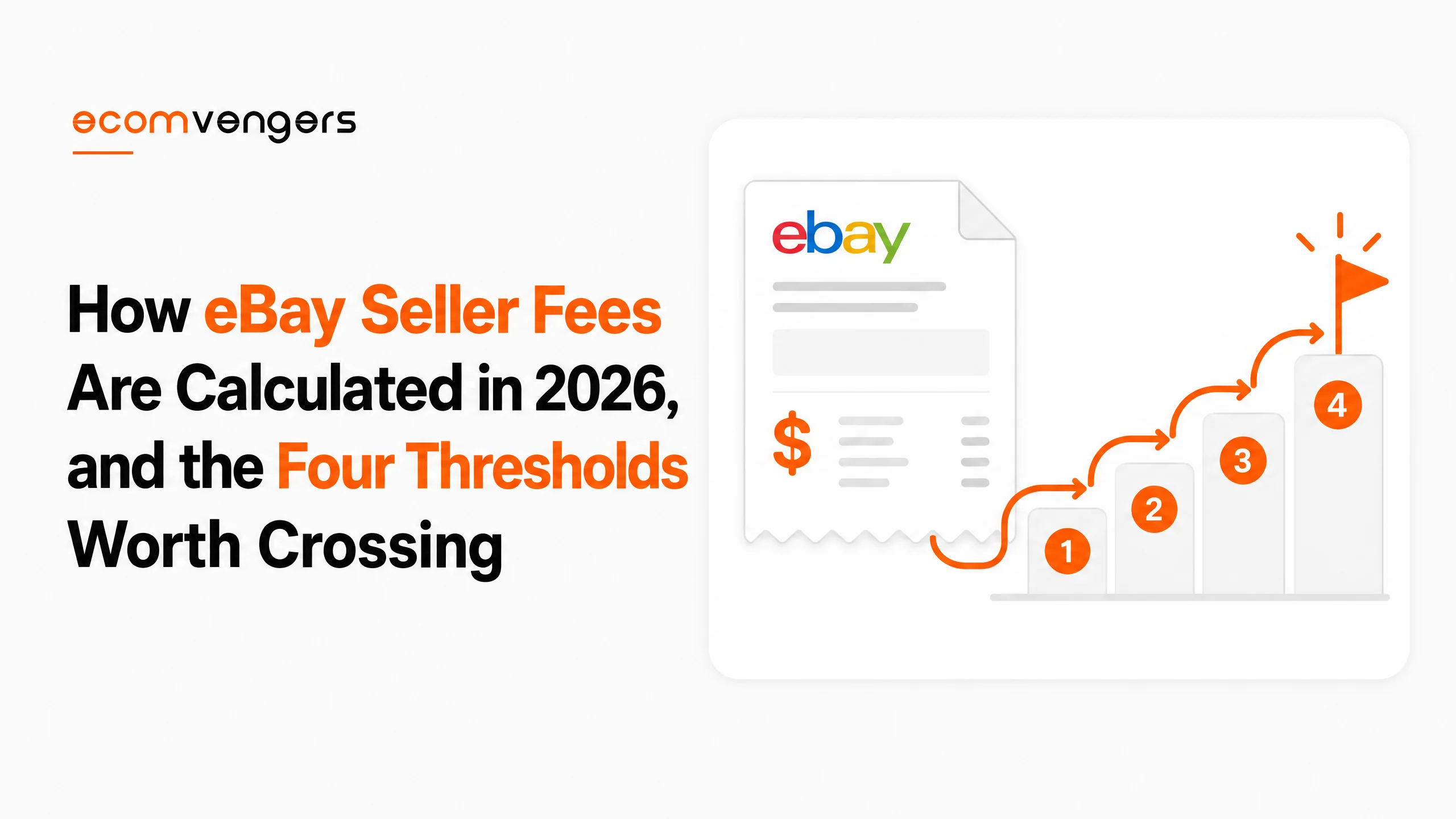
- eBay handles thresholds two different ways. Some categories re-rate only the portion above the line. Others re-rate the whole sale.
- Four categories re-rate everything. Bullion, women bags and handbags, jewellery, and athletic shoes.
- In those four, crossing the line lowers the rate. eBay takes 9% on a handbag at 2,001, and 15% on one at 2,000.
- Athletic shoes lose the per order fee too once the sale reaches 150.
- Watches, parts and accessories have three bands rather than two.
- Below Standard sellers pay an extra 6% on final value fees the following month, and 7% after four months in a row.
- Rates differ by marketplace. The US schedule is not the Canadian, British, German or Australian one.
How Much Does eBay Take From a Sale?
The eBay seller fee percentage is 13.6% of the total amount of the sale, plus 0.40 on orders over 10.00.
On a 100.00 sale in a standard category that comes to 14.00.
That is the answer most sellers came for, and it is right for most categories.
Asked the other way round, what percent of sale does eBay take? Just under 14% once the per order fee is counted.
How much does eBay take from each sale after that depends on three things. Your category, your postage, and your seller level.
Everything below is the detail that moves it. Your category, your thresholds, the postage you charged, and your seller level.
The Two Parts of Every eBay Seller Fee
eBay charges two main selling fees. An insertion fee when you create a listing, and a final value fee when the item sells.
Sellers call the second one several things.
The commission eBay charges, the eBay final listing fee, or simply the eBay percentage. They all mean the final value fee eBay applies when the item sells.
The insertion fee is the quieter of the two, and eBay listing rates are easy to overlook. You get 250 free listings a month, and after that eBay charges 0.35 per listing in most categories.
Some categories are free, guitars and basses among them. Others cost far more, and heavy equipment runs to 20.00 a listing.
The final value fee is the one that shapes your margin. It has a percentage part and a flat part, and both land on the same sale.
That flat part is the per order fee. eBay charges 0.30 on orders of 10.00 or less, and 0.40 on anything above.
It sounds trivial until you sell in volume at low prices, where it quietly becomes the larger of the two.
What eBay Counts as the Total Amount of the Sale
The percentage does not apply to the item price alone. eBay applies it to the total amount of the sale, and defines that broadly.
eBay states the total includes the item price, any handling charges, any postage costs collected from the buyer, sales tax, and any other applicable fees. Some exceptions apply to postage, but the principle holds.
So charging separately for postage does not move the money out of reach. If the buyer paid it, eBay counts it.
One definition works in your favour, though. An order is any number of items bought by the same buyer at checkout with the same postage method.
Sell someone four things at once and you pay one per order fee, not four.
The Two Ways eBay Handles a Fee Threshold
eBay runs two different threshold models, and the wording on its fee page tells you which one you are in. One re-rates only the amount above the line.
The other re-rates the entire sale.
Portion pricing, where only the excess changes rate
Portion pricing keeps your original rate on everything below the threshold and charges a lower rate only on the amount above it. Most categories read like this.
Thirteen point six percent on the total amount of the sale up to 7,500, then 2.35% on the portion of the sale over 7,500.
The phrase to watch is on the portion of the sale over. Only the excess is re-rated.
The first 7,500 keeps its original rate whatever the item eventually sells for.
Books, films and music work this way at 15.3%. Collectible cards and comics work this way at 13.25%.
Guitars and basses work this way at 6.7%.
Whole sale re-rating, where the entire amount changes rate
Whole sale re-rating applies a single rate to the entire sale, decided by which side of the threshold the sale lands on. Four categories read this way.
Fifteen percent if the total amount of the sale is 2,000 or less, and 9% if it is over 2,000.
There is no mention of a portion. eBay applies the test to the whole sale, and the answer then sets the rate for all of it.
Cross the line and the new rate covers every pound in the sale, not just the pounds above it. In these four categories the new rate is lower, which makes the boundary worth knowing about.
The eBay Final Value Fee by Category
The eBay final value fee by category runs from 6.7% on guitars and basses to 15.3% on books, films and music.
| Category | Model | Up to the threshold | Above it |
|---|---|---|---|
| Most categories | Portion | 13.6% to 7,500 | 2.35% on the excess only |
| Books, film and music | Portion | 15.3% to 7,500 | 2.35% on the excess only |
| Collectible cards and comics | Portion | 13.25% to 7,500 | 2.35% on the excess only |
| Guitars and basses | Portion | 6.7% to 7,500 | 2.35% on the excess only |
| Watches, parts and accessories | Portion, three bands | 15% to 1,000 | 6.5% to 7,500, then 3% |
| Coins and paper money, bullion | Whole sale | 13.6% at 7,500 or less | 7% on everything |
| Bags and handbags | Whole sale | 15% at 2,000 or less | 9% on everything |
| Jewellery, excluding watch parts | Whole sale | 15% at 5,000 or less | 9% on everything |
| Athletic shoes | Whole sale | 13.6% below 150 | 8%, and no per order fee |
Read down the Model column before you read across the rates. It decides whether a threshold is a mild adjustment or a cliff.
This is why a single figure for the eBay cut of sales misleads people. Sensible eBay seller pricing starts with the row you are actually in, because the cost to sell on eBay depends on where the listing sits.
Key point: five of the nine rows adjust only the excess. Four re-rate everything. Knowing which row you are in is worth more than knowing the headline percentage.
The Four Categories Where Crossing the Line Pays
Four categories use the whole sale model, and in every one the higher band carries the lower rate.
- Coins and paper money, bullion. 13.6% at 7,500 or less, 7% above.
- Women bags and handbags. 15% at 2,000 or less, 9% above.
- Jewellery and watches, excluding watch parts. 15% at 5,000 or less, 9% above.
- Athletic shoes. 13.6% below 150, 8% at 150 or more.
The handbag that earns more by costing more
A handbag priced one unit above the threshold nets you roughly 120 more, because the whole sale re-rates from 15% to 9%. Take a bag listed at 2,000.
The fee is 15%, so 300.00, plus the 0.40 per order fee. You keep 1,699.60.
Now list the same bag at 2,001. The sale is over the line, so the rate is 9% on the whole amount.
That is 180.09, plus 0.40. You keep 1,820.51.
One unit more revenue leaves you roughly 120 better off. Pricing a bag at 1,995 to look competitive is an expensive kind of tidy.
Athletic shoes, where the per order fee disappears
Athletic shoes lose the per order fee entirely once the sale reaches 150, on top of dropping from 13.6% to 8%. eBay states the per order fee is not charged at that point.
Below 150 the same shoes attract 13.6% plus the per order fee. So a pair at 149 pays more in fees than a pair at 150, despite bringing in less.
eBay also waives the insertion fee in that category when the starting price is 150 or more. Three separate concessions sit on the same number.
Key point: read the wording, not the percentages. On the portion of the sale over means only the excess re-rates. If the total amount of the sale is over means all of it does.
Why Watches Sit Outside Both Models
Watches, parts and accessories run on three bands rather than two, and they use the portion model throughout.
eBay charges 15% on the total up to 1,000, then 6.5% on the portion over 1,000 up to 7,500, then 3% on the portion over 7,500.
Note what this means alongside the jewellery rule. Jewellery and watches share a category heading, but watch parts are carved out and treated completely differently.
Sell a watch and you may be in either, depending on how the listing is categorised.
Getting that wrong is one more reason to check the category before you price, and our guide to choosing an eBay listing category covers what else rides on the decision.
The eBay Seller Fee That Depends on Your Account Health
Your rate is not fixed by category alone. It also moves with your seller level.
eBay states that an account evaluated as Below Standard in the monthly evaluation is charged an additional 6% on the final value fees applying to sales in the following calendar month.
Read the next line on that page too. eBay works the extra fee out as a percentage of the total amount of the sale, so it adds six points to the rate rather than 6% of the fee.
On a 13.6% category the rate becomes 19.6%, and it applies to every sale for a month.
It also escalates. After four or more consecutive Below Standard months the extra charge rises to 7%, so the same category runs at 20.6% until your seller level improves to Above Standard.
That is a fee problem with a metrics cause. Fixing it means fixing the underlying account, which is why we wrote separately on getting out of Below Standard and on removing transaction defects.
The second eBay surcharge, for item not as described returns
Below Standard is not the only way to pay extra. If your rate of item not as described return requests is rated Very High at the monthly evaluation, eBay adds 5% to final value fees in the affected categories for the following month.
Only that one service metric counts, and only in the categories where it reads Very High. If the rating stays there for four or more consecutive months, the charge rises to 6% until the rate improves to High or better.
The two do not stack. eBay says an account that is Below Standard and also rated Very High for item not as described returns is charged the Below Standard surcharge only.
Either way the cure is the same, and what eBay service metrics mean covers how the rating gets set in the first place.
Key point: a Below Standard month is charged twice. Once in lost visibility, and again in a surcharge on every final value fee for the following calendar month.
Why eBay Seller Fees Differ by Marketplace
Every figure above comes from the US schedule. Other marketplaces publish their own, and they do not match.
Canada runs close to the US but differs on insertion fees. Britain, Germany and Australia each separate private sellers from business sellers, and the two groups are charged on entirely separate pages.
So eBay UK private seller fees and business eBay account fees are published separately, and quoting one at the other is how sellers end up budgeting against the wrong number.
So a rate you read in a forum post is only useful if you know which country and which seller type it came from.
The eBay Seller Fees That Sit Outside Your Category Rate
Two more charges exist, and neither is a percentage of your category rate.
The dispute fee, charged per dispute
If eBay finds you responsible for a disputed amount, a chargeback for instance, it charges a dispute fee of 20.00 for each dispute. Sales tax is excluded from that figure.
It is flat, so it lands hardest on cheap orders. Twenty on a thirty pound sale is most of the sale.
It also arrives on top of losing the disputed money itself. We set out the mechanics in responding to an eBay payment dispute.
The international fee, and the trap inside it
eBay charges an international fee of 1.65% of the total amount of the sale on cross border sales.
The trigger is wider than most sellers expect. eBay charges it if the delivery address is outside the US, or if the buyer registered address is outside the US whatever the delivery address says.
So a parcel going to a US address can still carry the fee, because the buyer happens to be registered abroad. Sellers using eBay International Shipping on eligible listings are not charged it.
Key point: the international fee follows the buyer, not the parcel. A domestic delivery to a buyer registered abroad still carries it.
What Changes an eBay Seller Fee Before the Sale Happens
eBay names four things that set the amount it charges. The item price, the format and category you choose, any optional listing upgrades you add, and your seller conduct and performance.
Three of those four are decisions you make before anything sells.
Optional upgrades are a fee you choose
Subtitles, bold and the other listing upgrades carry their own charges. They are easy to add, easy to forget, and charged whether or not the item sells.
Some sellers are on a different schedule entirely
Store subscribers, vehicle sellers and eBay Live sellers are charged on separate pages. So if you subscribe to a Store, the rates on the main fee page are not the ones that apply to you.
A refund may return part of the fee
If you refund a buyer or cancel a sale, eBay states you may be eligible for fee credits under its fee credits policy.
Read the word may. Eligibility is not automatic, and assuming the money comes back is how a thin margin turns negative.
A Worked Example, From Sale Price to Net
Take a 200.00 sale in a standard category, with 10.00 postage charged to the buyer.
The total amount of the sale is 210.00, because eBay counts the postage the buyer paid. eBay then takes 13.6% of that, which is 28.56.
Add the per order fee of 0.40.
So eBay takes 28.96 before you have paid for the item, the packaging or the label.
Now suppose the buyer is registered abroad. The international fee adds 1.65% of 210.00, which is 3.47, and the total becomes 32.43.
Then suppose the account was Below Standard at the last evaluation. eBay adds another 6% of the 210.00 total, which is 12.60, and you reach 45.03 on a 200.00 item.
Nothing in that sequence is unusual. Each step appears on the fee page, and together they move the headline 13.6% to about 16% of the item price, and past 22% once the surcharge applies.
That gap matters when you price. A margin built on the headline rate has already spent money the schedule was always going to take, and the shortfall only shows up once the month closes.
How to Check Your Own Category Before You Price
Find your category on the eBay fee page, read its threshold wording, then price against it. Three steps, and the first is the one people skip.
- Find your exact category on the eBay fee page, not the nearest one that sounds similar.
- Read the wording for the threshold. Portion, or total amount of the sale.
- If it is the total amount, work out what the item is worth just above the line before you settle on a price.
Our eBay profit calculator does the arithmetic for you, including the break-even price and the ad rate you can afford. It prints the date each rate was last checked, so you can see how fresh the figure is rather than trusting it blindly.
Key point: fee rates change. Anything quoting exact percentages, this one included, is a snapshot, so eBay selling fees 2025, eBay seller fees 2025 and eBay selling fees 2026 are three different documents. Check the date on the source before you price a catalogue around it.
What to Do When an eBay Seller Fee Looks Wrong
Start with the monthly financial statement, because that is where eBay itemises what it charged and why.
eBay states that the costs and fees for supplemental services appear on that statement, and that it charges the payment method set up on your seller account.
So the order page tells you what sold. The statement tells you what it cost.
Sellers who only read the first of those two spend months guessing.
Check the category before you query the rate
Most fee surprises are category surprises rather than billing errors. A listing sitting in a neighbouring category carries that category rate, and the gap between 13.6% and 15% stays invisible until the invoice lands.
A second category, where you have added one, carries its own charge as well. That is easy to forget months after the listing went up.
Check whether a performance surcharge is running
Six extra points on every final value fee for a month reads like a rate change, and it is not one. It is a performance charge, and eBay says it flags the affected listings on your Account Summary.
Check there before you conclude the rate moved. A surcharge ends when the underlying rating improves, which makes it a metrics job rather than a billing one.
Check whether a refund should have returned a fee
Refunds and cancellations may qualify for fee credits, and the credit does not always appear on its own. Compare the statement against the refunds you issued rather than assuming the two agree.
What eBay Seller Fees Cannot Tell You
Fees cannot tell you whether a sale was worth making. The cost of eBay is the easy part of a margin, published and predictable, and it behaves the same way every time.
What they will not tell you is whether the sale was worth making. A return, a defect, or a case closed against you costs more than the fee ever did, and none of it appears on the fee page.
So treat the fee schedule as the floor of the calculation rather than the whole of it. The sellers who get this right are usually the ones watching the metrics behind it.
That is the quiet argument running through the whole schedule. Two of the charges above, the surcharge and the dispute fee, are priced off your conduct rather than your catalogue, which makes account health a pricing input rather than an afterthought.
Frequently Asked Questions
What percentage does eBay take from a sale?
In most categories it is 13.6% of the total amount of the sale up to 7,500, plus a per order fee of 0.30 or 0.40. Some categories are higher and some are far lower.
Are eBay seller fees charged on postage?
Yes. eBay states the total amount of the sale includes handling charges and postage collected from the buyer, along with sales tax.
Some exceptions apply.
What is the eBay per order fee?
It is a flat charge on top of the percentage. Orders of 10.00 or less are charged 0.30, and orders above that are charged 0.40.
Does selling several items to one buyer cost more?
Not in per order fees. An order is any number of items bought by the same buyer at checkout with the same postage method, so it carries one per order fee.
How many free eBay listings do you get?
Two hundred and fifty a month in most categories. After that the insertion fee is 0.35 per listing, though some categories are free and some cost considerably more.
Why did my eBay fee rate change after a threshold?
Because your category uses the whole sale model. Crossing the threshold re-rates the entire sale rather than only the amount above it.
Which eBay categories re-rate the whole sale?
Bullion, women bags and handbags, jewellery excluding watch parts, and athletic shoes. In each one the higher band carries the lower rate.
Is it worth pricing an item just above a fee threshold?
In the four whole sale categories it often is. A handbag priced at 2,001 rather than 2,000 is charged 9% instead of 15% on the entire sale.
Do athletic shoes really have no per order fee?
Not when the total amount of the sale reaches 150. eBay states the rate is 8% at that point and the per order fee is not charged.
Do Below Standard sellers pay higher eBay fees?
Yes. eBay adds 6% to final value fees on sales in the following calendar month after a Below Standard evaluation, and 7% after four or more consecutive Below Standard months. A Very High rate of item not as described returns can add 5% in the affected categories, but the two never stack.
Are eBay fees the same in every country?
No. Each marketplace publishes its own schedule, and several separate private sellers from business sellers onto different pages entirely.
How much are eBay seller fees?
Two charges rather than one. An insertion fee on the listing, then a final value fee on the sale that runs from 6.7% on guitars to 15.3% on books, plus the per order fee.
What is the eBay final listing fee?
It is the final value fee under another name. Sellers often call it the final listing fee, but eBay charges it when the item sells rather than when it is listed.
Are eBay commission rates the same for every category?
No. The commission eBay charges runs from 6.7% to 15.3% depending on the category, and several categories change rate again at a threshold.
What is the cost to sell on eBay?
Insertion fees above your free listing allowance, the final value fee on each sale, and anything optional you added. Cross border sales and a poor seller level add more.
Do business eBay account fees differ from private seller fees?
On several marketplaces, yes. Britain, Germany and Australia publish separate schedules, so business eBay account fees and private seller fees are different documents.
Where do I find the current eBay fees?
On the selling fees page for your own marketplace. Rates move, so check the date rather than trusting a figure quoted in a forum or an article.
What are the fees for eBay selling?
Two of them. An insertion fee once you pass your free listing allowance, and a final value fee when the item sells. Optional upgrades and cross border sales add more on top.
How much do eBay take per sale?
In most categories 13.6% of the total plus the per order fee. How much is the eBay seller fee in practice depends on your category, your postage and your seller level.
Where can I get help with an eBay fee or account problem?
Our profit calculator handles the arithmetic. If the real problem is a restriction or a seller level, the suspension removal service is the faster route.
Price to the Threshold, Then Check the Category
Most fee advice stops at the headline percentage, which is why most sellers never notice the boundaries.
The schedule is more interesting than that. It runs on two different threshold models, and it names four categories where crossing the line lowers the rate on everything below it.
Four things to do with that, in order.
- Find your exact category on the eBay fee page and read its wording rather than its number.
- Work out whether it re-rates the portion or the whole sale.
- If it re-rates the whole sale, test a price just above the threshold before you commit to one below it.
- Check your seller level, because a Below Standard month adds 6% to every final value fee.
Worth holding on to: the fee page is written carefully, and the difference between two rates often sits in a single phrase rather than a number. Read it like a contract, because that is what it is.
Sources
- eBay, Selling fees, for the insertion and final value fee structure, the per order fee amounts, the category rates and thresholds, the two threshold models, the athletic shoes concessions, the definition of an order, what the total amount of the sale includes, and the additional final value fees for a Below Standard evaluation or a Very High item not as described return rate.
- Our own rate schedules for five marketplaces, each carrying the date it was last checked, sit inside the eBay profit calculator.
- Documented account work, with the eBay messages attached, is collected in the case study archive. More on seller costs and account health across the EcomVengers blog.
Zaman Khan is the eBay and TikTok Shop expert at EcomVengers. He covers the commercial side of selling: fees, pricing, profit tracking, shipping, listing tools and the account decisions that shape a store. He writes our guides on what eBay actually charges and how to run a catalogue efficiently.
View all posts by Zaman Khan