eBay publishes the list.
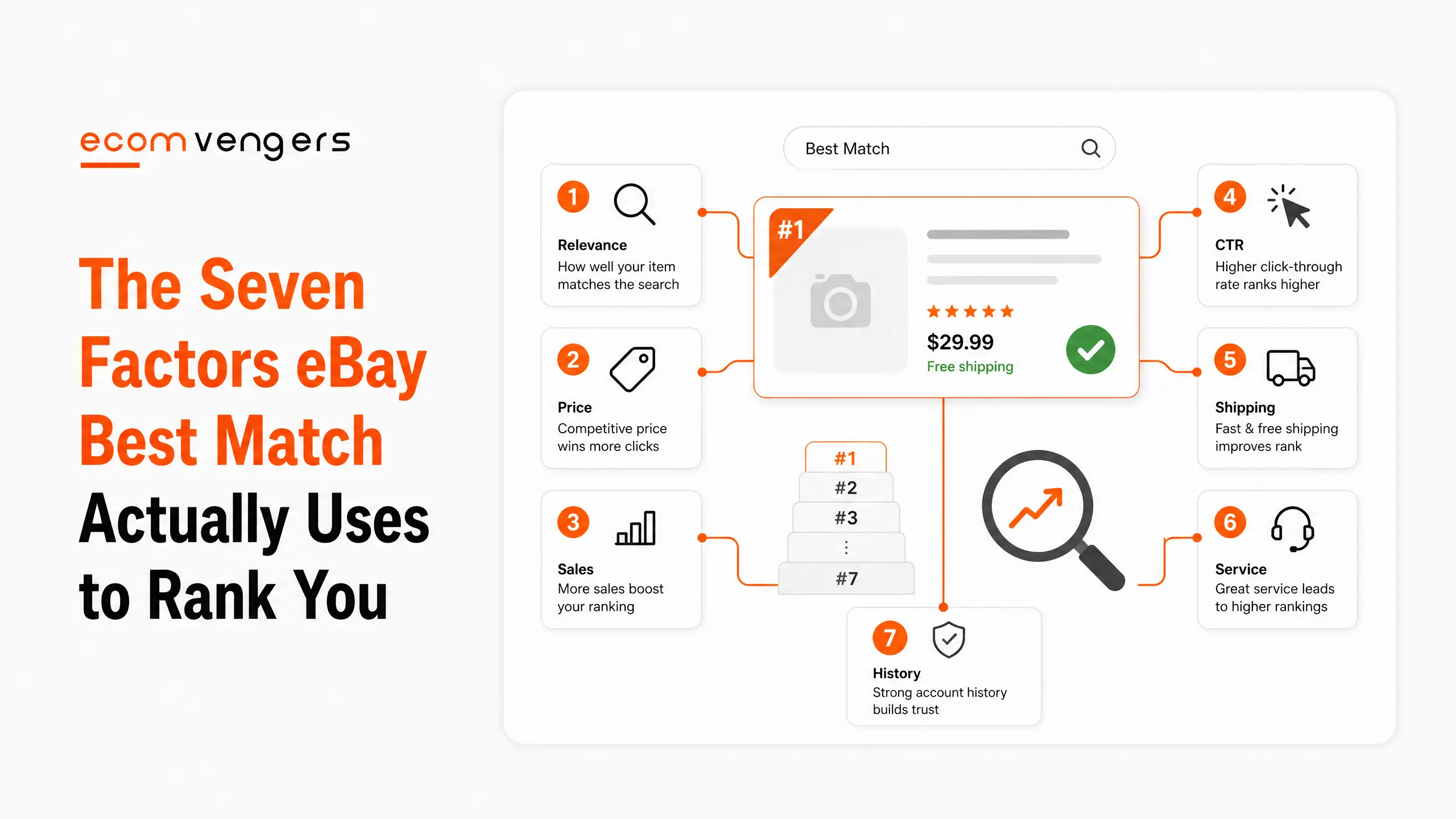
Seven factors decide eBay Best Match, named on a help page anyone can read, and almost nothing written about eBay SEO bothers to quote them.
eBay is also unusually blunt about the whole subject. There is no secret to improving your position in the Best Match sort order.
That sentence puts an entire industry out of business, and it is on eBay’s own site.
Here is what the seven factors actually are, and what eBay tells you to do about each one.
Key Takeaways
- Best Match is the default sort order. eBay SEO is the work of ranking inside it.
- eBay names seven ranking factors. Not three, and not a secret formula.
- Two of the seven are about relevance. Matching the search terms, and how complete the listing is.
- Two are about the offer itself. How popular the item is, and the price.
- One is your seller record. Track record sits in the ranking formula directly.
- Titles get 80 characters. Clear, concise, and spelled correctly.
- You get 24 photos free. Most sellers use a fraction of them.
- No borders or text on images. eBay states this plainly.
- Never use a catalogue stock photo on a used item. Another explicit instruction.
- Your selling terms are a ranking input. Return policy and handling time are named.
- Format choice matters. eBay sets out when auction beats fixed price.
- You can list in a second category. eBay says so directly.
What eBay Best Match Actually Is
Ranking inside one sort order, on one site, against one algorithm.
eBay describes it simply. When buyers search, the default order of results is called Best Match, and it is designed to show the most relevant listings while taking account of what users find most important when deciding what to buy.
Two halves sit in that sentence. Relevance to the query, and desirability to the buyer.
Most sellers work hard on the first half and ignore the second entirely.
This article is about how the ranking works. If you would rather hand the catalogue work to someone, that is what our eBay SEO services page covers instead.
Why it is not Google SEO
There are no backlinks, no domain authority, and no content marketing.
What there is instead is a transaction record. eBay can see whether people clicked, whether they bought, whether the parcel arrived, and whether they complained afterwards.
A search engine that watches the whole purchase is a different animal to one that watches a page.
That is why your account health belongs in a ranking article at all, and we cover that side in the transaction defect rate.
The Seven Factors eBay Names
Straight from the Best Match page, in eBay’s own order.
- How closely the listing matches the buyer’s search terms.
- How popular the item is.
- The price of the item.
- The quality of your listing, meaning description, photos and so on.
- How complete the listing is.
- The listing terms of service, such as your return policy and handling time.
- Your track record as a seller.
Read them as three groups rather than seven items, because that is how the work divides.
Factors one and five are relevance. Two and three are the offer. Four, six and seven are the experience you are promising and the record backing it up.
Only the first group is what most people mean by SEO. The other five factors are running whether you optimise anything or not.
Best Match Factor 1: Matching the Search Terms
The title carries most of this, and eBay gives it three rules.
Write a clear and concise title, spelled correctly, and no longer than 80 characters. Those three rules sit alongside the search manipulation policy, and the title analyser checks a title against both at once.
Notice what is absent. Nothing about repeating a keyword, nothing about stuffing synonyms, and nothing about a formula.
Spelling is a ranking instruction
It reads like housekeeping and it is not.
A misspelled title cannot match a correctly spelled search, and buyers overwhelmingly spell things correctly because their phones do it for them. The old trick of listing under a common misspelling to find bargain hunters works for buyers, not for sellers.
eBay puts correct spelling in the same sentence as the character limit, which tells you how it views the matter.
Clear and concise beats crammed
Eighty characters is a ceiling rather than a quota, a point our guide to writing eBay listing titles that rank works through in detail.
A title reading like a keyword list matches fewer searches than one reading like a product name, because eBay is matching a query to a description of an object rather than counting terms.
Use the words a buyer would type, in the order they would type them, and stop when the item is described.
Our guide to eBay listing optimization works through the tactical side of that in detail.
Best Match Factor 5: How Complete the Listing Is
Taking this one out of order, because it is the other half of relevance.
eBay states the principle in one line. The more it knows about your item, the better it can match it to buyer searches.
Completeness is therefore not tidiness. It is the raw material the matching runs on.
Item specifics are the mechanism
eBay names the fields it wants. Make, model, size, colour and style.
Those are the same fields buyers filter by, which is the part sellers miss. An empty field does not merely weaken your relevance, it removes you from a filtered result set entirely.
Fill every field that applies, not just the ones marked required. We have gone further into how eBay item specifics decide your visibility.
Use the catalogue where you can
eBay asks for an accurate description using product details from its catalogue wherever possible. The catalogue is matched on eBay product identifiers, which are not optional in every category.
That pulls in structured data eBay already trusts, which is faster than typing it and more consistent than guessing at attribute names.
It comes with one warning attached, and we get to that in the photo rules.
Best Match Factor 4: Listing Quality and Photos
Description and photos, and the photo rules are the most specific instructions on the whole page. Our guide to taking eBay listing photos that sell covers the shot list.
eBay asks for high quality photos taken from every angle, showing any flaws or scratches, and notes you can include up to 24 pictures for free.
Twenty four. Most listings we audit use four. A listing video can sit alongside them; see what to put in an eBay listing video.
Two things eBay tells you not to do
Both are common, and both are stated as instructions rather than suggestions.
Do not add borders or text to your photos. That rules out the price flashes, the free postage banners and the branded frames that sellers add believing they help.
Do not use the stock photo as your main picture when using the eBay catalogue, if your item is not brand new. A used item shown by a catalogue image is a not as described return waiting to happen. The catalogue works the other way too: under the eBay images, videos and text policy, your own photos can end up on listings from other sellers.
That second rule connects directly to your metrics, which we cover in eBay service metrics.
Photograph the flaws deliberately
eBay asks for images of scratches, flaws and anything a buyer would want to see.
Sellers resist this because it looks like advertising the worst of the item. What it actually does is remove the gap between the listing and the parcel, and that gap is where returns come from.
A clearly photographed scratch costs you a few buyers. An unphotographed one costs you a case.
Key point: listing quality is the one factor that improves two things at once. Better photos lift your ranking under factor four and cut the not as described returns that damage factor seven. Very little else on eBay pays twice.
Does Your eBay Description Affect Ranking?
eBay names it twice, which is more attention than most sellers give it.
It appears inside factor four as part of listing quality, and again in the instruction to add an accurate description using product details from the eBay catalogue wherever you can.
Accurate is the operative word in both places.
Write it for the buyer who is about to complain
That is a more useful test than writing it for the algorithm.
Name the item condition honestly, include measurements, list what is in the box, and say what is missing. Each of those removes a reason for the return that would otherwise damage factor seven.
A description written to prevent a dispute reads better than one written to please a search engine, and it ranks at least as well.
Nothing on eBay’s page asks you to repeat keywords in the description, and hidden text has never been a good idea anywhere.
Best Match Factors 2 and 3: Popularity and Price
The two you cannot edit your way out of.
eBay names how popular the item is, and the price of the item, as separate ranking factors. Neither responds to a keyword.
Popularity is the market’s verdict on the product. Price is your verdict on the market.
What popularity actually rewards
Items people are already buying, which is a sourcing decision rather than a listing one.
No amount of optimisation lifts a product nobody wants above one everybody does. The honest answer for a dead line is usually to stop stocking it.
That is an uncomfortable thing for an agency to write and it remains true.
Price is competitive, not cheap
eBay twice recommends competitive prices and reasonable postage, and never recommends being cheapest.
Postage sits inside this. A low price with heavy postage reads worse than a fair price with sensible postage, because buyers compare the total.
Price against completed sales rather than against the other live listings, since live listings are the ones that have not sold yet.
Best Match Factor 6: Your Selling Terms
This is the factor sellers are most surprised by.
eBay names the listing terms of service, such as your return policy and handling time, as one of the seven. Your policies are not administrative settings sitting beside the listing. They are part of what decides where it appears.
eBay asks you to make terms and conditions clear, to include postage and handling costs, accepted payment methods and your return policy, and to specify any international limits in your return policy or warranties.
A vague returns policy is therefore a ranking problem as well as a customer service one.
It is also the gate on the fee discount, which we set out in what Top Rated actually requires.
Why Postage Counts as Part of Your eBay Price
eBay mentions reasonable postage twice on a page about ranking, which is not an accident.
It opens by telling sellers to start with competitive prices, reasonable postage and great customer service, then closes with the same three.
Postage therefore sits inside two separate factors at once. It is part of what a buyer compares on price, and it is part of the terms of service eBay names outright.
Buyers compare the total
A cheap item with expensive postage loses to a fairly priced one with sensible postage.
Loading cost into postage used to be a way to look cheap in a sorted list. It now reads badly to buyers and gains you nothing on a factor eBay explicitly frames around reasonableness.
Price the item honestly and charge what postage costs.
Handling time is a promise, not a setting
eBay names handling time as an example of the terms it counts.
A short handling time helps you in search and hurts you everywhere else if you cannot hold it. Missing your own stated window is what produces late shipments, and late shipments damage the track record sitting in factor seven.
Set the time you can keep during your worst week, which is the argument we make in fixing an eBay late shipment rate.
Best Match Factor 7: Your Track Record as a Seller
The account is in the algorithm, which is why this site spends so much time on metrics.
eBay tells you how to keep a positive selling history in three lines. Get the item to the buyer on time and use tracking where possible. Describe the item clearly and accurately. Keep track of inventory to avoid having to cancel sales.
Those three map exactly onto the three things that damage a seller level.
Late parcels, wrong descriptions, cancellations
Read eBay’s own advice against its own penalties and the overlap is total.
On time delivery with tracking is what protects your late shipment rate. Accurate descriptions are what keep item not as described returns down. Inventory control is what stops the cancellations that become defects, which we cover in cancelling without a defect.
So the ranking advice and the account health advice are the same advice.
A seller fighting a defect problem is also fighting a visibility problem, whether or not anyone has told them.
Which is why a demotion hurts twice
Dropping to Below Standard costs placement directly.
eBay applies a search placement penalty straight after that evaluation, on top of whatever factor seven was already doing to you. The recovery sequence sits in getting off Below Standard.
Rebuilding after that is its own project, and we walk through it in recovering sales after reinstatement.
Auction or Fixed Price: Which Format Ranks Better?
eBay sets out when each one is the correct choice, and it is not a ranking trick.
Use auction style when you are not sure of the value of your item and want to sell it quickly, or where the item is unique or hard to find.
Use fixed price when you know the value or the price you want, when you have multiple items you can group into a multi quantity or multi variation listing, when you have a lot of inventory and want to minimise listing fees, or when you want your items visible for more than 10 days.
That last clause is the ranking one. An auction disappears after ten days and takes its accumulated history with it.
Why fixed price usually wins for a business
Because a listing that persists can accumulate the signals the other factors measure.
Views, watchers and sales history all attach to the listing. Ending and recreating it throws that away and starts from nothing, which is the same mistake sellers make when relisting after a problem.
Revise rather than relist, wherever the platform allows it.
Category, and the Second Category Nobody Uses
Pick the category most relevant to your item, and know that you have an option most sellers ignore.
eBay states you can also choose to list in a second category.
That is genuinely useful for items sitting between two obvious homes, and it carries a fee on many sites, so treat it as a decision rather than a default.
Getting the first category wrong is the more common and more expensive error, because filters and browse paths run off it. We cover how to choose an eBay listing category in its own guide.
What eBay Does Not Say
Worth listing, because most eBay SEO advice lives here.
The Best Match page says nothing about keyword density, nothing about hidden text in descriptions, nothing about ending and relisting on a schedule, and nothing about a magic hour to list at.
It also names no weightings. Seven factors are listed without any indication of how much each one counts, and anyone presenting a percentage breakdown has invented it.
What eBay does say, twice, is that there is no secret and that following good listing and selling practice is what lifts you.
That is a boring answer, and it is the sourced one.
Worth knowing: the absence of published weightings is not an invitation to guess at them. It means the sensible strategy is to be strong on all seven rather than to optimise one and hope it carries the rest.
How Do You Diagnose an eBay Listing That Will Not Rank?
Work the seven factors in order and the answer usually arrives within minutes.
Start by searching for your own item
Type what a buyer would type, and see whether you appear at all.
Appearing low is a different problem to not appearing. If the listing is missing entirely from a search you should obviously match, the cause is relevance or eligibility rather than ranking.
Then repeat the search with a filter applied, such as a size or a colour. A listing that vanishes when a filter goes on has an empty item specific behind it.
Compare yourself with what outranks you
Open the three listings above yours and read them against the seven factors.
Count their photos. Read their titles. Check their handling time and their returns policy. Look at the total price including postage rather than the headline figure.
In most audits we run, the gap is visible in under a minute and it is rarely the title.
Then check whether the problem is the account
If every listing you own has slipped at once, the cause is not any individual listing.
A whole catalogue moving together points at factor seven, and usually at a seller level that changed at the last evaluation. That is a very different repair job.
One listing sinking while the rest hold steady points at the listing itself.
Key point: the single most useful diagnostic question is whether one listing dropped or all of them did. It splits the problem cleanly into a listing job and an account job, and those need completely different weeks of work.
Where Promoted Listings Fits Against Best Match
Alongside the seven factors rather than instead of them.
Advertising buys placement. It does not improve the listing, the price, the terms or the record, and a promoted listing that nobody clicks is an expensive way to learn that. We break down how eBay Promoted Listings work and what they cost separately.
Get the seven right first, then advertise the listings that already convert. Our Promoted Listings management is built around exactly that order, and the Promoted Listings calculator sets the rate those listings can carry.
Below Standard sellers cannot use it at all, which is another reason factor seven comes first.
Which Metrics Show Your eBay Ranking Is Improving?
Three numbers, and they answer three different questions.
Impressions answer whether you are being surfaced
This is the ranking number, and it moves when the first five factors improve.
Flat impressions after a week of title and item specific work means the listing is still not matching the searches you assumed it would. Go back to the search box and check.
Views answer whether the result is attractive
Impressions rising while views stay flat is a thumbnail and price problem.
Buyers are seeing you and choosing something else, which points at the main image, the title and the total cost rather than at relevance.
That is a very different fix to the one above, and running both at once tells you nothing about which worked.
Sales answer whether the page delivers
Views rising without sales is a listing page problem.
Description, photo depth, postage cost, returns policy and condition detail all live here. So does trust, which is where a thin listing quietly loses to a thorough one at the same price.
Change one thing at a time, and give each change a fortnight before you judge it.
On one eBay AU store we grew, impressions, views and units sold all moved together, and that simultaneous movement is what separates real recovery from bought traffic.
Which eBay Ranking Fixes Should You Do First?
Cheapest and fastest first, since the seven factors are not equally easy to move.
- Fill every item specific that applies. Free, immediate, and it feeds two factors.
- Rewrite titles that read like keyword lists. Free, and limited only by your time.
- Add photos up to the 24 you already pay nothing for.
- Tighten the terms. Handling time you can hold, and a returns policy you will honour.
- Fix the account health problems, because they are the slowest to move.
- Only then review pricing and what you stock.
The first three cost nothing but attention, and most catalogues we audit are failing all of them.
Frequently Asked Questions
What is eBay SEO?
The work of ranking inside Best Match, which is the default order of eBay search results. eBay names seven factors its algorithm considers, from search term matching through to your track record as a seller.
How many ranking factors does eBay have?
Seven are published on the Best Match page, introduced as factors the algorithm considers. eBay gives no weightings, so any percentage breakdown you see elsewhere is somebody’s guess.
How long should an eBay title be?
No more than 80 characters, and eBay asks for clear, concise and correctly spelled rather than full. Using every character is not the goal.
How many photos should I upload?
You can include up to 24 free, and eBay asks for every angle plus any flaws or scratches. There is no reason to stop at four.
Can I put text or a border on my photos?
No. eBay instructs sellers not to add borders or text to photos, which rules out price flashes and promotional frames.
Does my returns policy affect my ranking?
Yes. eBay lists the terms of service, giving return policy and handling time as its examples, among the factors Best Match considers.
Does ending and relisting improve my position?
Nothing on the Best Match page suggests it does, and a new listing starts without the views, watchers and sales history the old one had accumulated.
Is auction or fixed price better for ranking?
eBay frames the choice around your situation rather than around ranking. Fixed price suits sellers who know their price, hold stock, and want visibility beyond 10 days.
Can I list in two categories?
Yes, eBay states you can also choose a second category. It usually carries a fee, so use it where an item genuinely sits between two homes.
Does my seller level really affect search?
Your track record is one of the seven factors, and a Below Standard evaluation adds a separate placement penalty on top. The two compound.
Will Promoted Listings fix a weak listing?
No. Advertising buys placement for a page that still has to convert, so it multiplies whatever the listing already does. Fix the seven factors first.
Do I need keywords in the description?
eBay asks for an accurate description using catalogue product details, and says nothing about repeating keywords. Write it to prevent returns rather than to please a search engine.
Why did all my listings drop at once?
A whole catalogue moving together points at your account rather than any listing. Check whether your seller level changed at the last evaluation on the 20th.
Does free postage help my ranking?
eBay asks for reasonable postage rather than free postage. Buyers compare the total cost, so a fair item price with sensible postage beats a low price with an inflated delivery charge.
How long before changes show up?
Give any single change a fortnight before judging it, and change one thing at a time. Running three fixes together tells you the listing improved without telling you which fix did it.
Should I revise a listing or start a new one?
Revise wherever you can. A new listing begins without the views, watchers and sales history the old one had built up, and those feed the popularity factor.
When should I bring in help?
When the catalogue is large enough that item specifics and titles cannot realistically be fixed by hand. That bulk work is what our eBay SEO service exists for.
Be Strong on Seven Things
eBay published the list, said there was no secret, and most of the industry decided that could not possibly be true.
First, fill the item specifics, because completeness is the factor you control absolutely.
Second, photograph properly and take the 24 slots you are already given.
Third, protect the track record, since it is a ranking factor and a penalty at the same time.
Then price sensibly and stop looking for the trick. There is not one, and eBay said so first.
Documented growth work sits in the case study archive, including an eBay AU store that went from barely surfacing to 829,607 impressions in 90 days. More across the rest of the EcomVengers blog.
Four moves, in this order, when a listing will not rank.
First, work out whether one listing dropped or all of them did. That single question splits a listing job from an account job, and the two need different weeks.
Second, fix the matching before anything else. If the words a buyer types are not in your title and specifics, no other factor gets a chance.
Third, read impressions rather than sales while you work. Impressions tell you whether eBay is surfacing you, which is the part you just changed.
Fourth, advertise only what already converts. Promotion multiplies a listing, and multiplying a poor one is an expensive way to confirm it was poor.
Worth holding on to: eBay names seven factors and publishes no weightings. Any percentage breakdown you meet elsewhere is somebody guessing with confidence.
Sources
- eBay, Optimising your listings for Best Match, for the factors eBay names and the guidance attached to each.
- The search manipulation policy, for the listing structures eBay says help reach the best position, and the ones that break a rule.
- Details in the seller standards policy, for the seller record that feeds the seventh factor.
- Our own figures come from published client cases with the eBay messages attached, collected in our eBay case study library.

Ali Khan is the founder of EcomVengers, the eBay growth and account recovery agency. He has spent the better part of a decade pulling suspended sellers back from MC011 and MC999 notices, repairing wrecked defect rates, and turning buried listings into ranked ones. When eBay's villains show up, he is the one sellers call. You handle the millions, he handles the villains.
View all posts by Ali Khan