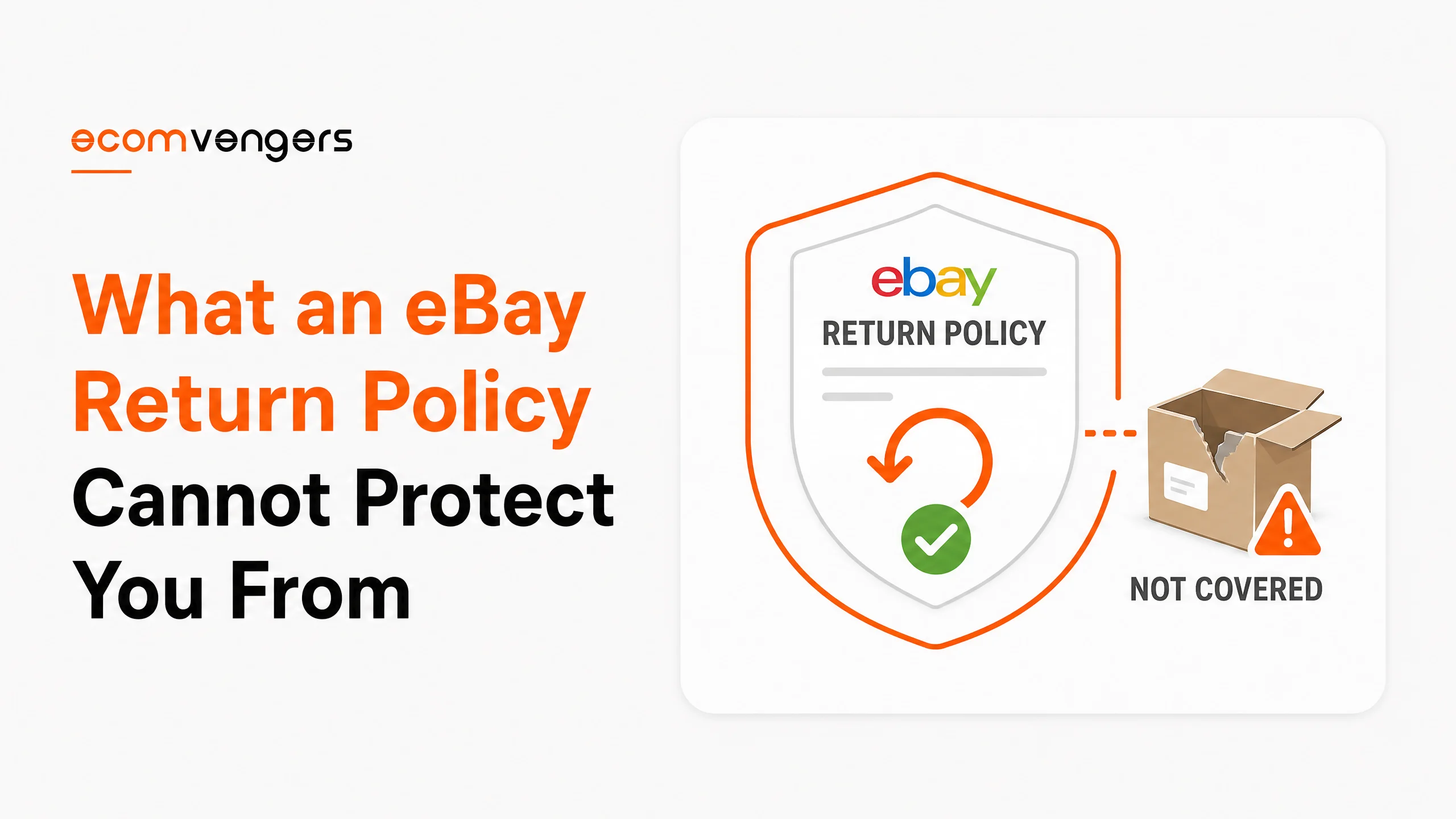
You set your listing to no returns. You feel protected.
Then a buyer says the item does not match the listing, and the return arrives anyway.
eBay is direct about it. Where an item is the wrong size or fit, or does not match the description, you are required to accept the return and cover the return postage.
Your policy governs one kind of return. The Money Back Guarantee governs the other, and it does not ask your opinion.
Sellers reach us convinced eBay broke its own rules. It rarely has. It applied a rule they had never read.
Which returns you control, which you do not, and the clock that turns one into a defect, which is where your eBay transaction defect rate starts to move.
Key Takeaways
- Your returns policy governs change of mind returns only.
- A not as described return runs on the Money Back Guarantee instead.
- eBay requires you to accept those and cover the return postage.
- A no returns policy does not stop them. It stops the other kind.
- Money Back Guarantee cover runs 30 days from the estimated or actual delivery date.
- Once the item is back, you have two business days to inspect and refund.
- eBay reimburses the final value fee once you refund the buyer.
- It also says accepting the return can reduce the chance of a defect.
- Label subsidies and refund deductions may apply to your case.
- You can set return address rules by reason, refund amount or other conditions.
- Rules can also auto accept returns or send an immediate refund.
- Some categories sit outside the guarantee entirely, including vehicles and property.
The Two Kinds of eBay Return
One you write the rules for. One eBay writes for you.
A change of mind return is yours. Sellers call it buyer remorse, and your policy decides whether you take it, how long the returns window runs, and who pays the postage.
A not as described return is not yours. eBay says you are required to accept it and cover the return shipping cost.
It gives three examples of that second group. Wrong size, wrong fit, or an item that does not match the description.
Notice how ordinary those are. None of them require bad faith, and two of them can happen on an accurate listing.
What a no returns policy actually does
It closes the door you controlled and leaves the other one open.
eBay describes the signal it sends. A no returns policy tells buyers to take extra time making sure they are buying the right thing.
That is a real effect, and it cuts both ways. Fewer casual returns, and fewer casual buyers.
What it does not do is stop a case. So sellers who choose it expecting immunity have bought the wrong product.
Key point: a no returns policy closes change of mind returns only. eBay still requires you to accept a not as described return and cover the postage.
The Two Clocks Running on Every Return
One belongs to the buyer. The shorter one belongs to you.
Money Back Guarantee cover runs for 30 days from the estimated or actual delivery date. That is the window a buyer has to raise a problem.
Your clock starts later and runs faster. Once the returned item reaches you, eBay gives you two business days to inspect it and refund, or to ask eBay for help.
Two business days is not long when a parcel lands on a Friday. Sellers lose cases to a bank holiday more often than to a dispute.
Pro tip: set a rule to accept returns automatically. Most sellers lose the window to a delay rather than a decision, and the rule removes the delay entirely.
Asking for help counts as acting
Worth knowing, because sellers treat silence as a position.
Where the item comes back damaged, incomplete or plainly not the one you sent, you contact eBay inside the window rather than sitting on it.
The sequence before that is worth knowing too. eBay notifies you when a return request arrives, and where the return meets your policy or the guarantee it provides the buyer with a return label straight away.
Doing nothing hands the decision to eBay anyway, and it arrives without your evidence attached.
Why Accepting a Return Is Usually the Cheap Option
Because of what eBay hands back when you do.
Two things follow a refund. eBay reimburses your final value fee, and it states that accepting the return can reduce the chance of getting a defect.
It also names protections that may apply to your case, including label subsidies and refund deductions.
Sellers usually ask about this as a restocking fee. eBay frames it as a refund deduction instead, so a partial refund is the mechanism rather than a fee you set yourself.
Refusing does not make the return go away. It converts a return into a case, and a case eBay closes against you counts twice over.
Once as a case closed without seller resolution, and again inside your defect rate. Both of those are covered in why two eBay cases closed without seller resolution can end your account.
So the argument you win on principle can cost more than the item did.
Where a Return Turns Into a Service Metric
At the moment the buyer picks their reason, not at the refund.
A not as described return feeds your item not as described rate. That rate sits in service metrics, where eBay compares you against sellers with a similar profile.
It counts the report rather than the outcome. Refunding within the hour does not remove it, which is the argument in why resolving a case fast still counts against your eBay service metrics.
So generosity protects the relationship and the seller level. It does not protect that particular number.
Let the case count climb instead and the seller level itself moves. That route ends at Below Standard, and getting back out is covered in getting off eBay Below Standard.
Only fewer reports move it, which means the work happens in the listing rather than in the resolution.
How to Choose an eBay Return Policy That Fits
The choice is narrower than it looks, because half the decision is already made.
You are only setting terms for change of mind returns. Everything else runs on the guarantee whatever you pick.
A longer window is a selling argument
eBay frames it that way directly.
A generous window, such as 30 or 60 days, tells buyers you will be there if something goes wrong. That confidence is worth something at the point of purchase.
It also spreads returns out. A 60 day window rarely produces more returns than a 30 day one, and it does produce more sales.
Free returns are a trade, not a gift
eBay says offering free returns helps drive sales and builds buyer confidence.
You are buying conversion with postage. Whether that trade works depends on your margin and your return rate, and both of those are numbers you already have.
Run it per product line rather than across the shop. Free returns on a heavy low margin item is a different proposition from free returns on jewellery.
No returns suits a specific kind of stock
Not the kind most sellers apply it to.
It fits items where a change of mind return is genuinely unworkable, and where your description leaves no room for a not as described claim.
Applying it to used goods with thin descriptions achieves the opposite. You have blocked the cheap return route and left the expensive one wide open.
What eBay Gives Back for a Buyer-Friendly Return Policy
A return policy reads like a pure cost. eBay treats it as a placement signal too, and it pays for that signal in search.
eBay states it has launched features that help listings with buyer-friendly return policies stand out in search results. Two of them reach the buyer before your listing does.
- A free returns filter. Buyers narrow results by returns policy, so a stricter policy drops you out of that filtered set completely.
- A free returns label. eBay flags the generous policy while the buyer is still scanning results.
So the policy decides more than what happens after a sale. Sometimes it decides whether the listing is seen at all. That puts it beside the other inputs in how Best Match ranks listings.
The protection that makes free returns affordable
Most sellers refuse free returns because they picture paying postage on goods that come back ruined. eBay answers that objection directly.
A seller offering free returns can issue a partial refund instead of a full one. The deduction runs to 50% of the item price when the item comes back worse than it left. Sellers on a standard paid return do not get that right.
Read it as a trade rather than a giveaway. You take on the postage, and in exchange you get the deduction, the filter and the label.
Key point: the deduction rides on free returns, not on the length of your window. eBay names 30 or 60 days as a generous window, but it is the free postage that unlocks the partial refund.
The Return Rules Most Sellers Never Set Up
eBay lets you automate a surprising amount of this, and almost nobody does.
You can set your returns address rules so items come back to different places depending on the return reason, the refund amount, or other conditions.
You can also create rules that automatically accept returns, or send an immediate refund.
Immediate refunds below a threshold
This is the rule worth setting first.
On a low value item, the postage to get it back can exceed what the item is worth to you. Refunding without a return is often cheaper, and it ends the case in minutes.
Set the threshold from your own numbers rather than a feeling. Compare the return postage against the recovery value of the item coming back.
Automatic acceptance protects the clock
Most sellers lose time rather than arguments.
A rule that accepts returns automatically removes the delay between the request arriving and somebody noticing it. That delay is where escalation lives.
It suits anyone who was going to accept the return anyway, which on a not as described claim is everyone.
What the Money Back Guarantee Does Not Cover
A specific list, and it is worth knowing if you sell in those categories.
eBay excludes motor vehicles, recreational vehicles, motorbikes, boats and aircraft. It also excludes industrial construction machinery, real estate, websites and businesses for sale.
Classified ads, services, digitally delivered content, travel tickets and vouchers sit outside it too, along with items combined with or attached to NFTs.
eBay explains the reason as the unique nature of those items or the delivery method they need. Sellers in those categories are working under their own terms rather than the guarantee.
Why Return Postage Costs More Than the Label
The label is the small part. The handling is the rest.
A returned item has to be received, opened, checked against what you sent, repackaged and relisted. On a busy week that is the job that gets postponed, and postponing it is what runs down the clock.
Then there is the stock itself. An item that comes back opened rarely resells at the price it left at, so the loss is the discount as well as the postage.
Build the return into the price, quietly
Sellers price for the sale and then treat every return as an unexpected loss.
A product line returning one in twenty needs that cost in the margin from the start. Work it out once per line and stop being surprised by it monthly.
Our eBay fee and profit calculator has a refund rate field for exactly this, so you can see what a return rate does to a margin before you set the price.
How to Cut Your eBay Return Rate at Source
Returns are a listing problem long before they are a logistics one.
Three of eBay’s own examples for a mandatory return are wrong size, wrong fit and does not match the description. All three are things a listing can prevent.
Measure it rather than name the size
A size label means different things across brands and decades.
Give the actual measurements, flat, in centimetres. Chest, length, sleeve, waist. A buyer with a tape measure does not open a wrong size case.
Photograph the flaw you would rather not mention
The mark you hope nobody notices is the one that comes back.
Shoot it close up and name it in the description. Buyers forgive a flaw they were told about, and they open cases over flaws they discover.
Condition labels carry their own promises here, which is the whole of what each eBay item condition promises the buyer on your behalf.
Say what is in the box
Missing accessories generate more disputes than cosmetic wear.
List what ships and what does not. Cable, charger, manual, remote, original packaging. Buyers assume the complete set unless you say otherwise.
Read your returns by reason each month
The pattern is usually narrower than sellers expect.
One product line, one supplier, or one photograph is normally producing most of them. Fixing that beats improving your returns process across the board.
Check the structured fields while you are there. Wrong item specifics put you in front of buyers looking for something else, and a loose listing title does the same, so both quietly raise your return rate.
What a Good Returns Process Cannot Fix
The report that started it.
Handling returns quickly protects your seller level, your buyer relationships and your fees. It does not remove an item not as described report from your service metrics.
Nor does it help a listing nobody reaches. Returns only exist where sales exist, and sales are a title and specifics job first.
One more honest limit. Some returns are simply the cost of selling online, and a return rate of zero usually means a description so cautious that it is costing you sales.
Frequently Asked Questions
Can I refuse a return on eBay?
Only a change of mind return, and only where your policy says no returns. Where the buyer says the item does not match the listing, eBay requires you to accept it.
Does a no returns policy protect me?
It closes change of mind returns. It does nothing about a not as described claim, which runs on the Money Back Guarantee instead.
Who pays return postage on eBay?
On a change of mind return, your policy decides. On a not as described return, eBay states that you cover the return shipping cost.
How long does an eBay buyer have to open a case?
Money Back Guarantee cover runs 30 days from the estimated or actual delivery date.
How long do I have to refund a returned item?
Two business days from the item arriving back with you, to inspect and refund or to ask eBay for help.
Do I get my final value fee back?
Yes. eBay reimburses the final value fee once you refund the buyer.
Does accepting a return avoid a defect?
eBay says accepting the return can reduce the chance of getting a defect. Refusing risks a case closed without seller resolution, which lands as both a case and a defect.
Can I deduct from the refund if the item comes back damaged?
Yes, if you offer free returns. eBay lets those sellers issue a partial refund instead of a full one. The deduction runs to 50% of the item price when the item comes back worse than it was sent. Sellers on a standard paid return do not get that right.
Can I set different return addresses?
Yes. You can set rules by return reason, refund amount or other conditions, and send returns to different locations.
Should I refund without asking for the item back?
Often on low value items, where return postage costs more than the item is worth to you. eBay lets you automate that with an immediate refund rule.
Are free returns worth offering?
eBay says they help drive sales and build buyer confidence. Whether the trade works depends on your margin and your return rate, so run it per product line.
Which items are not covered by the Money Back Guarantee?
Vehicles, motorbikes, boats, aircraft, industrial construction machinery, real estate, websites and businesses for sale. Classified ads, services, digital content, travel tickets and NFT related items are also excluded.
Set the Policy You Control, Fix the Listing You Do Not
Half of your returns are governed by a document you did not write.
Four steps, in this order, if returns are eating your month.
First, split your returns by reason. Change of mind belongs to your policy, and not as described belongs to the guarantee. Only one of those responds to a policy change.
Second, protect the two business day window. Set a rule to accept returns automatically, because most sellers lose to a delay rather than to a decision.
Third, set an immediate refund threshold. Where return postage costs more than the item is worth back, asking for it returned is an expensive way to make a point.
Fourth, read last month’s returns by reason and find the product line producing them. That single fix beats any process improvement.
Worth holding on to while you work: a no returns policy is a marketing position rather than a shield. It tells buyers to be careful, and eBay says as much, but it leaves the expensive route untouched.
The only lever that moves not as described returns is the listing. Measurements instead of size labels, the flaw photographed rather than hoped over, and a plain list of what is in the box.
Write the policy for the returns you control. Write the listing for the ones you do not.
Sources
- The UK Seller Centre on buyer-friendly return policies, for the free returns filter, the free returns label, the improved search visibility and the 50% partial refund deduction.
- The UK Seller Centre on managing returns, for 30 or 60 days being named as a generous window.
- eBay Seller Center, Managing returns, for the requirement to accept a wrong size, wrong fit or not as described return and cover the postage, the two business day inspection window, the final value fee reimbursement, the label subsidies and refund deductions, and the return address and automation rules.
- The eBay Money Back Guarantee, for the 30 day cover from the estimated or actual delivery date and the list of excluded categories.
- Details in the seller standards policy, on cases closed without seller resolution counting as transaction defects.
- The service metrics policy, on the item not as described rate and the peer benchmarking behind it.
- Our own examples come from client cases we have worked, and the wider guides sit in the EcomVengers blog.
One number to check before you change anything. Your defect headroom decides how urgent this is, and the eBay seller level calculator works it out from your own volume.
Where returns have already pushed a metric somewhere you cannot pull it back from, that is the work we do. Send us a month of return reasons and we will tell you which listings are generating them.

Ali Khan is the founder of EcomVengers, the eBay growth and account recovery agency. He has spent the better part of a decade pulling suspended sellers back from MC011 and MC999 notices, repairing wrecked defect rates, and turning buried listings into ranked ones. When eBay's villains show up, he is the one sellers call. You handle the millions, he handles the villains.
View all posts by Ali Khan