eBay allows you two.
Not two per cent. Two cases.
Your defect rate gets 2% of everything you sell, and late deliveries have no minimum requirement at all. Cases closed without seller resolution gets a number you can count on one hand.
Most sellers meet that asymmetry in the month it costs them their seller level. eBay cases closed without seller resolution is the shortest leash on your account.
The good news sits in eBay’s definition, and it has three parts rather than one.
Key Takeaways
- Three things must all be true. You did not resolve the issue, eBay stepped in, and eBay found you responsible.
- Resolving it yourself leaves no mark. A full refund you issue before eBay steps in does not count against this metric.
- The allowance is 2, or 0.3% of transactions, whichever is higher. eBay states the tie break explicitly here.
- The crossover falls at 667 transactions. Below that you get exactly two, and above it the percentage takes over.
- Unique buyers do not soften this metric. eBay applies that protection to defect and late delivery rates only.
- Only two metrics decide Below Standard. This one, and the transaction defect rate.
- You have 30 days to appeal. eBay counts that window from its decision on the case.
- Evaluation lands on the 20th. Work the queue before it, or wait a full cycle.
- Your evaluation period depends on volume. Over 400 transactions in three months uses three months, otherwise twelve.
- Below Standard costs Promoted Listings immediately. eBay blocks new campaigns and edits to existing ones.
- Fees rise from the 1st of the next month. The penalties arrive on two different clocks.
- A long run Below Standard reaches your other accounts. eBay may restrict related accounts as well.
What Is a Case Closed Without Seller Resolution?
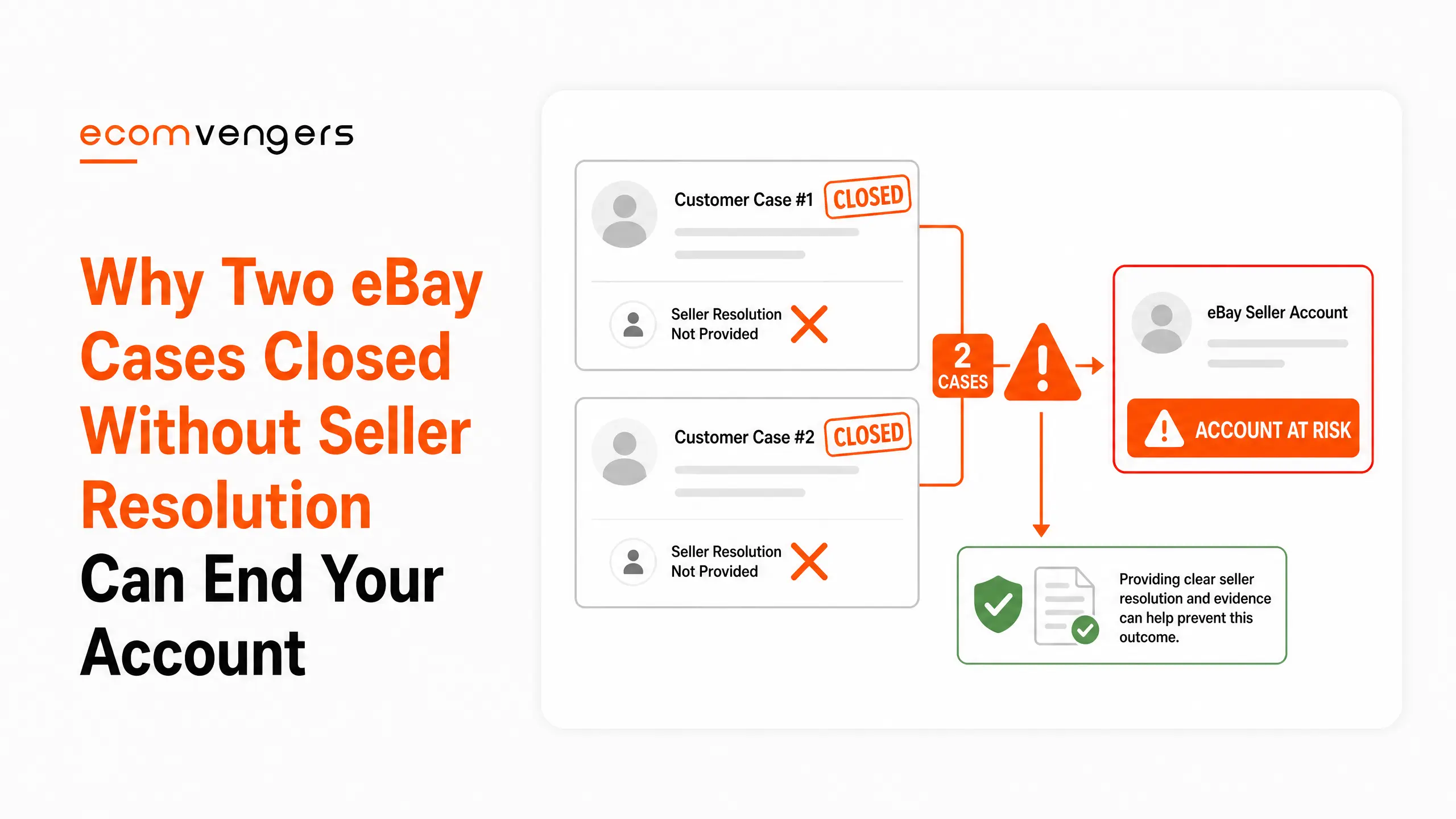
It is a buyer issue that you did not settle, that eBay then decided, and that eBay decided against you.
eBay sets the sequence out in its seller standards policy. When a buyer reports that an item has not arrived or requests a return, the seller is responsible for providing a resolution.
A case counts against you when the seller did not resolve the buyer’s issue, eBay stepped in to review the case, and the seller was found responsible.
Read that as three conditions rather than one outcome.
For the actions, time frames and how it decides an outcome, eBay points sellers to its Money Back Guarantee policy. That is where the case rules actually live.
Where the chain breaks
You only need to break one link, and the first one is entirely yours.
Refund the buyer, accept the return, or send the replacement before eBay steps in, and the first condition fails. Nothing reaches the metric, however much the order cost you.
Sellers routinely lose money on the refund and take the mark as well, because they argued until eBay decided for them.
Paying and losing is the worst of the available outcomes, and it is the most common one.
Which Buyer Requests Become Cases Closed Without Resolution?
Two of them, and eBay names both in the sentence that defines the metric.
The definition starts when a buyer reports that an item has not arrived, or requests a return. Those are the two openings that can end as a case closed without seller resolution.
Everything else flows from one of them.
Item not received
The buyer says the parcel never came, and tracking decides the rest.
A delivery scan to the buyer’s address is the strongest position available to you. Without one you are asking a reviewer to prefer your word to that of a buyer who is out of pocket.
That is a bet worth avoiding on anything you can afford to track.
Return requests
The buyer wants to send it back, and the reason they select changes your position entirely.
Where the reason given is not as described, your own returns policy stops being the document that decides it. Sellers refuse those requests on the strength of a no returns setting and lose the case that follows.
A remorse return and a not as described return are different problems wearing the same button.

How Many Cases Closed Without Seller Resolution Are Allowed?
Two, or 0.3% of your transactions, whichever is higher.
eBay states that tie break in plain words on this metric, which it does not do everywhere. The allowance is 2 cases within an evaluation period, or 0.3% of your transactions, whichever is higher.
So the 2 is a floor rather than a ceiling. A large seller is not capped at two cases a year, and a small seller is not punished for having no volume to dilute them.
Where the crossover falls
At 667 transactions, and the arithmetic is worth doing once.
0.3% of 667 is exactly 2. Below that volume the flat allowance of two is the higher number, so it is the one that applies. Above it the percentage takes over and your allowance grows with your sales.
On 200 transactions you get two. On 3,000 you get nine.
Work out your own number before you assume you are close to the edge, because half the panic we field on this metric is arithmetic rather than performance.
Which transactions get counted
Your evaluation period moves with your volume, which changes the denominator.
eBay counts the last three months for sellers with more than 400 transactions in that window. Everyone else is measured across the last twelve months instead.
That second rule cuts both ways. A quiet seller gets a year of sales to dilute a bad case, and also carries that case for a full year.
eBay also states it only counts transactions where the buyer has paid.
Do the arithmetic once: take your transaction count for the evaluation period that applies to you, multiply by 0.003, and compare it against 2. Whichever number is higher is your actual allowance. Write it down, because it is the only threshold that matters on this metric. Our seller level calculator runs the same comparison if you would rather not do it by hand.
Why Cases Closed Without Resolution Bite Hardest
Two reasons, and the second one surprises people who have read the defect rules.
Only two metrics decide Below Standard
The minimum standards list is short, and late delivery is not on it.
eBay names two requirements. No more than 2 cases closed without seller resolution, or 0.3% of transactions, and a transaction defect rate no higher than 2%.
A wall of late parcels will cost you Top Rated and nothing more. Two lost cases can move you to Below Standard on their own.
Our guide to the transaction defect rate covers the other half of that list.
Unique buyers do not soften it
This is the protection sellers assume they have and do not.
Under fair evaluation, eBay says it takes the number of unique buyers into account for your transaction defect and late delivery rates. Cases closed without seller resolution is absent from that sentence.
So one determined buyer opening three cases against you lands three marks, where the same buyer generating three defects would be weighed differently.
The one defect per transaction rule still applies, and it is the only dilution on offer here.
What Happens If These Cases Take You Below Standard?
The penalties arrive on two different clocks, which is why the damage feels like it keeps growing.
Straight after the evaluation
Five things, and eBay applies them immediately.
- Your items may sit lower in Best Match search results.
- Your selling limits may decrease.
- eBay blocks you from Promoted Listings, including edits to existing campaigns.
- Funds from your orders may sit on hold until tracking shows the item is on its way.
- You lose the ability to deduct from a refund when an item comes back used or damaged.
The Promoted Listings block is the one that catches growth sellers hardest. You cannot edit your way out of it, because editing is part of what stops.
The funds hold is covered in our guide to surviving an eBay payout hold.
From the 1st of the following month
Higher final value fees, on everything you sell.
That delay is why sellers think they escaped. The search and advertising penalties land on the 20th, the money lands on the 1st, and the second one is the one you feel in the accounts.
If it goes on for months
The consequences stop being about one account.
eBay states that where an account has been Below Standard for an extended period, it may downgrade the Store to Basic. It may also place selling restrictions on your account and related accounts, or stop you registering a new one.
That is the sentence connecting a performance problem to a suspension, and we follow it through in why eBay suspends an account for being linked to another.
Read Your Projected eBay Seller Level, Not the Current One
Your dashboard shows two numbers, and only one of them is a warning.
eBay states that the Seller Dashboard shows your current seller level alongside the level you would get if it evaluated you today. The second figure is the one carrying information you can still act on.
eBay also recommends checking it regularly, so you can take action before the next evaluation rather than after it.
Sellers watch the current level, see Above Standard, and relax through the exact fortnight that decides the next one.
What to do with a projected Below Standard
Treat it as a deadline rather than a verdict.
Three things still move that projection before the 20th. Resolve every open request yourself, appeal any case decided in the last 30 days, and keep selling cleanly so the denominator grows.
After the 20th none of the three help you until the following month, which is the difference between a bad fortnight and a bad quarter.
Step #1: Resolve It Before eBay Steps In
This is the whole game, and it is decided in the first 48 hours of a case.
A buyer opens a request. You now have a window in which any resolution you provide is yours rather than eBay’s. Refund, replace, accept the return, or send the postage label.
Do it inside that window and the first condition never becomes true.
The three responses that create these cases
Silence. An unanswered request escalates on its own timetable, and eBay decides it without your side of the story.
Arguing the principle. You may be entirely right about the buyer and still lose the case, at which point you have paid the refund and taken the mark.
Partial gestures. A part refund the buyer rejects is not a resolution, and the case continues from where it was.
Key point: the money is usually gone either way. Deciding quickly changes whether you also lose the metric, and the metric is worth more than the order on all but your largest sales.
When Should You Defend a Case Instead of Refunding?
When the third condition is the one you can beat.
eBay only records the case where it finds the seller responsible. A decision in your favour leaves nothing on the metric at all, so a case you can win costs you nothing but the wait.
The question is what you can actually evidence.
Evidence a reviewer can check
Scans, timestamps, and photographs taken before the parcel left you.
Tracking showing delivery to the buyer’s address, a carrier scan inside your dispatch window, or a listing photograph of the exact item all give a reviewer something to verify. Those cases deserve a proper defence.
What will not move a decision
Your feedback score, your years on the platform, and your read on the buyer’s motives.
None of that can be checked, so none of it counts. Sellers routinely spend their strongest paragraphs on exactly this material and wonder why the decision went the other way.
Where your case rests on character rather than record, refund it today and keep the metric.
Worth knowing: order value changes the calculation. On a small item the metric is worth more than the money, so resolve it and move on. On a high value order with a delivery scan behind you, the case is worth defending properly.
Step #2: Appeal Inside the 30 Day Window
eBay gives you a month, counted from its decision rather than from the evaluation.
The policy states you can appeal a case closed without seller resolution within 30 days of eBay’s decision on that case. Miss it and the mark stays for the rest of your evaluation period.
Work from your Seller Dashboard rather than from memory, and check each case against something eBay can verify.
An appeal that offers new evidence is a different submission to one that repeats your original argument more loudly. Our guide to why most eBay appeals fail covers that distinction in detail.
The protections that remove marks for you
Some come off without an appeal, and it is worth checking before you write one.
eBay states it automatically removes associated defects where it determines a buyer has violated its abusive buyer policy. It also removes defects and late deliveries for events outside your control, giving severe weather and carrier disruptions as its examples.
Both of those sentences name defects rather than cases, so do not assume a case comes off the same way. Report the abusive buyer anyway, because the defect removal is real and it is free.
Step #3: Fix the Causes Behind Your eBay Cases
Cases are a symptom, and they cluster around a small number of causes.
Item not received, on untracked postage
Without tracking you cannot win the case, because you cannot evidence delivery.
An item not received request against an untracked parcel has one likely ending, and it is not the one where you keep the money. Tracking turns an argument into a record.
The same scan protects your late delivery rate, which we cover in fixing an eBay late shipment rate.
Listings that describe an object you did not send
Not fraud, usually. Just a photo from the good one and a condition note written optimistically.
Not as described requests come from the gap between the listing and the parcel. Photograph the actual item, name the flaw, and the gap closes.
Our guide to eBay listing optimization covers the description side of this.
A returns policy you did not mean
Refusing a return you advertised is the fastest route to a case you will lose.
Set the policy you will actually honour on a bad week, not the one that reads best. A 30 day policy you resent is worse than a 14 day policy you follow.
How Long Does It Take to Recover Your Seller Level?
One evaluation at minimum, and often more, because the cases stay in your period.
eBay evaluates on the 20th of each month. If your level improves at a future evaluation, the same time frames apply for limitations to be removed, so the immediate penalties lift immediately and the fee penalty lifts on the 1st.
The slow part is the denominator. A case sits in your evaluation period until it ages out, which takes three months at volume and twelve months without it.
Selling more clean transactions is the only lever that moves the percentage in your favour, which is awkward when your listings just fell down search.
Which eBay Metric Is Actually Hurting You?
Worth settling before you spend a week on the wrong one.
| Metric | Below Standard threshold | Unique buyers counted? |
|---|---|---|
| Cases closed without seller resolution | 2, or 0.3% of transactions, whichever is higher | No |
| Transaction defect rate | No more than 2% of transactions | Yes |
| Late delivery rate | No minimum requirement stated | Yes |
The top row has the smallest number and the fewest protections. That combination is why it ends accounts the other two merely bruise.
Frequently Asked Questions
Does refunding a buyer create a case closed without seller resolution?
No, provided you refund before eBay steps in. The metric requires that you did not resolve the issue, so resolving it yourself keeps the case off your record entirely.
How many eBay cases closed without seller resolution are allowed?
Two within your evaluation period, or 0.3% of your transactions, whichever is higher. Below roughly 667 transactions the flat two applies, and above it the percentage gives you more room.
Can I appeal a case closed without seller resolution?
Yes, within 30 days of eBay’s decision on the case. That window runs from the decision rather than from the monthly evaluation, so it can close while you are still watching the dashboard.
Does one buyer opening several cases count once?
No. eBay applies the unique buyer adjustment to transaction defect and late delivery rates, and this metric is not named alongside them.
Will two cases really make me Below Standard?
They can, if 0.3% of your transactions works out lower than two. Exceeding the allowance on either minimum standard is enough on its own.
Do cases affect my transaction defect rate as well?
They are separate metrics with separate thresholds, though one order can feed both. eBay limits you to one defect per transaction, which caps how far a single bad order travels.
Does an unpaid order count against me?
No. eBay states it only counts transactions where the buyer has paid, so unpaid items sit outside the evaluation completely.
Can I see my cases before the evaluation?
Yes, and eBay recommends it. The Seller Dashboard shows your current level alongside the level you would get if eBay evaluated you today.
Does a case closed in my favour count?
No. The third condition requires that eBay found the seller responsible, so a decision your way fails that test.
How long does a case stay on my record?
For the length of your evaluation period, which is three months at over 400 transactions and twelve months below that. Lower volume sellers carry each case considerably longer.
Can other sellers see that I am Below Standard?
No. eBay shows Top Rated status on your feedback profile, and states that other members cannot see your seller level otherwise.
When should I bring in help?
When you have appealable cases and an evaluation date inside the next fortnight, because the value is in working the whole batch before the 20th. That is the work our account recovery service does alongside defect removals.
Decide Fast, Not Fairly
Almost every case we see lost was winnable on the day it opened, and lost on the day it escalated.
First, work out your real allowance, because two and 0.3% are rarely the same number.
Second, resolve open requests yourself before eBay decides them for you.
Third, appeal anything decided in the last 30 days that has evidence behind it.
Being right is not one of the three conditions. Resolving it is.
Sources
Defect removals we have won are documented with the eBay messages attached in the case study archive. More on seller performance across the rest of the EcomVengers blog.
Sources
- eBay, Seller standards policy, for the allowance of two cases or 0.3% of transactions, whichever is higher, and for the worked examples behind it.
- Terms in the eBay Money Back Guarantee policy, on what happens when eBay steps into a case and finds the seller responsible.
- Removal grounds sit in Defect removal.
- Consequences are set out in Account restrictions and suspensions.
- Our own figures come from published client cases with the eBay messages attached, collected in our eBay case study library.

Ali Khan is the founder of EcomVengers, the eBay growth and account recovery agency. He has spent the better part of a decade pulling suspended sellers back from MC011 and MC999 notices, repairing wrecked defect rates, and turning buried listings into ranked ones. When eBay's villains show up, he is the one sellers call. You handle the millions, he handles the villains.
View all posts by Ali Khan