eBay publishes the exact grounds on which it removes a defect. There are six of them.
Not one of those six is “the buyer was unreasonable”, and not one is “I am sorry, it will not happen again”.
Yet that is what most appeals say.
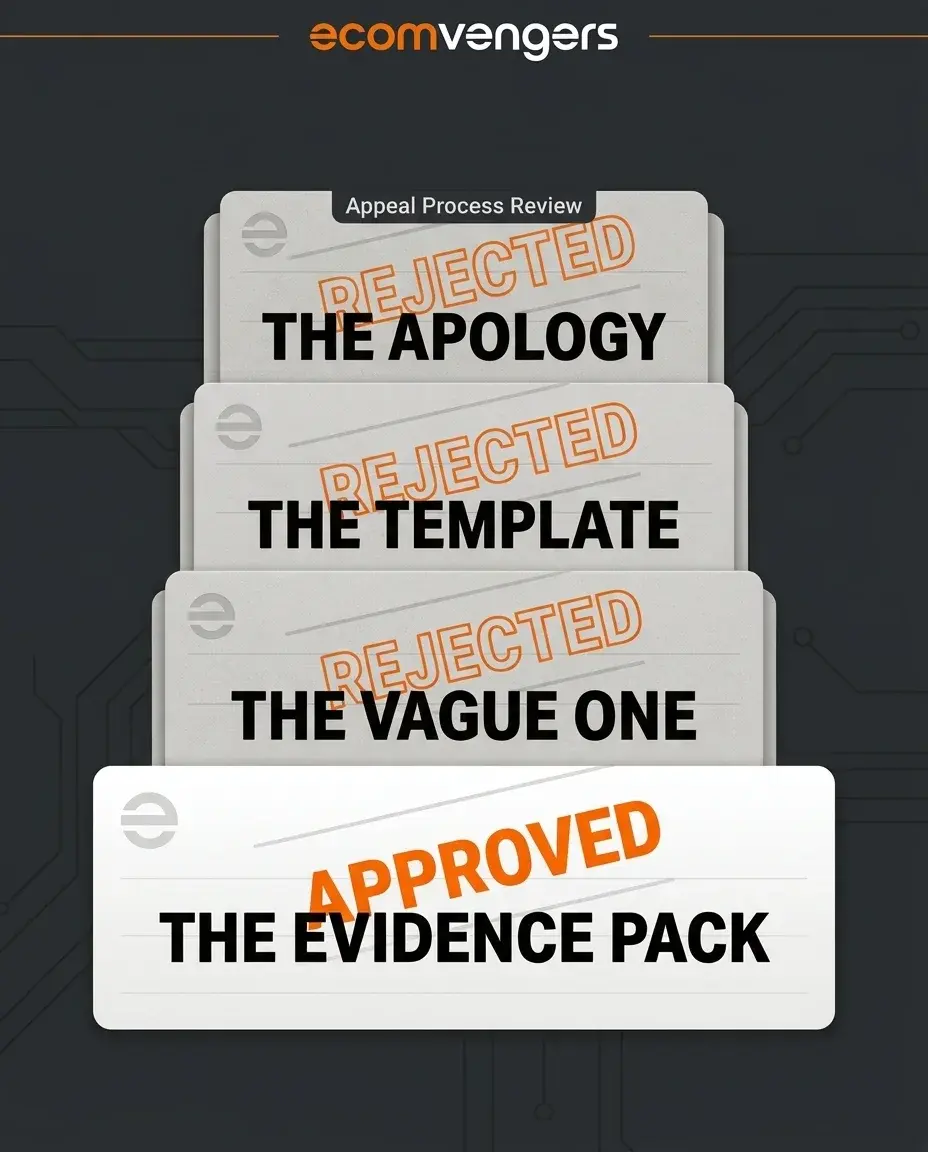
The rejected eBay suspension appeals that land on our desk are rarely badly written. They are usually well written, sincere, and answering a question eBay never asked.
That is the whole problem, and it is fixable.
Eight reasons an appeal gets rejected, each with the primary source that proves it.
Key Takeaways
- An eBay appeal is a narrow question, not a plea. eBay tests your submission against published criteria, and anything outside those criteria is noise to the reviewer.
- Six defect removal grounds are automatic. eBay states it removes those defects itself, so appealing them wastes the one submission you should be spending elsewhere.
- You get 30 days to appeal a case closed without seller resolution. eBay sets that clock from its decision on the case, not from when you noticed the defect.
- Most restrictions are not appeal situations at all. eBay says most resolve through a one time payment or by following the steps in your Messages.
- The instructions are in eBay Messages, not your inbox. If a restriction email is not in Messages, eBay did not send it.
- eBay evaluates seller performance on the 20th of each month. Removals apply at the next evaluation, so a successful appeal rarely changes your dashboard today.
- The defect limit is 2% of transactions. Below Standard only applies when those defects involve more than 4 different buyers.
- Only two events create a defect. A seller cancellation for out of stock, and a case eBay steps into and closes against you.
- There can only be one defect per transaction. Sellers routinely appeal the same order twice because they count the feedback and the case separately.
- Winning a Money Back Guarantee case removes the feedback too. eBay removes buyer feedback and the detailed seller ratings from transactions resolved in your favour.
- A second eBay appeal that repeats the first gets the same answer. If nothing changed on the account, nothing changes in the decision.
- Appeal the cause, not the number. One of our accounts now reports 0.00% across defect rate, late despatch and cases closed without resolution, achieved by fixing transactions rather than arguing about them.
What Does eBay Actually Decide When You Appeal?
An eBay suspension appeal decides one narrow thing: whether your situation meets a published criterion.
It is not weighing how sorry you are. It is not weighing how long you have sold. The review tests your submission against a list, and the list is public.
That single sentence explains most rejections we see.
The three separate things sellers call “an appeal”
They are genuinely different processes with different rules, and mixing them up is reason number one further down.
| What you are contesting | What eBay is deciding | The clock |
|---|---|---|
| A case closed without seller resolution | Whether its decision on that case was correct | 30 days from the decision |
| A defect on your dashboard | Whether the defect meets a removal ground | Applied at the next evaluation |
| An account restriction or suspension | Whether you have done what the notice asked | Stated in your eBay Messages |
Read that table again before you write anything.
Three quarters of the rejected appeals we review target the wrong row.
Where the eBay appeal sits in the wider process
If you are still working out which restriction you are under, start with our guide to every eBay restriction type and how each one is lifted. That article owns the diagnosis, and the restriction identifier is the quick version of it.
This one starts later, at the point where you have already submitted something and eBay has said no.
The appeal window closes before most sellers know it opened
A case decided on the 3rd, against eBay’s 30 day appeal window and its evaluation on the 20th.
Window and evaluation date from the eBay seller standards policy. Calendar arithmetic, not a study.
Reason #1: You Appealed a Decision eBay Was Not Making
The most common failure is aiming at the wrong target entirely.
eBay’s own restrictions page lists six reasons it restricts or suspends an account, and most of them are not arguments at all. They are tasks.
- Unpaid eBay selling costs sitting on the account
- A refund eBay paid your buyer that now needs reimbursing
- An unresolved buyer issue, or missing tracking information
- A breach of one of eBay’s rules or policies
- Account information eBay could not verify
- A suspicion that a third party reached the account
You resolve four of those six by doing something rather than explaining something.
eBay says so directly on the same page: “Most account restrictions or suspensions can be resolved by making a one-time payment, or by following the steps we gave you in the email in your Messages.” That sentence is quoted from the eBay account restrictions and suspensions policy.
An eBay appeal against an unpaid fee is not an appeal. It is an invoice you have not settled.
How to tell which one you are actually in
Open the notice and look for a verb.
If eBay tells you to pay, verify, upload or confirm, you are in a task. Do the task. Nothing you write will substitute for it.
If eBay tells you a policy was violated and invites a response, then and only then are you writing an eBay appeal.
The specific notice codes behave differently here, which is why we split them out. The MC011 recovery guide covers the abnormal activity review and its payout hold, and the MC999 guide covers the harder restriction and whether grounds for appeal exist at all.
Key point: eBay states the details of what you need to do are in the message it sent you. Before you draft a single line, open eBay Messages and read the notice again with a pen. The instruction is almost always more specific than sellers remember it being.
Reason #2: Your eBay Appeal Missed the 30 Day Window
eBay gives you 30 days to appeal a case closed without seller resolution.
The eBay seller standards policy puts it plainly: “You can appeal a case closed without seller resolution within 30 days of eBay’s decision on the case.”
Read the clock carefully. It starts at eBay’s decision.
It does not start when the defect appears on your dashboard, and it does not start when you finally notice your seller level slipping.
Why sellers find out too late
Most sellers discover the damage at evaluation, and evaluation runs on a different clock.
eBay evaluates seller performance on the 20th of each month. A case decided on the 3rd sits quietly for seventeen days before it changes anything you can see.
By the time the dashboard tells you, you have burned more than half the window.
Nobody checks the Resolution Center on a good week. That is exactly when you should.
Do the arithmetic once: a case decided on the 3rd expires around the 2nd of the following month. Your first sight of it on the dashboard is the 20th. That leaves thirteen days to gather tracking, write the appeal and submit it. Diary the case date, not the evaluation date.
Reason #3: Your eBay Appeal Argued Fairness Instead of a Stated Ground
Fairness is not a criterion. It is a feeling, and eBay does not review feelings.
This is the single biggest gap between what sellers write and what reviewers test.
A typical rejected eBay appeal explains that the buyer was difficult, the order was cheap, the seller has a decade of good feedback, and the whole thing feels disproportionate. Every word of that can be true and it still fails, because none of it maps to a published ground.
What eBay actually protects you against
The seller standards policy lists the protections in its own words. eBay removes defects when a buyer breaches the Abusive buyer policy, and it removes defects and late deliveries for events outside your control such as severe weather or carrier disruption.
It also states a rule sellers keep tripping over: “There can only be one defect per transaction.”
So the eBay appeal that wins does not say the outcome was harsh. It says the transaction meets a named ground, and here is the evidence.
Rewrite the sentence, not the tone
Take the weakest line in your draft and give it a ground and a document.
| What sellers write | What passes review |
|---|---|
| The buyer was clearly abusing the system | eBay has actioned this buyer under the Abusive buyer policy, so the associated defect qualifies for removal |
| The parcel was late but that was not my fault | Carrier tracking shows a despatch scan inside my stated handling time on 14 July |
| I have been selling here for eleven years | The case was resolved in my favour, so the feedback and detailed seller ratings qualify for removal |
| This one order should not define my account | Only one defect can be counted for this transaction, and it has been recorded twice |
Same facts. Different question answered.
If you want the full anatomy of the document itself, we wrote a separate guide on how to write an eBay plan of action. This article assumes you already sent one.
Six defect grounds that need no appeal at all
Each ground eBay lists as removed automatically from a seller’s performance standards.
Grounds quoted from the eBay Seller Center defect removal page.
Reason #4: You Appealed a Defect That Removes Itself
Some defects come off without you doing anything at all.
eBay’s Seller Center states that certain defects received for reasons beyond a seller’s control “will be automatically removed from the seller’s performance standards and feedback profile”. It then lists the examples.
- The buyer did not pay and an unpaid item is recorded against them
- A Money Back Guarantee request is ruled in the seller’s favour
- The defect resulted directly from an eBay site issue or program error
- eBay takes action on a buyer under the Abusive buyer policy
- eBay instructs you to hold a shipment, or cancels the transaction itself
- Valid tracking shows the defect came from systemic delays, which eBay posts on its announcement board
Those six are quoted from the eBay Seller Center defect removal page.
Spending your eBay appeal on one of them is like queueing to pay for something the shop is giving away.
The removal you are most likely to miss
Winning an Item Not Received case does more than clear the case.
eBay states that buyer feedback of every kind, along with the detailed seller ratings, is removed from transactions where a Money Back Guarantee case is resolved in your favour.
Sellers win the case, see the negative feedback still sitting there a day later, and open a second appeal about the feedback.
It was already coming off. The second eBay appeal just adds noise to the file.
Check the report before you write
eBay’s Transaction Defect Report syncs daily and records the date each defect was removed.
Download it first. If the removal date is already populated, close the draft and go and do something more useful.
Reason #5: Your Evidence Did Not Match What eBay Asked For
Evidence fails on specifics, not on volume.
eBay tells you what proof of delivery has to show: a shipping company’s status of “delivered”, the delivery date, and the recipient’s address. For transactions of $750 or more it also requires signature confirmation.
A screenshot of your courier dashboard showing “Completed” is not that.
Four evidence mistakes we see weekly
The wrong date is highlighted. The despatch scan matters for handling time. Delivery scans matter for the estimated delivery date. Sellers routinely circle one and argue the other.
The document is unreadable. A photograph of a monitor, taken at an angle, is technically evidence. It is not persuasive evidence.
Volume becomes the argument. Forty attachments signal that you have not identified which one proves your point. Send the two that do.
The supplier paperwork is missing. When eBay questions your stock, it wants supplier invoices that name the goods and the seller. Screenshots of an order confirmation rarely carry the same weight.

Worth knowing: we won a late despatch removal for an Australian seller because carrier tracking showed the despatch scan inside handling time and delivery by the estimated date.
The negative feedback on the same account came off on a separate ground, because the listing had disclosed the issue before purchase. Two problems, two grounds, two arguments. The details sit in the eBay AU defect and late despatch removal case study.
Reason #6: You Never Opened the eBay Message
eBay writes to you twice, and sellers read the wrong copy.
The policy says eBay sends an email to your registered address and to your eBay Messages “explaining why”, and tells you what you need to do so the account can be reinstated.
Messages holds the authoritative copy.
The spoof test that takes four seconds
eBay states it directly: if you cannot find a copy of the email in your Messages, it was not from eBay.
That single check kills a whole category of panic. Suspension notices are a favourite of phishing operators, for the obvious reason that a frightened seller clicks faster.
Check Messages first. Every time.
Read it for the instruction, not the verdict
Sellers read the notice once, absorb the bad news, and never go back for the detail.
eBay says reinstatement “may be as simple as waiting for a temporary suspension to end, making changes to your listings, or sending us some more information”.
Three different actions, and the notice tells you which one applies to you.
Reading it properly is free. So is doing what it says.
Reason #7: Nothing Changed Between Your First eBay Appeal and the Second
A resubmission that repeats the first submission gets the first answer.
This is the rejection loop, and it is the one that costs sellers weeks.
The first eBay appeal goes in. It comes back declined. The seller adds two paragraphs of context, softens the tone, resubmits with more feeling, and receives the identical outcome nine days later.
What has to be different
Something on the account, not something in the letter.
A new document you did not have. A ground you did not cite. Or a corrective action you have now taken and can evidence with a date.
Assertions are free. Dated evidence is not, and reviewers can tell the difference.
What a genuine change looks like
When eBay opened a review on a UK account we handle and held its payouts, the difference was documentary rather than rhetorical.
eBay closed the restriction eighteen days after the notice, crediting “all required receipts and documents”. The account returned to good standing.
The full timeline sits in the MC011 suspension removal case study, including the eBay notices themselves.
One note on that case, because the number gets misread. The notice set a selling limit of 28,000 items or a monthly value cap. That is an allowance eBay grants, not revenue the account earned.
Reason #8: You Appealed While the Dashboard Still Showed the Problem
Timing decides more eBay appeals than tone does.
If open cases, unresolved returns and pending late deliveries are still sitting on the account, you are asking eBay to trust a forecast it can currently disprove.
Clear what you can clear first.
The thresholds you are being measured against
eBay’s published minimums give you the target, and they are more forgiving than most sellers assume.
| Metric | eBay’s stated limit | The detail sellers miss |
|---|---|---|
| Transaction defect rate | No more than 2% of transactions | Below Standard applies only when defects involve more than 4 different buyers |
| Cases closed without seller resolution | 2 cases, or 0.3% of transactions, whichever is higher | The allowance is a floor of two, not a pure percentage |
| Late delivery rate | Low rate required for Top Rated | A high rate alone will not make you Below Standard |
| Top Rated defect rate | No more than 0.5% | Capped at no more than 3 different buyers |
Figures above are quoted from the eBay seller standards policy.
Notice the fourth column of reality here: a seller can sit above 2% and still not be Below Standard, because the buyer count has not been met.
Sellers appeal in a panic that the arithmetic did not justify.
What the metrics look like once the cause is fixed
One eBay AU account we manage, measured against eBay’s published thresholds.
Account rates from the eBay AU defect removal case study. Thresholds from the eBay seller standards policy.
Is It an eBay Rejection or a Request for More Information?
Look for whether the message closes the matter or leaves it open.
A rejection states a decision and usually names the policy. A request for information asks for a document, a date or a confirmation, and it means the file is still live.
Sellers treat the second as the first, get demoralised, and stop replying at the exact moment eBay was still listening.
The wording that tells you which one it is
A closed decision explains what happened and what the consequence is. It reads backwards, at the past.
An open request contains an instruction and usually a deadline. It reads forwards.
If there is a verb aimed at you, the matter is open. Answer it that day.
What to Do in the First 48 Hours After an eBay Rejection
Work in this order, because each step changes what the next one should say. A denied appeal is not the end of the route. It does mean the next submission has to carry something the first one did not.
- Reopen the notice in eBay Messages and write down the exact policy named. Not your summary of it.
- Download the Transaction Defect Report. Check whether the defect you are contesting already carries a removal date.
- Date every open case. Anything decided more than 30 days ago is out of scope, and pretending otherwise wastes the submission.
- Match each remaining item to a named ground. If it does not map to one, it is not going in the appeal.
- Clear what is still open. Resolve live cases, upload missing tracking, settle outstanding fees.
- Fix the cause and record the date you fixed it. A handling time change made yesterday is evidence. A promise is not.
- Submit once, with the two documents that prove it. Then stop, and let the review run.
That sequence is deliberately unglamorous. It also works more often than a better adjective.
Pro tip: removals apply at the next evaluation rather than the moment eBay agrees. If your appeal succeeds on the 22nd, the dashboard may not reflect it until the following month. That gap is normal, and it is not a sign the appeal failed.
Does a Successful eBay Appeal Restore Your Sales?
It restores your right to sell. It does not restore your search placement.
Those are two different things, and the gap between them surprises sellers more than the suspension did.
A restricted account stops accumulating sales history. Listings that ended early lose their momentum. Reinstatement hands you the keys to a shop that has been dark for three weeks.
Recovering the ranking is a separate job, and it starts with listing quality rather than another appeal. Our eBay listing optimization guide is the practical starting point, and our eBay SEO service exists for accounts that need the visibility rebuilt properly.
Frequently Asked Questions
How many times can you submit an eBay appeal?
eBay does not publish a hard cap, but each submission is reviewed against the same criteria, so repeating yourself achieves nothing. Resubmit only when you have new evidence, a ground you did not previously cite, or a corrective action you have actually completed and can date.
How long does eBay take to answer an appeal?
There is no published service level, and in practice it ranges from a few days to several weeks depending on the restriction type and whether a human review is required. On one UK account we handle, eBay closed a payout-holding review eighteen days after the original notice, which is a reasonable benchmark for a documented verification case rather than a promise.
Can you appeal an eBay defect after 30 days?
The 30 day limit applies specifically to appealing a case closed without seller resolution, measured from eBay’s decision on that case. Defects that qualify for automatic removal are not bound by that window, because eBay removes them on its own initiative rather than in response to your appeal.
Does an eBay appeal make things worse?
A well-grounded eBay appeal does not damage your position, but a scattergun one wastes reviewer attention and can bury the point you needed to make. The genuine risk is not the appeal itself, it is spending it on the wrong target while a real deadline runs down.
What is the difference between an eBay restriction and a suspension?
A restriction limits specific activity such as listing, revising or receiving payouts, while a suspension removes account access more broadly. A permanent suspension reads differently to an indefinite suspension in the notice. The wording tells you which one you have. eBay groups both under the same policy page and both are lifted by satisfying the instruction in your Messages, though the taxonomy matters enough that we cover all eight types separately.
Why was my eBay appeal rejected without explanation?
Short rejections usually mean the submission did not engage a published ground, so there was nothing specific for eBay to respond to. Go back to the original notice, identify the exact policy it names, and rebuild the appeal around that single point rather than around the account’s overall history. Sellers often try to escalate instead, through a generic appeal form, a lead specialist, or eBay Business Support. Neither route changes the outcome when the submission still misses the published ground.
Do I need a plan of action to appeal an eBay suspension?
Only when eBay has cited a policy violation and asked how you will prevent recurrence, which is a narrower set of cases than sellers assume. Where one is genuinely required, it has to name a root cause, a corrective action and a preventive action. The structure matters more than the length, and we set that out step by step in a separate guide.
Will eBay remove negative feedback if I win the case?
Yes. eBay states that buyer feedback of every type, along with the detailed seller ratings, is removed from transactions where a Money Back Guarantee case is resolved in the seller’s favour. That removal happens without a separate request, so a second appeal about the feedback is unnecessary.
How do I know if my defect qualifies for automatic removal?
Download the Transaction Defect Report, which syncs daily and records the date each defect was removed by eBay. If a removal date is already populated against the transaction you were about to contest, the work is done and the eBay appeal is unnecessary.
Does a high defect rate automatically mean Below Standard?
No, and this is the arithmetic most sellers get wrong. eBay only evaluates an account as Below Standard when transaction defects are associated with more than 4 different buyers, so a rate above 2% concentrated among two buyers does not trigger it. We break the full calculation down in our guide to transaction defect rate removal.
Can I open a new eBay account while an appeal is pending?
Do not do this. Registering a second account while the first is restricted is itself a policy problem, and it routinely converts a recoverable situation into a permanent one by linking the accounts together.
When should I stop appealing and get help?
After the second rejection on the same grounds, because at that point the problem is the framing rather than the facts. If payouts are being held and cash flow is tightening, that timeline argument becomes more urgent than the wording one, and our eBay suspension removal service exists for exactly that situation.
Start With the Message, Not the Letter
The eBay appeal you are about to write is probably not the problem.
First, open eBay Messages and read the original notice properly. Write down the exact policy it names and the exact action it asks for.
Second, download the Transaction Defect Report and cross out everything that already carries a removal date. That list is usually shorter than you expected, which is good news.
Third, take what survives and give each item a named ground and one dated document. Then submit once.
If the account is already two rejections deep, stop rewriting and go back to the notice. The answer has been sitting in Messages the whole time.
Sources
- Account restrictions and suspensions, eBay Help
- Seller standards policy, eBay Help
- Defect removal, eBay Seller Center
Our documented reinstatements, with the eBay notices attached, are collected in the case study archive. More on the mechanics of eBay account health across the rest of the EcomVengers blog.
If the numbers behind the account are the real question, our eBay ROI calculator and fee and profit calculator will tell you what a month of held payouts actually costs you.

Ali Khan is the founder of EcomVengers, the eBay growth and account recovery agency. He has spent the better part of a decade pulling suspended sellers back from MC011 and MC999 notices, repairing wrecked defect rates, and turning buried listings into ranked ones. When eBay's villains show up, he is the one sellers call. You handle the millions, he handles the villains.
View all posts by Ali Khan