
eBay once told a UK seller she was free to sell 28,000 items, or £187,174.78 worth of stock, every month.
The same message put her payouts on hold.
That contradiction is an eBay MC011 notice in miniature. A set of numbers that says eBay trusts the account, bolted to an action that says it does not.
It is the marketplace equivalent of being handed the keys and the parking ticket in the same envelope.
We recover marketplace accounts for a living, and eBay suspension removal is the bulk of that work.
We publish the eBay messages from the cases we handle, screenshots included, so you can check the reasoning instead of trusting it.
Seven steps. Here is what an eBay MC011 is really asking for, and how to give it exactly that.
Key Takeaways
- An eBay MC011 is a verification review, not a verdict. eBay is checking who you are and where your stock came from, not punishing a policy breach.
- The trigger is usually a change in pattern. A jump in volume, a new category, a new supplier, a new device or a new payout destination.
- Documents close it. Arguments do not. The case we published closed on receipts, and eBay said so in writing.
- An eBay MC011 review can hold your money separately from your selling. Payouts and selling privileges are two different switches.
- The notice usually still shows your selling limit. That figure is a monthly allowance, not your turnover, and it is not a promise the restriction is minor.
- 18 days, notice to written close. That is the timeline on the UK case in our archive, from the 19 July hold to the 6 August confirmation.
- Reply once, completely. A part-finished document pack restarts the queue rather than speeding it up.
- Never open a second account. eBay stores names, addresses, IPs and bank details specifically to link accounts, and linking makes a temporary problem permanent.
- Keep fulfilling the orders you already have. Defects earned during a restriction outlive the restriction.
- Get the close in writing. A review with no stated end date drifts unless somebody works it.
- Reinstatement returns your right to sell, not your search position. Plan the visibility rebuild before the restriction lifts, not after.
What Is an eBay MC011 Notice?
An eBay MC011 notice is the message eBay sends when it has flagged unusual selling activity on your account and opened a review, normally holding your payouts until that review closes.
The code itself is just eBay’s internal reference for that template. It carries no verdict.
Which is exactly why it panics people.
The wording is bureaucratic, the consequence is immediate, and nothing in the message tells you what you did.
Sellers read “unusual selling activity” and hear “fraud”.
eBay means something closer to “this account changed shape and we would like to see the paperwork”.
Here is the part most articles skip.
An eBay MC011 is a risk and verification check, which puts it in a different family from a policy strike or a performance restriction.
Those want a corrective action plan. This one wants evidence.
If you want the full map of which eBay restriction is which, our guide to every eBay restriction type covers all eight and how to lift each one.
Key point: an eBay MC011 asks a question about your business, not about your behaviour.
Answer the question eBay actually asked and it closes. Answer with an apology and you have spent your reply on the wrong document.
What the notice usually contains
Most eBay MC011 messages carry three things.
A statement that eBay noticed unusual selling activity, a hold placed on payouts while the review runs, and a restatement of your current monthly selling limit.
That third item confuses everyone.
Your selling limit is an allowance, not a measure of what you sold, and raising it is a separate exercise from clearing a restriction.
eBay sets it from your sales volume and buyer feedback and reviews it monthly, and both active and sold listings count toward it.
Seeing a large number there does not mean eBay considers the review minor. It means your allowance was large before the review started.
Why Do Most eBay MC011 Appeals Take Longer Than They Should?
Because most sellers write the first reply as an apology, and eBay was asking for a filing cabinet.
Read a dozen seller forum threads and you will see the same shape repeated.
A long, sincere message explaining that the seller has been on eBay for years, has great feedback, and would never break a rule.
No invoices attached. No supplier details.
Nothing showing where the stock came from.
Sincerity is not a document.
The second reason is drip-feeding. Sellers send one invoice, wait, get asked for more, send another.
Every incomplete submission puts the case back in a queue behind everyone else’s.
Three partial replies over two weeks is slower than one complete pack on day two, and it is the single most common self-inflicted delay we see.
The third reason is silence. An eBay MC011 review rarely comes with a completion date, so a case with nobody pushing it simply sits.
The UK case below is the counter-example.
Documents assembled in the form eBay asked for, submitted as one pack, then tracked through support until eBay confirmed the outcome in writing.
You can read the MC011 reinstatement with both eBay screenshots in full.
The whole restriction ran between two eBay messages
Dates taken from the two eBay notices published on the case study page.
A single eBay UK account, not an average. Both messages are reproduced as screenshots on the case study.
Eighteen days is not a promise. It is one of two documented timelines we publish, with both eBay messages beside it. It shows what the ceiling looks like when you build the response properly.
Step #1: Read the eBay MC011 Message Before You Reply to It
Open the notice in your eBay Messages, not in your email, and read it as a request list rather than a judgement.
Email copies get truncated, and phishing copies get sent. The version in Messages is the real one.
Yes, that means reading all of it. Including the part everyone scrolls past on the way to the panic.
Then pull four facts out of it and write them down somewhere you will still have them in a fortnight.
- The date. Every timeline you quote later runs from this, so record the exact day the notice landed.
- What eBay says it noticed. Usually a phrase like unusual selling activity. Copy it word for word.
- What eBay has done. Payouts held, selling restricted, listings ended, or some combination.
- What eBay is asking you for. Often a document list, sometimes only a link to a verification flow.
If item four is empty, that is information too. It usually means the review is running on eBay’s side and your job is to be ready rather than to send something immediately.
Screenshot the whole message.
Notices get superseded, threads get replaced, and the wording of the original is what you will be quoting when you escalate.
A new seller restricted on day two in our archive was back selling in 48 hours largely because we captured the original notice before anything moved.
Step #2: Work Out What the MC011 Restriction Switched Off
Log in and test each function, because what still works tells you how serious the review is faster than the wording does.
Try to revise a listing. Try to create a draft. Check Seller Hub for a payout status. Look at whether your existing listings are live, ended, or hidden.
Think of it as a very boring escape room. Rattle every door and note which ones are actually locked.
eBay operates these as separate switches, and MC011 does not always flip all of them.
| What you find | What it usually means | Where to start |
|---|---|---|
| Payouts held, listings still live | Verification review, selling untouched | Assemble documents, keep trading normally |
| Payouts held, listings ended | Verification review with a selling restriction attached | Documents first, then ask eBay to reinstate the listings at close |
| Can list, but not above a cap | A selling limit, not a restriction | Request an increase, no appeal needed |
| Cannot buy or sell at all | A full account suspension, not a standard eBay MC011 | Identify the underlying reason before writing anything |
Write your finding as one sentence: what is blocked, what is not, and from what date.
That sentence becomes the first line of everything you send eBay afterwards, and it saves the support agent reading your case the ten minutes they would otherwise spend working it out.
Agents who understand a case quickly move it quickly.
We document every account we work the same way, which is why our published eBay case studies all lead with dates and states rather than adjectives.
Step #3: Protect the Orders You Have Already Taken
Ship everything that is already sold, on time, even though the money for it is sitting behind a hold.
This is the step sellers skip, and it is the one that causes damage lasting long after the eBay MC011 review closes.
Here is the trap.
A payout hold means you are funding fulfilment out of your own pocket for a few weeks.
The tempting response is to slow down, cancel a few orders, or quietly stop posting until the money moves.
Every one of those creates a defect, a late dispatch, or a case, and eBay’s performance system does not care that your payouts were frozen at the time.
Do the arithmetic once: work out what fulfilling your current order book costs you in real cash over the next 21 days.
If that number is survivable, keep shipping and stop debating it.
If it is not, reduce what you list rather than what you post, because unshipped orders leave a permanent mark and unlisted stock does not.
Our eBay fee and profit calculator gives you the per-order number to multiply.
Cancelling to protect cash flow is a genuinely bad trade. Defect rates and late dispatch rates are removable afterwards.
But removal is a separate piece of work with its own evidence requirements, as our defect and late shipment removal case on eBay AU shows.
Cheaper not to earn them.
Answer buyer messages the same day, too. Buyers who feel informed do not open cases, and nobody escalates an order that arrived when it said it would.
Step #4: Build the Document Pack eBay Actually Asked For
Assemble one complete set of evidence covering three things: who you are, where you trade from, and where your stock came from.
eBay’s own guidance for blocked accounts says these requests concern proof of identity, proof of address, or proof of merchandise, and that the list of required documents is normally in your Messages.
So read the list. Then over-deliver slightly on the merchandise half, because that is the half sellers under-supply.
| Category | What to include | What gets it rejected |
|---|---|---|
| Identity | Government photo ID for the account holder, matching the registered name exactly | A nickname on the account, an expired document, a cropped corner |
| Business | Registration or VAT certificate where you have one, plus a bank statement showing the payout account | Statements with the account number blacked out entirely |
| Address | A recent utility bill or bank statement at the registered trading address | A document older than three months, or an address that differs from your eBay settings |
| Merchandise | Supplier invoices covering the specific items in your recent listings, with supplier contact details visible | Order confirmations from a retail site, screenshots of a marketplace basket, invoices that do not name your business |
Where MC011 document packs usually fall down
The merchandise line is where reviews stall.
eBay wants to see that your business bought the stock you are selling, from a supplier, in the quantities you are listing.
A retail receipt for one unit does not answer a question about four hundred.
Match your invoices to the listings that grew fastest, not to a random sample. A change in pattern triggered the review, so the evidence should cover the change.
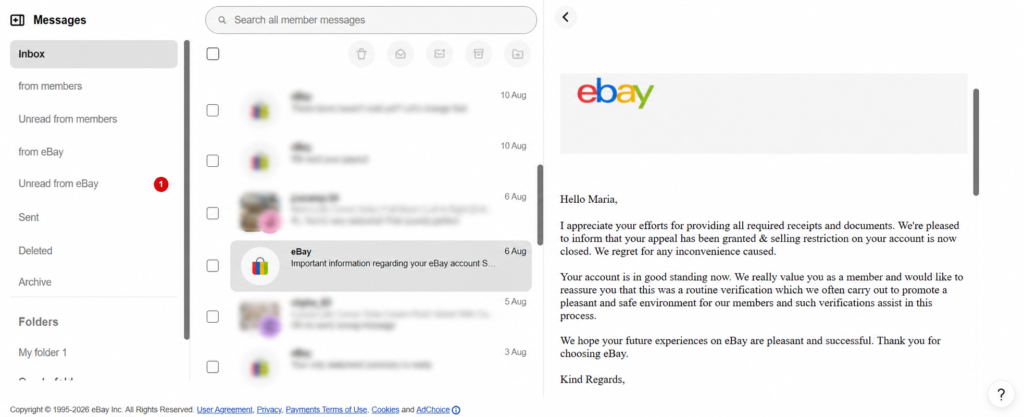
Worth knowing: in the case we published, eBay named the reason it granted the appeal.
It thanked the seller for providing all required receipts and documents, and described the exercise as routine verification carried out to keep the marketplace safe.
That is eBay telling you, in its own closing message, what the review was measuring.
Documents. Not tone.
Label every file before you send it
Name every file so a stranger can sort it without opening it.
Something like 02-supplier-invoice-2026-07-14-acme-ltd.pdf beats scan1.pdf by more than it should.
Nobody has ever opened scan1.pdf and felt reassured. Least of all the person who saved it, three weeks earlier.
Keep the pack in one folder, because you will be sending it again.
We keep the same habit across the free seller tools we publish: label the input, and the output stops being ambiguous.
Step #5: Write the Response as a Verification File, Not an Appeal Letter
Open with the facts of the account, list what you have attached, and stop.
No preamble about how much eBay means to your family. The person reading it processes a queue, and the fastest way to get help is to be easy to process.
This is not the moment for your origin story. Save it for the podcast.
Here is a structure you can lift directly.
Account: [eBay user ID] | Registered business: [legal name]
Notice received: [date], reference MC011
Current state: payouts on hold, [listings live / listings ended]
About the activity you flagged:
[Two sentences. What changed and why. Example: volume rose from
roughly 300 to roughly 900 units a month from 4 July after adding
[category] stock from [supplier name], a supplier we have used
since [date].]
Attached, in order:
1. Photo ID for [name], the registered account holder
2. [Business registration / VAT certificate], number [x]
3. Bank statement dated [date] showing the payout account
4. Proof of trading address dated [date]
5. Supplier invoices [dates], covering [item groups], from [supplier]
6. [Anything eBay named specifically in the notice]
Happy to supply anything further in whatever format your team
prefers. Please confirm in writing once the review is closed.
Three things that template does deliberately.
It explains the pattern change in plain language, which is the actual question behind the review.
It numbers the attachments, so a missing file is obvious to both sides.
And it asks for written confirmation, which is what turns a vague review into a closable case.
Send it once, complete. Resist the urge to follow up an hour later with the invoice you forgot.
Step #6: Track the Case Until eBay Closes It in Writing
Contact eBay support on a schedule, quoting the same reference and the same one-sentence summary every time, until you have a message saying the restriction is closed.
A review with no stated end date does not close itself.
A cadence that works: confirm receipt within two working days of sending the pack, then check in every three to four working days after that.
Polite, short, identical wording. You are not persuading anyone, you are keeping the case visible.
Be the polite regular who turns up every Tuesday. Not the one firing off nine messages on a Friday night.
Keep a log with the date, the channel, the agent reference and what you were told.
When a case needs escalating, that log is the escalation.
Without it you are starting the conversation from zero for the fourth time, which is roughly as effective as it sounds.
And take the close in writing. Not a phone assurance, not a status page. A message you can screenshot.
Step #7: Rebuild Visibility After the Restriction Is Lifted
Expect your listings to come back with less search visibility than they had, and plan the recovery as a separate project.
Reinstatement restores permission. It does not restore ranking, and getting sales back afterwards runs on its own timetable. Status runs on a slower one still, since eBay Top Rated Seller status is rebuilt over full evaluation periods rather than good weeks.
Relisting is a bit like moving house. You find things you forgot you owned, and a few you should have binned in 2019.
Listings eBay ended lose their sales history and their accumulated relevance signals.
Even listings that stayed live spend the review period with reduced impressions, because a chunk of that period usually includes a spell where you were shipping cautiously and converting less.
Three moves, in this order.
- Relist your proven items first. Restore the twenty listings that produced most of your revenue before touching the long tail.
- Fix the item specifics while you are in there. A forced relist is the cheapest opportunity you will get to close gaps you have been ignoring, and our guide to eBay listing optimisation covers what actually moves placement. Check your eBay product identifiers in the same pass.
- Buy back the impressions deliberately. Promoted Listings is the fastest way to put a relisted item back in front of buyers while its organic signals rebuild.
That last point has evidence behind it.
One eBay AU account we manage reached 829,607 impressions, up 291.2%, across 90 days.
The mechanism was ad placement carrying newly optimised listings until organic caught up.
If the rebuild is bigger than your week, this is what eBay SEO and Promoted Listings management exist to absorb.
How Long Does an eBay MC011 Restriction Last?
eBay does not publish a fixed window for these reviews, and the notice itself normally gives no completion date, which is why the honest answer comes from cases rather than from policy.
The documented case in our archive ran 18 days. Hold notice on 19 July, written close on 6 August.
What that number is worth depends on what you do with it. It is not an average, because one case is not a sample.
One swallow does not make a summer, and one case does not make a service level agreement.
It is a demonstration that a high-volume account with a payout hold and a full document request can clear inside three weeks when you send a complete response and chase the case.
The review swallowed most of a trading month
18 days measured against the 31 day cycle eBay uses when it reviews selling limits.
Arithmetic, not a study: 18 divided by 31. The month is the unit because eBay reviews selling limits monthly.
The reason that proportion matters more than the raw day count is that payout cycles, supplier terms and rent do not pause while a review runs.
An eBay MC011 hold is a cash flow event before it is anything else.
What Happens to Your Payouts During an eBay MC011 Review?
Your sales keep completing and your money keeps accumulating, but eBay holds the payout until the review closes, at which point the balance is released rather than lost.
Nothing disappears. It queues.
The problem is that the amount held grows every day the review runs, while your costs carry on being due weekly. That is the shape sellers underestimate, so it is worth drawing.
The held balance grows every day the review runs
Cash sitting behind the hold, at £1,000 a day in net payouts. Swap in your own daily figure.
Arithmetic, not a study: daily net payout multiplied by days held. No eBay data is implied by the £1,000 figure.
Substitute your own daily payout figure and the curve tells you your real deadline, which is usually earlier than the review’s.
Knowing that number in week one is what lets you decide calmly whether to keep listing at full volume, and it is a better use of an evening than refreshing your Messages.
Two practical notes.
Keep enough working capital to fulfil the orders already placed before you take any more, and treat pausing new listings as a legitimate option rather than an admission of guilt.
Volume you never took on cannot become a defect.
Small accounts feel this differently.
The eBay Canada account in our archive turned over C$1,991.69 across 31 days, so a three-week hold there is an inconvenience.
At the UK account’s scale it is a financing problem. Same notice, different emergency.
What Should You Never Do During an eBay MC011 Restriction?
Do not open a second account, do not relist items eBay removed, and do not change your registered details while the review is running.
The second account is the one that ends businesses.
eBay is explicit that it keeps account information including seller name, email, IP addresses and bank details, and that this lets it trace new accounts back to restricted ones.
A workaround account does not restore your selling.
It converts a solvable verification hold into a linked-account case, and those are much harder.
A second account carrying your own bank details is a disguise made out of your passport.
Relisting removed items is the same mistake in a smaller costume. eBay’s guidance is direct about it: if listings were removed and your account is restricted, do not list those items again.
| Instead of this | Do this | Why |
|---|---|---|
| Opening a backup account | Waiting the review out on the original | Linked accounts turn a temporary hold into a permanent block |
| Changing your bank or address mid-review | Leaving details untouched until it closes | A change during verification reads as evasion and restarts the check |
| Cancelling orders to protect cash | Shipping and reducing new listings instead | Defects outlast the restriction, unlisted stock does not |
| Sending a new appeal every day | One complete pack, then a fixed check-in cadence | Each new submission re-queues the case |
| Venting at support | Repeating the same one-sentence summary | The agent reading it did not make the decision and can only route it |
One more. Do not delete the notice, however satisfying that would be. It is the only dated record you have of what eBay asked for.
Frequently Asked Questions
What does MC011 mean on eBay?
MC011 is eBay’s internal reference for the message it sends when it has flagged unusual selling activity and opened an account review. It normally comes with a hold on your payouts until the review is finished. The code identifies the template, not a specific accusation.
Is an eBay MC011 restriction permanent?
No. It is a review, and reviews close in one direction or the other. The case we published closed with eBay granting the appeal and confirming the account was back in good standing. What makes it feel permanent is that eBay gives no completion date, so nothing visibly moves until somebody supplies the documents and chases the case.
How long does an eBay MC011 review take?
eBay publishes no fixed window. The documented UK case in our archive took 18 days from the hold notice to the written confirmation that the restriction was closed. Treat that as one real data point rather than a standard, and assume the clock only starts properly once your complete document pack is in.
Why did eBay flag unusual selling activity on my account?
Usually because something about the account changed shape. A sharp rise in volume, a move into a new category, a new supplier, a new payout destination, or logins from a new device or country. None of those are against the rules. They just make an automated risk system want to see paperwork.
Can I still buy on eBay while my selling is restricted?
Often yes. eBay distinguishes between an account that is suspended and one that is only restricted, and a selling restriction usually leaves buying available. Test it rather than assuming, because what still works tells you how broad the action against your account actually is.
Will eBay release my held payouts once the review closes?
A hold is a delay rather than a forfeiture, so eBay normally releases the accumulated balance once the review resolves and the account returns to good standing. Ask for confirmation of the release date in the same message where you ask for confirmation that the restriction is closed.
What documents does eBay ask for in an MC011 review?
eBay’s own help guidance says these requests concern proof of identity, proof of address or proof of merchandise, with the specific list in your Messages. In practice that means photo ID matching the registered name, a recent proof of trading address, bank details for the payout account, and supplier invoices covering the stock behind your recent listings.
Can I open a new eBay account while my account is under review?
Do not. eBay’s seller standards policy states it may place selling restrictions on your account and related accounts, or restrict you from registering a new account. eBay normally links and closes a second account, and that turns a verification question into a much harder linked-account case.
Should I cancel my open orders during an eBay MC011 payout hold?
Ship them if you possibly can. Cancellations and late dispatches create defects that stay on your account after the restriction has gone, and removing them later is a separate piece of work with its own evidence requirements. If cash is genuinely tight, cut the number of new listings rather than the orders you have already accepted.
Does an eBay MC011 review affect my seller performance rating?
The review itself is a risk and verification check, so it sits outside the seller performance system. What hurts your rating is how you behave during it. Cancelled orders, late dispatch and unanswered buyer messages all feed straight into the metrics, and those consequences arrive whether or not the review ends well.
What should I do if eBay declines my appeal?
Find out what was missing before you resubmit anything. A decline on a verification review is almost always about evidence that did not cover the flagged activity, not about the tone of your message. Ask support to specify which document was insufficient, supply that exact item, and escalate with your contact log if the answer stays vague.
Will my sales recover after the restriction is lifted?
Not on their own, and not immediately. Reinstatement gives back the right to sell, but ended listings lose their sales history and relisted items start with weaker signals. Plan a deliberate rebuild: restore your best performers first, tighten their item specifics, and use paid placement to carry them until organic visibility catches up.
Your First Three Moves
First, open the notice in your eBay Messages and screenshot it. Write down the date, the exact phrase eBay used, what has stopped working, and what has been requested.
Second, build the whole document pack before you send anything. Identity, address, business, and supplier invoices that cover the activity eBay flagged. One submission, numbered, complete.
Third, set a check-in cadence and keep a log until you have the close in writing. Then start the visibility rebuild, because that clock starts the day the restriction lifts.
None of this is glamorous. It is admin, in the right order, done by somebody who is not currently panicking.
The eBay help pages linked above are the primary sources for what eBay says about blocked accounts and selling limits.
Everything else here comes from cases we worked and published with the eBay messages attached.
If you want more of that reasoning written up, it lives on the EcomVengers blog.
And if you would rather hand the whole thing to somebody who does this weekly, EcomVengers will look at your notice and tell you what we would send, before you commit to anything.
Sources
- eBay, Account restrictions and suspensions, on the reasons eBay restricts an account and on resolving most of them through a payment or the steps in your Messages.
- The selling limits page, on how eBay sets a monthly cap from your sales volume and feedback, and why both active and sold listings count toward it.
- Details in the seller standards policy, on the restrictions eBay may place on an account and on related accounts.
- Seller Center, Seller Help, where eBay says any policy issue on your account or listings appears.
- Our own figures come from published client cases with the eBay messages attached, collected in our eBay case study library.

Ali Khan is the founder of EcomVengers, the eBay growth and account recovery agency. He has spent the better part of a decade pulling suspended sellers back from MC011 and MC999 notices, repairing wrecked defect rates, and turning buried listings into ranked ones. When eBay's villains show up, he is the one sellers call. You handle the millions, he handles the villains.
View all posts by Ali Khan