Sales fall and the instinct is to start rewriting listings.
It is the most expensive possible first move, because it assumes you already know the cause.
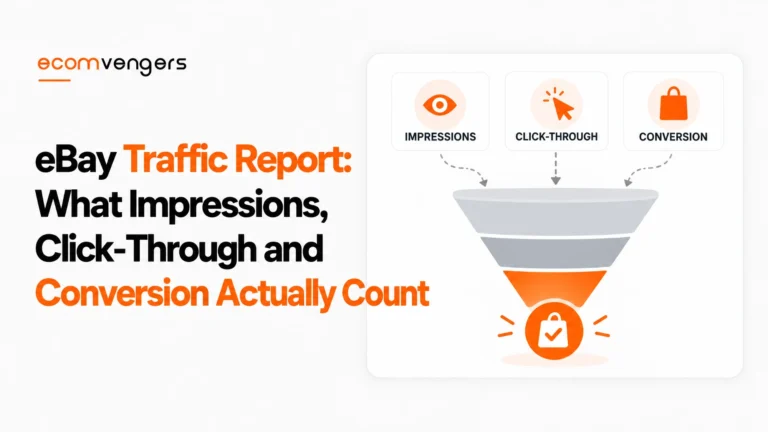
A drop has three possible shapes. Fewer people saw your listings, the same people saw them and stopped clicking, or they clicked and stopped buying.
Those three shapes have almost nothing in common, and eBay shows you which one you have for free.
There is also a fourth possibility that no amount of listing work will touch. eBay evaluates your account on the 20th of every month, and a level change quietly rewrites your economics.
So find the shape first. Then fix the thing that actually moved.
Key Takeaways
- Diagnose before you edit. Impressions, clicks and conversion fail in different ways and need different fixes.
- Seller Hub reports traffic and buyer traffic source at no cost, which is where the shape of the drop shows up.
- eBay evaluates your seller level on the 20th of each month. If sales fell shortly after a 20th, check your level before anything else.
- Below Standard brings limits and higher final value fees. That is a cost increase and a visibility problem at once.
- Only Top Rated is publicly visible. Other members cannot see your seller level, so buyers are not reacting to a badge you lost.
- The evaluation window moves with your volume. Over 400 transactions in three months and eBay counts those; under 400 and it reaches back twelve months.
- Two metrics set the floor. Cases closed without seller resolution, and transaction defect rate at no more than 2%.
- Below Standard needs more than four different buyers. A single unhappy buyer cannot push you down on defects alone.
- A restriction suppresses everything. eBay may end listings early and hold payouts, which looks exactly like a demand collapse.
- Since 15 October 2026, eBay Live transactions no longer count toward seller standards, including transactions completed before that date.
- The Seller Dashboard shows your projected level, not just your current one, so you can see a drop coming.
- Seasonality is a real answer. Three years of sold data exists precisely so you can tell a season from a problem.
Why Are My eBay Sales Down? Start With the Shape of the Drop
Open Seller Hub and find out whether you lost impressions, clicks or conversions, because each one points somewhere different. Our guide to reading the eBay traffic report explains what each of those numbers counts.
That single question eliminates most of the guesswork in about five minutes.
If impressions fell, eBay stopped showing your listings as often. The cause sits in ranking, in your account status, or in the market.
If impressions held but clicks fell, buyers saw you and chose somebody else. That points at your title, your main photo or your price against the competition. If price is the suspect, our eBay pricing strategy guide shows where a small change moves the fee as well as the sale.
If clicks held but orders fell, the listing page is losing people. Postage cost, returns terms and stock position do most of the damage there.
Each of those three needs a different week of work. Rewriting titles when you have an impressions problem fixes nothing and costs you days.
How to Read the Seller Hub Performance Tab
The Performance tab carries the traffic figures you need, and eBay charges nothing for it.
Seller Hub is free to use, and its Performance tab reports sales, selling costs as a percentage of sales, traffic and buyer traffic source.
Buyer traffic source is the line most sellers skip, and it answers a question listings cannot. It separates buyers who found you through eBay search from those who arrived another way.
You can select the data on the page to drill into charts, so you are not reading a single headline number.
One warning about the window you choose. Compare the same span against the same span last year rather than against last month, or every seasonal business looks like it is collapsing every January.
| What you see | What it usually means | Where to look next |
|---|---|---|
| Impressions down, clicks and conversion steady | Ranking or account status changed | Seller Dashboard, then Best Match factors |
| Impressions down across every listing at once | Account level event, not a listing problem | Messages, for a restriction notice |
| Impressions steady, click rate down | You are being out-presented in results | Titles, lead photo, price against sold data |
| Clicks steady, orders down | The listing page is losing the sale | Postage cost, returns terms, stock |
| Everything down, same period last year flat | Genuine demand change in your category | Sold data over three years |
| Sales down but selling costs up as a share | Possible fee change from a level drop | Seller Dashboard and your fee breakdown |
Key point: a drop that hits every listing on the same day is almost never a listing problem. Simultaneity across unrelated products points at the account.
Check Your eBay Seller Level Before You Touch a Listing
eBay evaluates your performance on the 20th of each month, so a sales drop that began just after a 20th has an obvious first suspect.
This is the check almost nobody runs first, and it is the cheapest one available.
eBay assigns one of three levels on that date, based on your recent transactions. Top Rated means you exceed expectations, Above Standard means you meet them, and Below Standard means eBay may place limitations on your selling activity, including charging higher final value fees, until your performance improves.
Read that consequence carefully, because it is two problems wearing one name. Your costs rise and your selling activity narrows at the same moment.
The Seller Dashboard shows your current level and what it would be if eBay evaluated you today. That projection is the part worth watching, because it turns a surprise into a warning.
The two metrics that set the floor
eBay requires no more than 2 cases closed without seller resolution, or 0.3% of transactions, whichever is higher.
It also requires a transaction defect rate of no more than 2% of transactions.
A transaction defect means one of two things. You cancelled an order unexpectedly, or a buyer reported an issue and you did not resolve it.
There is a safeguard worth knowing. eBay only evaluates you as Below Standard if your defects involve more than four different buyers, so one determined complainant cannot sink a level on their own.
We have taken each of these apart separately, in our guides to the eBay transaction defect rate and to cases closed without seller resolution.
Why the evaluation window moves
eBay adjusts how far back it looks according to your volume, which changes how long a bad month follows you.
If you had more than 400 transactions in the past three months, eBay counts those transactions.
If you had fewer than 400, it counts all your transactions from the last twelve months instead.
That asymmetry punishes small sellers for longer. A single bad week sits in a twelve month denominator rather than a three month one, which is a slower recovery than most sellers expect.
If you are already Below Standard, the route out is narrower than general advice suggests, and we have set it out in our guide to getting out of Below Standard.
Four Causes of an eBay Sales Drop That Have Nothing to Do With Your Listings
Four causes sit entirely outside the listing editor, and between them they explain most sudden drops.
Work through them before you rewrite anything, because each one has a different tell.
The first is an account restriction. eBay may restrict or suspend an account for six stated reasons: unpaid selling costs, an unreimbursed refund, an unresolved buyer issue, a policy violation, unverified account information, or suspected third-party access.
The tell is severity and breadth. eBay may end listings early and hold your payouts, and it sends an email to your registered address and your eBay messages explaining why.
So check Messages before you theorise. A restriction announces itself, which makes it the fastest cause to confirm or rule out.
The second is a seller level change, covered above. The third is seasonality, and the fourth is competition.
Competition is the one sellers resist most. If three new sellers undercut you in a thin category, your listings did not get worse, your market got harder.
Sold data settles both of the last two, because eBay holds three years of it. A phrase that softens every February is seasonal; a phrase that softened once and stayed down has new competitors.
Worth knowing: other members cannot see your seller level unless you are Top Rated. If sales fell, buyers are not reacting to a badge you lost, because they never saw it.
What an eBay Restriction Does to Your Listings and Your Fees
A restriction reaches further than most sellers expect, and it can cost you money you have already spent.
This matters for diagnosis because the damage outlasts the restriction itself.
Depending on the reason, eBay says you may lose the ability to bid, buy or sell, to leave feedback, to create new listings or revise existing ones, and to contact bidders.
Two items on that list deserve more attention than they get. You may also lose the ability to reply to your eBay messages, and to update your personal information.
Read that again if you are mid-restriction. The channel eBay tells you to use is a channel the restriction can close, which is why sellers so often describe the process as shouting into a cupboard.
Why your listing fees may not come back
eBay may end listings early depending on why it restricted the account.
If it removes listings for a policy violation, your eligibility for fee credits depends on the situation, and eBay takes any previous policy violations into account.
It states plainly that listing fees can be forfeited too, depending on the reason for the restriction or suspension.
So a second restriction costs more than a first one, even for the same conduct. History is an input, not just a record.
Payouts sit behind the same gate. eBay may place them on hold until it lifts the restriction, which we cover in our guide to eBay payout holds.
Key point: ended listings do not simply pause. You may lose the listing fees as well as the ranking history the listing had accumulated, which is the part that takes months to rebuild.
Late shipment rate, the third metric nobody watches
eBay calculates a third figure alongside defects and unresolved cases, and it rarely gets the same attention.
On the 20th it works out your cases closed without seller resolution, your transaction defect rate and your late shipment rate.
eBay shows buyers an estimated delivery date, and it holds you responsible for dispatching within your stated handling time using the service the buyer selected. Those settings live in your eBay shipping options, so check them before you blame the carrier.
That phrasing rewards a conservative handling time more than a fast one. A three day handling time you always meet beats a one day handling time you miss twice a month.
If your drop followed a busy period, this is the metric most likely to have moved quietly in the background.
What Changed for eBay Seller Standards on 15 October 2026
As of 15 October 2026, eBay no longer counts eBay Live transactions in your seller standards and service metrics calculations.
The detail that matters is retrospective. eBay applied the exclusion to all transactions completed before that date, not only to new ones.
So if you sell through eBay Live, your metrics may have moved without anything changing in how you trade. The 20 October evaluation was the first one calculated without them.
That cuts both ways. Problem Live transactions that were pushing your defect rate up have left the calculation, and so have clean ones that were diluting a problem elsewhere.
eBay says it will evaluate and report Live seller performance separately under a future programme, so this is a separation rather than an amnesty.
If your level or rates moved at the October evaluation and you cannot find a cause, check whether eBay Live volume was holding your denominator up.
Key point: a metric that moved at the 20 October 2026 evaluation without a change in your behaviour is probably the eBay Live exclusion, not a new problem. Rule that out before you go hunting.
Three Measurement Mistakes That Invent an eBay Sales Drop
Some sales drops never happened. They are artefacts of how the seller measured.
Rule these three out before you spend anything, because each one produces a convincing decline from healthy numbers.
Comparing a part-month against a whole one
The most common error is reading the current month while it is still running.
Eleven days of October against thirty-one days of September is a 65% fall before anything has gone wrong.
Always compare complete periods, or compare the same number of elapsed days in each.
Judging the account from one listing
A single listing losing sales tells you almost nothing about the account.
Listings compete with each other as well as with other sellers. One product going quiet while two others pick up its sales is a rotation, not a decline.
Read the account total first, then drill into the listing. Doing it the other way round produces a panic per product.
Ignoring where your buyers are
Performance thresholds are not uniform across eBay, which catches out anyone selling internationally. The fees and rules on a cross-border sale are in our guide to selling internationally on eBay.
eBay notes that different performance thresholds may apply on other eBay sites, or if you sell to international buyers.
So a seller who looks fine at home can be measured differently abroad, and a drop concentrated in one market may be a standards problem rather than a demand one. We unpack that in our guide to eBay global seller performance.
Check the buyer traffic source line in the Performance tab before concluding anything about demand. A fall concentrated in one source is a different story from an even decline across all of them.
When an eBay Sales Drop Really Is the Listing
Listing work is the right answer when impressions held and the click rate fell, because that is buyers choosing somebody else.
At that point you have a presentation problem rather than a visibility one.
Three things carry almost all of that weight. The title, the lead photo and the price a buyer sees next to four alternatives.
Start with the title, because it is the cheapest to change and the easiest to test. Our guide to eBay listing titles covers what belongs in one.
If impressions fell instead, ranking is the subject, and Best Match weighs listing quality and seller performance alongside relevance. We explain the factors in our piece on how eBay Best Match works.
Late dispatch deserves its own mention, because it damages both halves. It feeds the late shipment rate and it worsens the buyer experience that drives defects, which we cover in our guide to the eBay late shipment rate.
Resist the urge to change everything at once. Four simultaneous edits across a catalogue leave you unable to say which one worked.
Worth knowing: change one variable per product line and give it a fortnight. A catalogue-wide rewrite teaches you nothing except that something moved.
FAQs About an eBay Sales Drop
Why are my eBay sales down suddenly with no warning?
Check Messages first. eBay emails your registered address and your eBay messages when it restricts an account, and a restriction can end listings early and hold payouts.
Does a seller level drop reduce my visibility?
Below Standard brings limitations on your selling activity and higher final value fees until performance improves. Treat it as both a visibility and a cost event.
When does eBay evaluate my seller level?
On the 20th of each month, based on your recent transactions. The Seller Dashboard also shows what your level would be if eBay evaluated you today.
How many defects can I have before eBay drops my level?
Up to 2% of transactions, and no more than 2 cases closed without seller resolution or 0.3% of transactions, whichever is higher.
Can one buyer push me to Below Standard?
Not on defects alone. eBay only evaluates you as Below Standard if your transaction defects involve more than four different buyers.
Why do my sales recover more slowly than a larger seller’s?
Because the evaluation window moves with volume. Over 400 transactions in three months and eBay counts that window; under 400 and it counts twelve months, so a bad period lingers.
Can buyers see that my seller level dropped?
No. Top Rated appears in your feedback profile, but other members cannot see any other seller level.
Where do I see eBay traffic data for free?
The Performance tab in Seller Hub, which eBay states is free to use. It reports sales, selling costs as a share of sales, traffic and buyer traffic source.
Should I compare this month against last month?
Compare against the same period last year instead. Month on month comparisons make every seasonal category look like it is failing at the same times each year.
Do my sales drop while payouts are on hold?
A payout hold does not itself reduce visibility, but it often accompanies a restriction that does. If payouts are held, look for the restriction behind it.
Will relisting everything fix a sales drop?
Rarely, and it costs you your baseline. If the cause is an account restriction or a level change, relisting changes nothing except your listing fees. What each relist costs, and what it changes, is in our guide to how to relist eBay listings.
How long should I wait before judging a change?
Give a single change about a fortnight, and change one variable per product line so the result means something.
Does eBay Live still count toward my seller standards?
No. Since 15 October 2026, eBay has excluded eBay Live transactions from seller standards and service metrics, including transactions completed before that date, and it will report Live performance separately.
Can I still message eBay while my account is restricted?
Not always. eBay lists replying to your eBay messages among the things a restriction may block, which is why you should read the notice carefully before assuming a reply reached anyone.
Will I get my listing fees back if eBay ends my listings?
Not necessarily. eBay says fee credit eligibility depends on the situation, that it takes previous policy violations into account, and that listing fees can be forfeited.
Does a shorter handling time help my sales?
Only if you meet it every time. eBay measures dispatch against your stated handling time, so a realistic promise you keep protects your late shipment rate better than an ambitious one you miss.
Is a sales drop ever just the category?
Yes, and it is more common than sellers like. If the same weeks were soft in earlier years and your seller level has not moved, you are looking at a season rather than a fault.
Find the Cause Before You Spend the Week
A sales drop feels like a listing problem because listings are the part you can edit.
Most of the time it is not. A restriction, a level change on the 20th, a season or a new competitor will account for the majority of sudden falls, and none of them improve when you rewrite a title.
The diagnosis costs almost nothing, which is the argument for doing it first.
Work through it in this order.
- Open Messages and look for a restriction notice. This takes a minute and rules out the most severe cause.
- Open the Seller Dashboard, read your current level and your projected level, and note the date of the last 20th.
- Open the Performance tab and establish the shape of the drop: impressions, clicks or orders.
- Compare against the same period last year, never against last month.
- Check sold data over earlier years to separate a season from a decline.
- Check seller counts on your main phrases to see whether competition arrived.
- If your numbers moved at the 20 October 2026 evaluation, check the eBay Live exclusion before anything else.
- Only then edit listings, one variable per product line, and wait a fortnight.
If the cause turns out to be a restriction, the listing work can wait. Fix the account status first, because every hour spent on titles while an account is restricted is an hour spent on a listing nobody can see.
Sources
- The eBay seller standards policy, for evaluation on the 20th of each month, the three seller levels, Below Standard bringing limitations and higher final value fees, the 2% transaction defect rate and the cases closed without seller resolution thresholds, the definition of a defect, the more-than-four-buyers safeguard, the 400 transaction evaluation window rule, Top Rated being the only publicly visible level, the Seller Dashboard projection, and the removal of eBay Live transactions from seller standards as of 15 October 2026 including transactions completed before that date.
- Guidance on Seller Hub, for it being free to use and for the Performance tab reporting sales, selling costs as a percentage of sales, traffic and buyer traffic source.
- eBay’s page on account restrictions and suspensions, for the six reasons an account is restricted, the notification arriving by email and in eBay messages, listings being ended early, and payouts being placed on hold.
Abdul Mannan is the eBay account health expert at EcomVengers. He works on the numbers that decide a seller's standing: transaction defect rate, late shipment rate, cases closed without seller resolution, service metrics, returns and feedback. He writes our guides on keeping an account out of Below Standard and on finding out why sales have dropped.
View all posts by Abdul Mannan